Buying a house brings paperwork from five directions: your conveyancer, the seller, your lender, your surveyor and HM Land Registry. This is what should arrive at each stage, who gives it to you and what to do when something doesn't turn up.
When you buy a house in England or Wales, the paperwork arrives in three waves. Before exchange your conveyancer gathers the legal pack: the seller's answers on the property information and fittings forms, the title, the searches and a report on all of it. On completion you get the keys and a statement of where the money went. Afterwards come the stamp duty paperwork and confirmation that HM Land Registry has registered the home in your name.
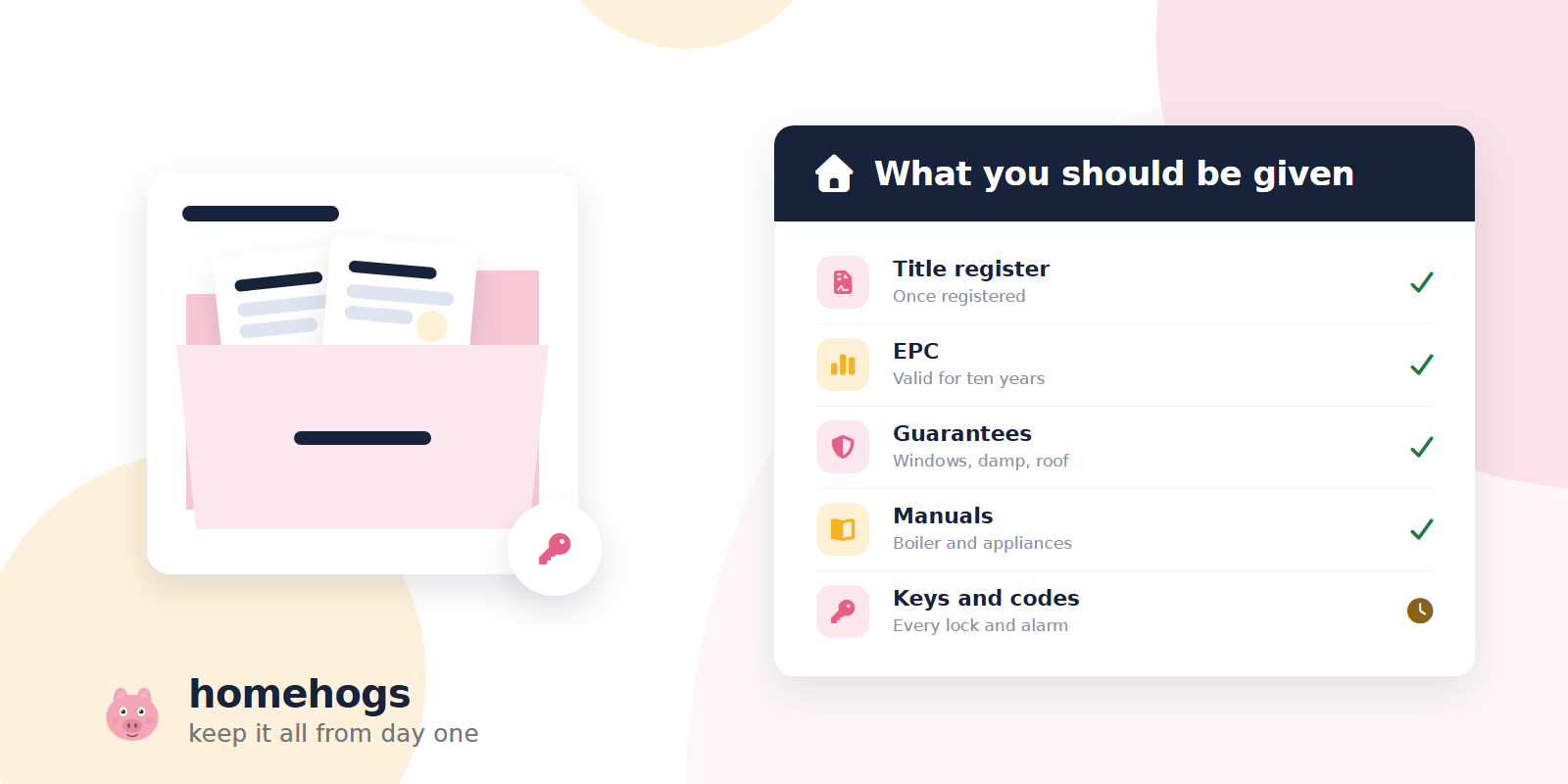
Alongside the legal paper, the seller should hand over the record of the house itself: guarantees, certificates, manuals, codes and the small facts nobody writes down, like which day the bins go out.
One thing you probably won't get is a bundle of old title deeds. Most homes in England and Wales are registered with HM Land Registry, whose register is the record of who owns them. This guide follows the process in England and Wales, with a section on Scotland and Northern Ireland near the end. If you're buying for the first time, our guide to buying your first home walks through everything around it.
The short version
- Before exchange your conveyancer should send you the seller's TA6 property information form, the TA10 fittings and contents form, the search results and a report on the title.
- The survey report comes straight to you from the surveyor, because you commissioned it.
- On completion you should get every key, the codes for anything with a keypad and a completion statement showing where each pound went.
- Your conveyancer usually files the stamp duty return on completion day; in England and Northern Ireland it's due within 14 days.
- HM Land Registry doesn't keep original paper deeds; the register is the record and a copy costs £7 online.
- The seller should leave guarantees, certificates, manuals and service records for the house; their answers on the TA6 and TA10 tell you what to expect.
- Ask your conveyancer for copies of everything in the file, because it's the best record of the house you'll ever be given.
Documents you should receive before exchange
Your conveyancer works through this pack before you're committed. Most of it should be sent to you to read. If it isn't, ask: it's the description of what you're buying.
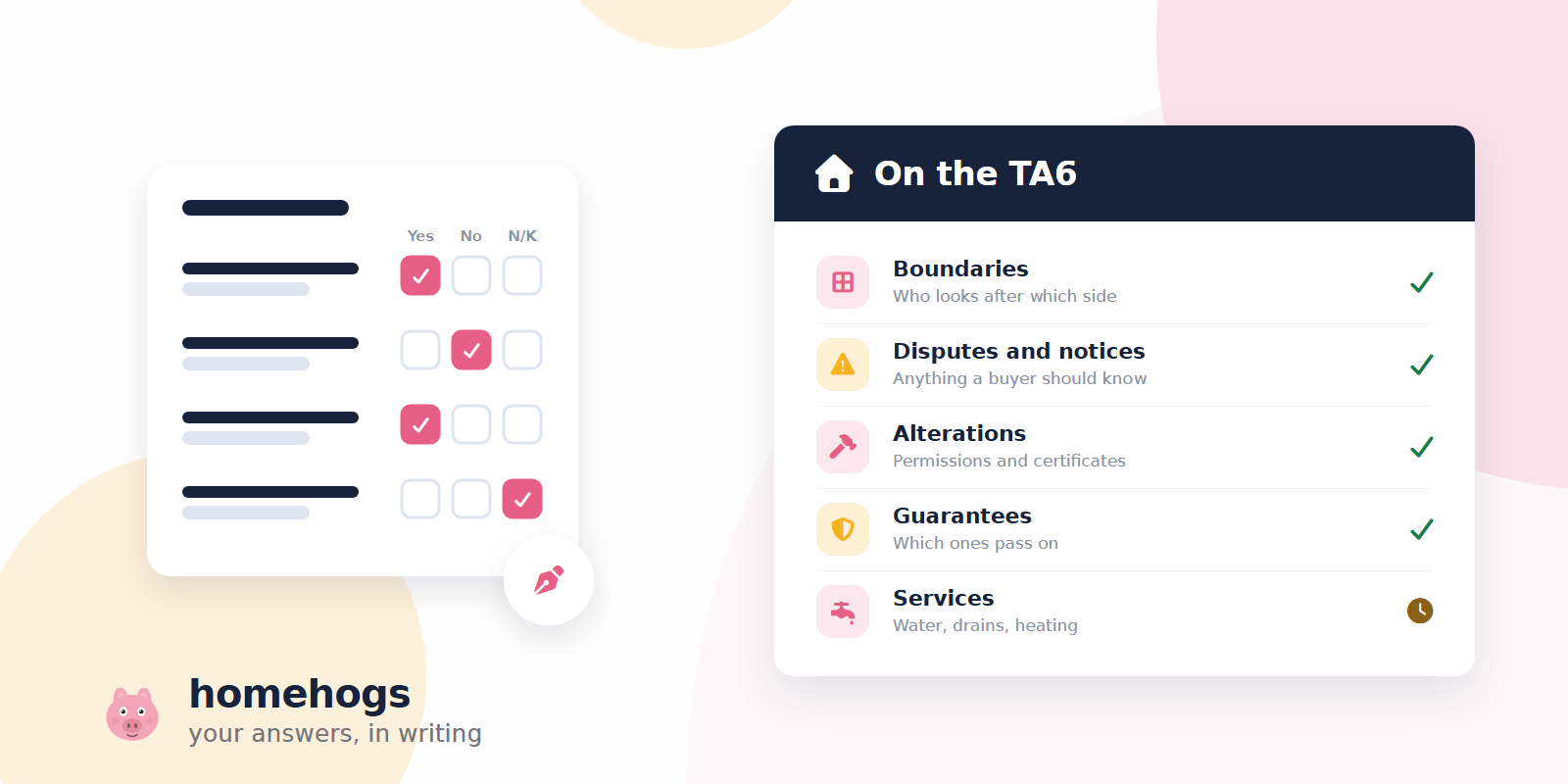
- The TA6 property information form. The seller's answers about boundaries, disputes, alterations, guarantees, services and more. Since 30 March 2026 the 6th edition is the one firms in the Law Society's Conveyancing Quality Scheme use on new sales. It allows more "not known" answers, which is honest rather than evasive. Our guide to the TA6 goes through it section by section.
- The TA10 fittings and contents form. A room-by-room list of what's included, what's excluded and anything the seller is offering at a price. It's the list you check against on completion day, so keep a copy where you can find it.
- Leasehold papers, for a flat or a leasehold house. The lease, the TA7 leasehold information form and the management pack from the landlord or managing agent, which shows the service charge, ground rent and any planned works. Leasehold service charges explained covers what to look for.
- The title. Copies of the title register and title plan from HM Land Registry, showing the owner, the general boundaries, rights of way, covenants and the seller's mortgage.
- The searches. Usually a local authority search, a drainage and water search and an environmental search, with others such as a mining search where the area calls for one.
- The seller's evidence. Copies of planning permissions, building regulations completion certificates, window certificates, gas and electrical certificates and guarantees, usually sent in answer to the TA6.
- The report on title. Your conveyancer's summary of all of the above, with anything unusual flagged. Read it properly: it's the one document that explains the others.
- Your mortgage offer. From the lender, along with the lender's valuation if they share it. A valuation is a limited check for the lender's benefit, not a survey.
- Your survey. From the surveyor you instructed. If you're still choosing a level, house survey levels explained goes through the options.
The EPC no longer comes through the TA6: the 6th edition stopped asking for it, because the estate agent deals with it when the home is marketed. It's on the public register either way and valid for ten years. Our free EPC checker finds it by postcode.
On completion day: keys, codes and the completion statement
Completion is when the money moves and the home becomes yours. You should come away with:
- Every key. Front and back doors, window keys, the garage, the shed, the side gate and any communal doors. Count them against what the seller said they'd leave.
- Codes and remotes. The burglar alarm, a key safe, a garage door, gates and anything smart such as a thermostat or video doorbell, plus how to reset them. Better still, reset them yourself on day one.
- The completion statement. Your conveyancer's account of the price, the mortgage advance, your deposit, the stamp duty, their fees and the searches and other costs they paid on your behalf, adding up to what you handed over. Keep it with the purchase papers.
- Whatever the seller left in the house, which should match the TA10.
Our guide to the first two weeks in a new home covers the meter readings, the locks and the stopcock that belong to the same day.
After completion: stamp duty and HM Land Registry
Two things happen after completion that you mostly don't see. Both leave a document worth keeping.
The stamp duty return
In England and Northern Ireland a Stamp Duty Land Tax return must be sent to HMRC and any tax paid within 14 days of completion. Your conveyancer usually does it on the day. HMRC then issues an SDLT5 certificate, which proves the return was sent and has to go to HM Land Registry with the registration. Ask for a copy of both.
Wales has Land Transaction Tax instead, with a return due within 30 days of the day after completion. Scotland has Land and Buildings Transaction Tax, administered by Revenue Scotland. In each case your solicitor or conveyancer normally deals with it.
Registration with HM Land Registry
Your conveyancer then applies to register you as the owner, with your lender's mortgage against the title. It's their job, not yours. When it's done, HM Land Registry lets them know and most conveyancers send you a copy of the updated register.
It isn't always quick. HM Land Registry's processing figures for July 2026 show 41.6% of changes to existing registered titles completed within a day. Of the rest, over half took about 13 weeks and most were done in about six months. A wait of a few months is normal.
Your conveyancer's file
Once the matter closes, the file goes into storage. It holds everything above, plus letters that sometimes answer questions years later. Ask how long the firm keeps files: copies are much easier to get while everything is still to hand.
What the seller should hand over about the house itself
The legal pack proves you own the house. This part tells you how to look after it. It's also the part buyers most often forget to ask for.
- Guarantees and warranties. Replacement windows, damp-proofing or timber treatment, a new roof, cavity wall insulation, a newer home's structural warranty. Some pass to the next owner as they are; some need your details registering with the company. Check the terms of each.
- Certificates for work done. Building regulations completion certificates for extensions and structural work, the FENSA or CERTASS certificate for windows, the Building Regulations Compliance Certificate for a boiler fitted by a Gas Safe registered engineer, electrical certificates and, for solar panels or a heat pump, the MCS certificate.
- The boiler's paperwork. The manual and the Benchmark commissioning checklist, which has a service record each engineer fills in.
- Manuals for anything staying. The oven, hob, extractor, built-in fridge, dishwasher, shower, thermostat, alarm and garage door. If the paper has gone, a photo of the model plate lets you find the manual online.
- Service history. When the boiler was last serviced and by whom, chimney sweeping, gutter clearing and the names of anybody who has done good work on the house.
- The small facts. Bin days and which bin is which, where the stopcock and meters are, which switch on the fuse board does what, which fences are theirs and which neighbour holds a spare key.
The seller's answers on the TA6 and the list on the TA10 tell you what to expect. Those are what the seller is held to. Anything beyond them is goodwill, which is still worth asking for: most sellers are happy to leave a folder if somebody asks before the removal van arrives.
Checklist: what you should receive and who gives it to you
Use this as you go. Not every row applies to every purchase.
| Document | Who gives it to you | When | If it's missing |
|---|---|---|---|
| TA6 property information form | Seller, via their conveyancer | Before exchange | Ask your conveyancer for a copy |
| TA10 fittings and contents form | Seller, via their conveyancer | Before exchange | Ask your conveyancer for a copy |
| Lease, TA7 and management pack | Seller, landlord or managing agent | Before exchange | Your conveyancer chases it |
| Title register and title plan | HM Land Registry, via your conveyancer | Before exchange | £7 each online from HM Land Registry |
| Search results | Your conveyancer | Before exchange | Ask for copies |
| Report on title | Your conveyancer | Before exchange | Ask for it in writing |
| Mortgage offer | Your lender | Before exchange | Your lender or broker |
| Survey report | Your surveyor | Before exchange | Ask the surveyor to resend it |
| EPC | Seller's agent | When the home is marketed | Free on the EPC register |
| Keys, codes and remotes | Seller, often via the agent | Completion day | Ask the agent the same day |
| Completion statement | Your conveyancer | Around completion | Ask your conveyancer |
| SDLT return and SDLT5 certificate | Your conveyancer | Soon after completion | Ask your conveyancer |
| Updated title register | HM Land Registry, via your conveyancer | Weeks or months later | Check it yourself for £7 |
| Guarantees and certificates | Seller | Before completion | The issuer or scheme, often for a fee |
| Boiler manual and Benchmark checklist | Seller | Completion day | Manufacturer's website; ask the last engineer |
| Appliance manuals | Seller | Completion day | Manufacturer's website, by model number |
What to do if something is missing
Very little is lost for good. Work through it in this order.
- Before exchange, ask through your conveyancer. This is when your position is strongest, because nothing is binding yet. A missing certificate can be chased, replaced or sometimes covered by an indemnity policy, which your conveyancer can explain.
- After completion, ask the seller through the agent or the conveyancers. People are usually happy to help in the first few weeks, while they still remember where things are.
- Go to whoever issued it. FENSA reissues window certificates for £30. Gas Safe Register sends a replacement Building Regulations Compliance Certificate for £8.40, though it doesn't hold records for older installations. MCS and HETAS charge £36 for a copy. The council's building control team holds completion certificates for work it inspected.
- Search the public records. The EPC register is free, as is the register of planning decisions, which takes a postcode and sends you to your council's records.
Our guide to building your home's service history from scratch goes through every register in turn. How to prove work was done on your home explains which evidence carries most weight.
Scotland, Wales and Northern Ireland
- Wales uses the same forms and the same HM Land Registry as England. The difference is the tax: Land Transaction Tax, with its own return and a 30-day deadline.
- Scotland works differently. The seller provides a Home Report, with a single survey, a property questionnaire and an energy report, so you see much of the information before you offer. The contract is formed by letters between the solicitors called missives. Ownership is registered with Registers of Scotland. Ask your solicitor for copies of the Home Report, the missives and the title.
- Northern Ireland has its own conveyancing procedures and its own land registry, run by Land & Property Services. Stamp Duty Land Tax applies as it does in England.
Wherever you buy, the house-related half of this guide is the same: the guarantees, certificates, manuals and codes matter just as much in Aberdeen or Armagh.
What to keep and for how long
Keep everything about the house for as long as you own it, then hand that half on to whoever buys it from you.
Keep the legal half too: the TA6 and TA10, the report on title, the searches and the title. When you sell, the buyer's conveyancer asks many of the same questions. The answers you were given are the starting point for your own. Our checklist of documents needed to sell a house shows what you'll be asked for.
Then the money papers: the completion statement, the stamp duty return and certificate and the mortgage offer. They show what you paid and what it cost you, which an accountant or a future lender may ask about.
homehogs keeps a home's certificates, guarantees, manuals and receipts in one place, each attached to the thing it's about. Its logbook page shows what's recorded and what's still missing. It's a tidy home for the folder the seller handed over and a quick way to notice what they didn't.
Sources
- Law Society: TA6 6th edition
- Law Society: Transaction forms
- GOV.UK: Stamp Duty Land Tax
- GOV.UK: SDLT online and paper returns
- Welsh Government: Land Transaction Tax guide
- Revenue Scotland: Land and Buildings Transaction Tax
- GOV.UK: HM Land Registry processing times
- GOV.UK: Search the register
- GOV.UK: Find an energy certificate
- GOV.UK: Search the register of planning decisions
- FENSA: Replacement certificates
- Gas Safe Register: Building Regulations Compliance Certificate
- MCS: Certificate queries
- HETAS: Certificates of compliance
- mygov.scot: Home Report
- nidirect: Searching the Land Registry
Last fact-checked 5 October 2026.
Give the handover folder a proper home
homehogs keeps your new home's certificates, guarantees and manuals together and reminds you before a warranty ends or a service falls due, so nothing from the handover ends up lost in a drawer.
Start free