The TA6 is the Law Society's property information form that sellers in England and Wales complete through their conveyancer. The buyer relies on every answer. Here's what changed in the 6th edition used since 30 March 2026, what each part asks about, how to answer it well and the documents to gather first.
The TA6 is the Property Information Form: the Law Society's standard questionnaire that sellers in England and Wales fill in through their conveyancer. It tells your buyer what you know about the home, from who looks after the fences to whether the boiler has its certificate. The buyer is entitled to rely on your answers, which is why it matters more than it looks.
Since 30 March 2026 firms in the Law Society's Conveyancing Quality Scheme have had to use the 6th edition (2025) on new instructions. It's shorter than the edition before it and offers "not known" more often. It also no longer asks for your EPC.
This guide explains what the form is, what changed, what each part asks about in plain words and how to answer it well. It's an explainer, not legal advice: your conveyancer is the person to ask about a particular answer.
The short version
- The TA6 is the Law Society's property information form, completed by the seller through their conveyancer in England and Wales
- The 6th edition (2025) replaced the 4th and 5th editions on 30 March 2026 and is required for Conveyancing Quality Scheme firms on new instructions
- It has 15 sections, ten fewer than the 5th edition, with no questions on council tax, the asking price, tenure or the EPC
- A yes or a no is a statement the buyer can rely on, so answer from documents rather than memory
- Not known is a proper answer when it's true, but you need reasonable grounds for giving it
- If anything changes before contracts are exchanged, tell your conveyancer straight away
- Most sellers also complete the TA10 fittings and contents form; leasehold sellers add the TA7
What is a TA6 form?
The TA6 gives a buyer key information the seller has about the home, before they commit to buying. It's used for most ordinary home sales in England and Wales. A few practical points:
- Who fills it in. Every seller named on the title, or whoever is selling for them under a grant of probate, a power of attorney or a trust. All of them sign it. A representative who never lived in the home should ask people who did.
- Where it comes from. Your conveyancer sends it, often as an online form. The Law Society doesn't sell its forms to the public, but it does publish explanatory notes for sellers and buyers that are worth reading alongside it.
- When. The Law Society says it's designed for use once an offer has been accepted, though you can complete it before a buyer is found. Doing it early takes the pressure off.
- What your conveyancer does with it. They send it to the buyer's conveyancer as part of the contract pack. They don't verify your answers, but good practice is to read them and query anything that looks inconsistent. The form itself says the seller's solicitor isn't liable for the accuracy of your replies.
- When it isn't used. It isn't intended for buying a brand-new home from a developer, where the TA8 does the job. It may need amending for part exchange or an auction.
If you were instructed before 30 March 2026 your conveyancer may still be using an older edition for that sale, which is allowed.
What changed in the TA6 6th edition
The 5th edition, published in 2024, added questions to match National Trading Standards guidance on the material information estate agents put in listings. Many conveyancers raised concerns about how usable it was. The Law Society paused its mandatory rollout, ran an independent consultation with more than 1,200 participants and replaced it with the 6th edition, whose structure is closer to the 4th.
| 5th edition (2024) | 6th edition (2025) | |
|---|---|---|
| Sections | 25 | 15 |
| Council tax, asking price, tenure and charges | Asked | Removed |
| Physical characteristics, building safety, restrictive covenants, coastal erosion, accessibility, coalfield or mining | Asked | Removed |
| Energy Performance Certificate | Asked | Removed: the agent deals with it at marketing |
| "Not known" options | Fewer | More, plus "are you aware" questions |
| Explanatory notes | Dense | Rewritten with examples |
Why the removals? The Law Society says it streamlined the form to avoid duplicating what's gathered elsewhere in a sale. Agents still collect much of that information for the listing: they have their own legal duty not to leave out material information a buyer needs to make an informed decision, under the Digital Markets, Competition and Consumers Act 2024.
Two smaller changes matter when you're filling it in. More questions now ask whether you're aware of something. For those, a "no" counts the same as "not known". The form also makes clear that "you" means whoever is completing it, including an executor or attorney.
What each part of the TA6 covers
In plain words, here are the main parts of the 6th edition, what they ask about and what helps you answer. Read the Law Society's notes for the detail behind each question.
| Part | What it asks about | What helps you answer |
|---|---|---|
| Property and seller details | Who is selling and in what capacity | Title register, probate or power of attorney papers |
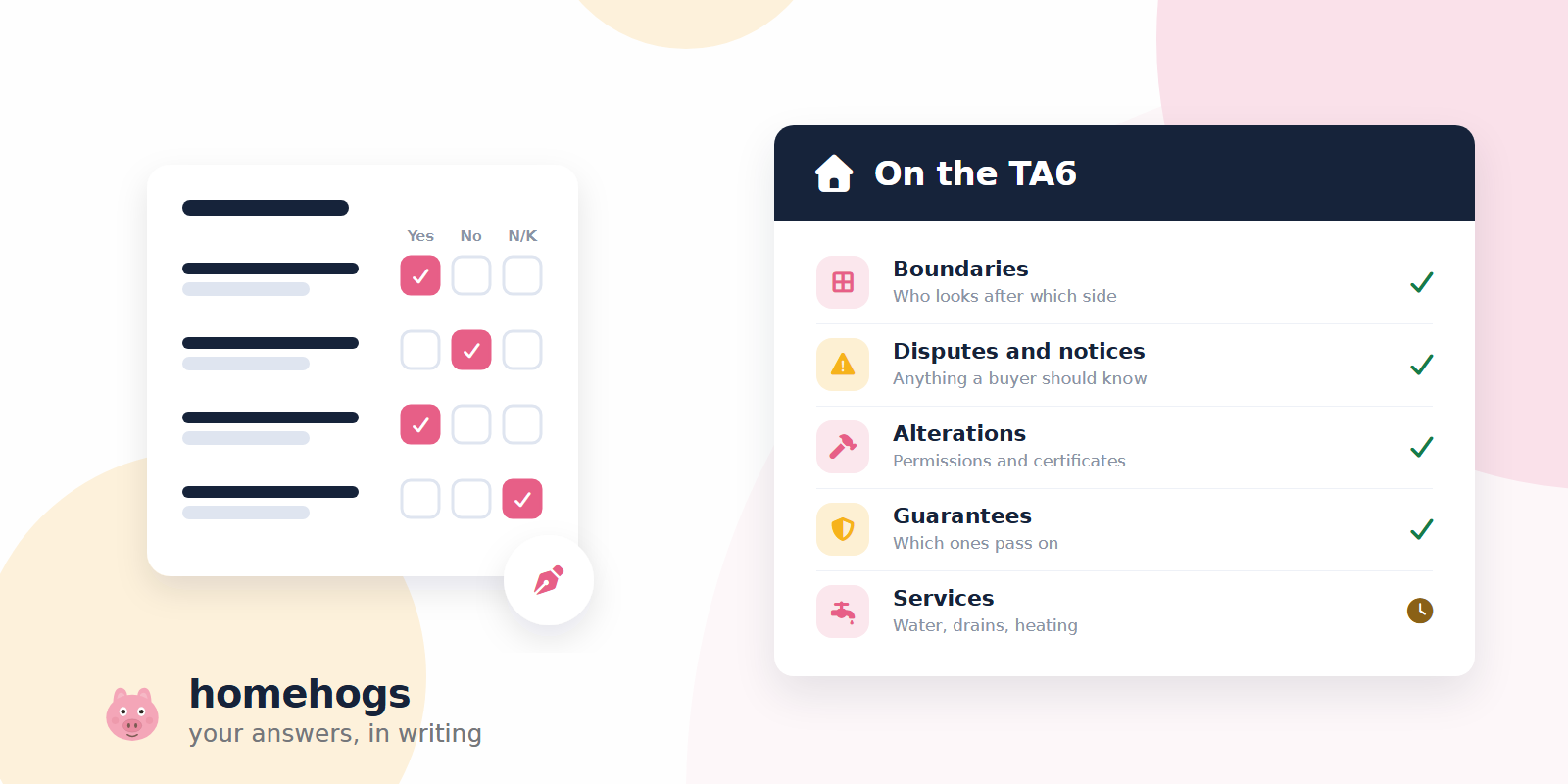
| Boundaries | Who looks after each boundary, irregular or moved boundaries, anything overhanging, party wall notices | Title plan, party wall notices, any boundary agreement |
| Disputes | Past or current disputes or complaints about the home or neighbours, plus worries that could become one | Letters and emails, complaints to the council |
| Notices | Formal notices or proposals affecting the home or the area, such as planning applications or road schemes | Letters from the council or neighbours |
| Alterations | Building work and changes of use with their permissions, unfinished work, solar panels and any related agreements, listed status, conservation areas and protected trees | Planning decisions, completion certificates, competent person certificates, solar agreements |
| Guarantees and warranties | What guarantees exist and whether any claims were made | The guarantees themselves |
| Insurance | How the home is insured and any difficulty getting cover or claims | Your policy schedule and claims history |
| Environmental matters | Flooding and flood defences, radon tests, Green Deal finance, Japanese knotweed | Flood history, radon results, electricity bill, knotweed plan |
| Rights and informal arrangements | Rights of way, shared drives and paths, pipes and drains crossing land, informal arrangements with neighbours | Title deeds, any shared maintenance agreement |
| Parking | Parking at the home, permits, electric vehicle charging | Permit details, charger installation paperwork |
| Services | Electrical work and certificates, the heating system and its servicing, drainage including septic tanks and treatment plants | Electrical and gas certificates, boiler service records, emptying or service records |
| Connection to services | Who supplies the utilities, with meter point numbers | Recent bills, Find My Supplier for a gas MPRN |
| Transaction information | Whether you're in a chain, any moving date needs, who lives at the home | Your own plans, any tenancy or occupier details |
| Completion | Whether the price clears every mortgage, removing what isn't included | Your mortgage details, the TA10 |
How to answer the TA6 well
Most problems with a TA6 come from answering quickly from memory. These habits help.
- Answer from documents, not recollection. Gather the paperwork first (the checklist below), then fill the form in with it open. If the extension was 2019, check it wasn't 2017.
- Accuracy over optimism. The form isn't a sales brochure. A buyer's surveyor and searches will turn most things up anyway. An honest answer given early rarely loses a sale.
- "Not known" is an answer. Use it when it's true, for example for who owns a boundary the deeds don't mention. The Law Society's notes say you must still have reasonable grounds for it, so don't use it to avoid finding something out.
- Describe, don't summarise. "A neighbour complained in writing about the hedge in 2023 and we cut it back" is better than "no disputes". The notes make clear buyers want to know about past problems as well as current ones.
- Say what you know about earlier owners. You aren't expected to know the history before you, but if you know the loft was converted in the 1990s, say so.
- Attach the evidence. Certificates, permissions and guarantees go with the form. If something should exist but is missing, say so and tell your conveyancer, rather than leaving a gap.
- Check anything filled in for you. Some systems pre-fill answers. You're still answering, so check each one.
- Keep it up to date. If something changes or turns out to be wrong before contracts are exchanged, tell your conveyancer at once.
- Ask before you guess. If a question doesn't make sense for your home, ask your conveyancer what it means rather than picking the answer that sounds best.
Our free sale-ready check runs through the same kinds of questions in a few minutes and shows where the gaps are, before the real form arrives.
What happens if an answer is wrong
The Law Society's own notes put it plainly to sellers: buyers can rely on what you say. If you give misleading information, the buyer may be able to claim compensation after completion. Incomplete answers can delay the sale or make the buyer withdraw.
The legal name for a false statement that persuades someone into a contract is misrepresentation. Three things about it are worth understanding:
- It doesn't have to be a lie. Under section 2 of the Misrepresentation Act 1967, a seller who made a wrong statement can be liable unless they prove they had reasonable grounds to believe it (and did believe it) up to the moment the contract was made. Carelessness can be enough.
- A "no" is a statement too. A yes or a no to a direct question is something the buyer can rely on. For the "are you aware" questions, a no means not known.
- The remedy can be serious. Usually it's compensation for the buyer's loss. In some cases a court can undo the contract, though it can award compensation instead.
That's why the habits above matter: answering from documents, using "not known" honestly and updating your answers before exchange are what give you reasonable grounds. If you're unsure how to answer something, ask your conveyancer before you sign, not after.
Documents to have to hand
The Law Society suggests having these to hand. We've added the specific certificates buyers' conveyancers ask for most often.
- Title. The title register and plan from HM Land Registry, plus any older deeds.
- Planning and building control. Planning decision notices, building regulations completion certificates and any listed building consent. Our guide to planning permission or building regulations explains which applies to what.
- Competent person certificates. FENSA or Certass for windows and doors, the Gas Safe compliance certificate for a boiler fitted since April 2005, electrical certificates for work since January 2005 and MCS certificates for solar panels or a heat pump. A missing FENSA certificate can be ordered online for £30.
- Guarantees and warranties. Damp, timber, roofing, cavity wall insulation, a new home warranty and any you're passing on for appliances.
- Service records. The boiler's service history, septic tank emptying or treatment plant servicing and anything else with a maintenance schedule.
- Boundaries and neighbours. Party wall notices and awards, any boundary agreement and correspondence about disputes or complaints. GOV.UK explains property boundaries.
- Notices. Letters about planning applications, road schemes or works near the home.
- Insurance. Your buildings insurance schedule and any claims.
- Environmental. Any flood history and defences (you can check flood risk on GOV.UK), radon test results, Japanese knotweed reports and any Green Deal plan.
- Energy and solar. Feed-in Tariff or Smart Export Guarantee agreements and any roof lease for panels you don't own.
- Utilities. Recent bills showing suppliers and meter point numbers.
- Parking and charging. Permit details and the paperwork for an electric vehicle charger.
For every document a sale can call for, where it comes from and what to do if it's missing, see what documents you need to sell a house. If paperwork for older work has gone missing, how to prove work was done on your home and building your home's service history cover how to recover it.
The TA10, TA7 and other forms
TA10 Fittings and Contents Form
The TA10 (3rd edition, 2013) records what's included in the sale price, what you're taking and what you'd sell separately, room by room: carpets, curtains and poles, light fittings, appliances, the shed, garden plants. Most sales use it. It becomes part of the contract, so decide before you list and stick to it. The Law Society's notes add one point worth knowing: if you agree to take something away, you only have to make good any damage if that was agreed and written into the contract.
TA7 Leasehold Information Form
If the home is leasehold, you complete the TA7 (5th edition, 2025) alongside the TA6. It replaced older editions on 30 March 2026. The new edition flows more logically, includes options for leasehold garages and limits its building safety section to blocks of flats. Your conveyancer will also ask the landlord or managing agent for a management pack, using the LPE1 enquiry form, which can take weeks. Our guide to leasehold service charges explains the figures it contains.
The others you might meet
The TA13 deals with the arrangements for completion. Your conveyancer completes it, not you. The TA8 is the developer's form for a new build. Commonhold homes have their own forms.
What to keep afterwards
Keep a copy of the TA6, TA10 and any TA7 exactly as you signed them, with the documents you attached. Questions about an answer can come up after completion. Your copy shows what you said and what you were relying on. Keep a note of where you got any answer that wasn't from a document, such as a conversation with a neighbour or the previous owner, with the date.
When you buy your next home, ask your conveyancer for the seller's completed forms and the documents attached. They're the start of that home's record. The next time you sell, half the TA6 is already answered.
That's the thinking behind a home logbook. homehogs keeps certificates, guarantees, service records and the dates of work done, each attached to the room, appliance or job it proves, so the documents a conveyancer asks for are already in one place.
Scotland and Northern Ireland
The TA6 is for England and Wales only.
- Scotland. Sellers must have a Home Report before the home goes on the market. One of its three parts is a property questionnaire completed by the seller, alongside a single survey and an energy report. Your solicitor or selling agent will guide you through it.
- Northern Ireland. The process and forms are different from England and Wales. A local solicitor will tell you what they need from you.
Sources
- The Law Society: TA6 Property information form (6th edition) (2025)
- The Law Society: TA6 explanatory notes for sellers and buyers
- The Law Society: Transaction (TA) forms
- legislation.gov.uk: Misrepresentation Act 1967, section 2
- legislation.gov.uk: Digital Markets, Competition and Consumers Act 2024, section 227
- GOV.UK: Selling a home
- GOV.UK: Your property boundaries
- FENSA: Find and order your FENSA certificate
- mygov.scot: Home Report
Last fact-checked 5 October 2026.
Keep the answers with the house
homehogs keeps your home's certificates, guarantees and service history together, each attached to what it proves, so the paperwork a sale asks for is ready long before anyone asks.
Start free