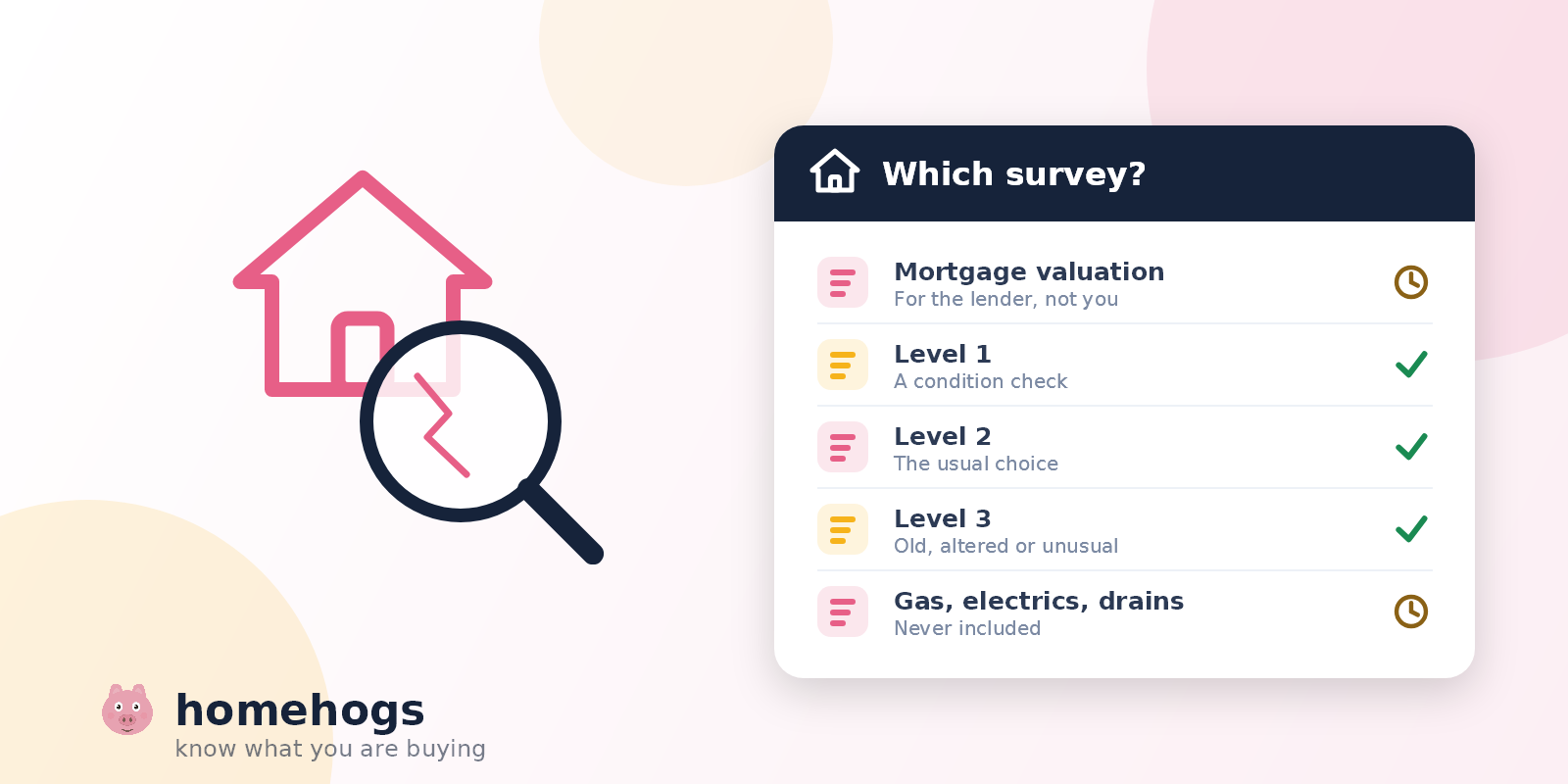
A mortgage valuation is not a survey and the three RICS levels are not simply cheap, medium and expensive. This compares what each level covers, walks through which one suits the home you are buying, lists what no survey covers and the specialists who fill the gaps, then gives the questions to ask before you book.
Most buyers of a conventional home in reasonable condition choose a Level 2 survey. Level 3 is for homes that are older, larger, altered, unusually built or showing signs of trouble; Level 1 suits newer, conventional homes in good condition. A mortgage valuation is not a survey at all: it is a limited check for the lender's benefit.
In England, Wales and Northern Ireland the buyer arranges the survey, ideally soon after an offer is accepted and well before contracts are exchanged. In Scotland the seller provides a Home Report that includes one.
The decision is usually made in a rush, alongside the mortgage and the conveyancer, so the guide below works from the building in front of you rather than from the price.
The short version
- A mortgage valuation is a limited check for the lender, not a survey of the building's condition.
- Level 1 suits newer, conventional homes in good condition and includes no valuation.
- Level 2 is the usual choice for a conventional home in reasonable condition, with a valuation as an optional extra.
- Level 3 suits large, older, run-down, unusual or much-altered homes and anyone planning major work.
- No survey level tests the gas, electrics or drains, so specialist checks are arranged separately.
- There is no official fee scale; published estimates run from about £300 for a Level 1 to £1,500 or more for a Level 3.
- In Scotland the seller provides a Home Report, which includes a survey and a valuation.
A mortgage valuation is not a survey
When a lender arranges a valuation, it is answering one question for itself: is this home good security for the loan? RICS describes it as a limited check on the property that will not include the level of detail a survey gives. It may be done from the outside or from sold price data. The valuer works for the lender, not for you.
A valuation that comes back without comment does not mean the house is sound. It means the lender is content to lend against it. If you want to know about the condition of the building, you commission a survey yourself.
The three levels and what each one covers
RICS members work to the RICS Home Survey Standard, which sets out three levels. The first edition has applied since March 2021; RICS says it intends to publish a second edition in early 2027. Until then, surveyors work to the current one. Older names still float about, so they are in the table too.
| Level 1 | Level 2 | Level 3 | |
|---|---|---|---|
| Used to be called | Condition Report | HomeBuyer Report | Building Survey |
| Suits | Newer, conventional homes in good condition | Conventional homes in reasonable condition, without major alterations | Large, older, run-down, unusual or much-altered homes; major works planned |
| What you get | The condition of each part, risks, legal points to check and urgent defects | More detail, plus advice on repairs and maintenance | The most detailed report: in-depth analysis, likely causes and repair options |
| Inspection | Visual and non-intrusive | Visual and non-intrusive, with more of the roof space and drainage chambers | Visual and non-intrusive, but the most extensive |
| Valuation | Not included | Optional: adds a market value and a rebuild figure for insurance | Not usually included; ask |
| Indicative cost | £300 to £900 | £400 to £1,000 | £630 to £1,500 |
The costs row is an estimate from the HomeOwners Alliance (see the costs section below), not an official scale.
A quick way to hold the difference: Level 1 tells you what a professional notices, Level 2 adds what to do about it and Level 3 explains why it is happening and what it could lead to.
Which survey should I choose? A decision guide
Work down the list and note every line that fits. Where more than one does, the higher level is the safer choice.
- If you are buying in Scotland, start with the Home Report the seller must provide. Commission your own survey as well if the home is old or unusual, or if the report flags something that worries you.
- If it is a brand-new home, a snagging inspection before completion is usually more useful than a Level 1 to 3 survey: it lists unfinished or poorly finished work for the developer to put right. Which? puts snagging inspections at around £300 to £600. Developers registered under the New Homes Quality Code must offer a pre-completion inspection, by you or an inspector you choose.
- If it is listed, thatched, timber-framed or built of stone, cob or another non-standard material, choose Level 3 from a surveyor who has worked on that kind of building. For a listed home, ask your conveyancer to check past alterations had listed building consent: in England and Wales, unauthorised works are a criminal offence. The free home lookup shows planning protections recorded at or near an address.
- If it has been extended or converted, or had walls or chimney breasts removed, choose Level 3. Ask your conveyancer for the planning and building regulations paperwork too (planning permission or building regulations?).
- If you can see signs of trouble or neglect (cracks, sloping floors, damp staining, a sagging roof, a long time empty), choose Level 3 and expect it may recommend a specialist.
- If you plan major work of your own, choose Level 3, so you know what you are building on.
- If it is large or old, Level 3 is the usual choice.
- If it is a flat, choose the level for the flat on the same rules. The survey covers the flat and what the surveyor can see of the building; the condition of the block as a whole (and who pays for repairs) comes from the leasehold information (service charges explained).
- If it is conventional (brick or block, an ordinary roof), in reasonable condition and not much altered, Level 2 is the usual choice. Add the valuation if you want an independent figure and a rebuild cost for insurance.
- If it is newer, conventional and clearly well kept, Level 1 may be enough if you mainly want a professional view of its condition.
Still torn between two? Think about how much an unexpected repair bill would hurt. If a large surprise in the first year would be a serious problem, the extra few hundred pounds for the higher level buys more information. If you have a repair budget and can live with surprises, the lower level may do. Describe the home to a surveyor and ask which level they would choose; a good one will tell you.
What a survey costs (estimates)
There is no official fee scale. Surveyors set their own prices, which rise with the home's value, size and complexity. Three published estimates, none of them official:
- RICS. A Level 1 costs from a few hundred pounds; some bespoke Level 3 services cost more than £1,000 (RICS consumer guide).
- Which? The average survey cost £462 for first-time buyers and £510 for home movers, using Reallymoving data for an average home in England in November 2025 (Which?, updated 29 May 2026).
- HomeOwners Alliance. Level 1 £300 to £900, Level 2 £400 to £1,000 and Level 3 £630 to £1,500, from its 2026 guide (HomeOwners Alliance, read 5 October 2026). It does not say how the ranges were gathered. Its figures rise with the home's value.
Get two or three quotes for the same level. Compare what each includes (a valuation, drainage chambers, outbuildings) as well as the price. Any specialist reports are extra.
What surveys usually do not cover
Every level is a visual, non-intrusive inspection. Surveyors do not lift fitted floor coverings or floorboards, open up walls or move heavy furniture, so anything hidden stays hidden. A survey also does not usually:
- test the gas, electrics, heating or drains (it looks at what is visible and may recommend a test)
- answer legal questions: boundaries, rights of way, planning permission and building regulations sign-off are for your conveyancer, though the surveyor may flag points to raise
- confirm whether a material contains asbestos (it may note suspect materials; only sampling confirms it)
- inspect what cannot be reached safely, such as high roofs seen only from the ground or a loft without safe access
- judge the structure and finances of a whole block of flats
- tell you what to pay, unless you add a valuation
When a report says further investigation is recommended, the surveyor is telling you they could not see enough to be sure. Getting that investigation done before exchange is what turns the survey into something you can act on.
Specialist surveys and when you might need one
A surveyor will often recommend one of these. They are separate jobs with separate fees. If the survey points to one, it is worth getting before exchange.
| Specialist | When it is usually suggested | Who to look for |
|---|---|---|
| Structural engineer | Cracks, bulging walls, signs of movement, removed walls or chimney breasts | A chartered structural engineer (IStructE or ICE member) |
| Damp and timber | High damp readings, rot, woodworm | An independent surveyor or a Property Care Association member |
| Drainage CCTV | Older or shared drains, slow drainage, trees near drain runs | A drainage contractor offering a camera survey |
| Electrical (EICR) | Old wiring or fuse box, no certificates for electrical work | A registered electrician (NICEIC, NAPIT or another scheme) |
| Gas and heating | No service record, an old boiler or gas fire | A Gas Safe registered engineer |
| Asbestos | Homes built before 2000 where suspect materials are noted | An asbestos surveyor who samples and tests |
| Japanese knotweed | Suspected knotweed on or near the plot | An invasive weed specialist |
| Trees | Large trees close to the house, especially on clay soil | An arboricultural consultant |
Two notes. A firm that sells damp treatments has something to sell, so an independent diagnosis is a useful check (condensation, damp or mould? explains the differences). And HSE guidance is that asbestos in good condition and left alone poses a very low risk, while buildings put up after 2000 are unlikely to contain it: never drill, sand or remove anything you suspect. Leave testing to a professional.
Questions to ask a surveyor before booking
- Are you RICS-registered (AssocRICS, MRICS or FRICS) and is your firm regulated by RICS? You can check on RICS Find a Surveyor.
- Which level would you recommend for this home? Why? Describe its age, construction and any alterations.
- How much experience do you have with this type of building (listed, timber-framed, thatched, flats)?
- Will you go into the loft, lift drain covers and look at outbuildings?
- Is a valuation included, with a rebuild figure for insurance?
- Can I see the terms of engagement before the inspection, including what you will not inspect?
- When can you inspect? When will I get the report?
- Can I call you to talk the report through afterwards?
- What is the total price, including VAT?
- If the estate agent recommended you, do they receive a referral fee?
Which? also suggests checking the terms of engagement and making sure you can speak to the surveyor who does the inspection.
Reading the report without panicking
Almost every survey comes back with a list of concerns. That is what you paid for; a report with nothing on it would be the surprising one. Levels 1 and 2 give each part of the home a condition rating, from 1 (no repair currently needed) to 3 (defects that are serious or need urgent repair or investigation).
- Separate the urgent from the eventual. A leaking roof is this month; repointing is this decade.
- Look hardest at what the surveyor could not see. Unknowns are where the money hides.
- Add up only what has to be done to live there safely. Treat the rest as a maintenance plan.
- Where the report recommends a specialist, get the specialist's quote before you renegotiate, so you are discussing a figure rather than a worry.
A survey is not a pass or a fail. It is a description of a building you are about to be responsible for.
If you are buying in Scotland
The position is different. A seller in Scotland must provide a Home Report, made up of a single survey (with a valuation), a property questionnaire and an energy report that includes the EPC. It must be no more than 12 weeks old when the home goes on the market. The seller pays for it.
That means a survey exists before you offer, prepared by a surveyor the seller instructed, so you can read it while deciding what to bid. Buyers can still commission their own, particularly for an older or unusual home or where the Home Report flags something.
In Wales and Northern Ireland the position is the same as in England: the buyer arranges the survey and the same three RICS levels apply.
What to do with it afterwards
Most people read the survey once, use it to negotiate and never open it again, which wastes most of what it is worth. After completion, keep:
- the full report and the terms of engagement
- any specialist reports and quotes
- emails or letters about renegotiation, including any agreed price reduction
- the valuation and rebuild figure, if you had them (rebuild cost, not market value explains why the second matters)
- photos of anything the report flagged
The recommendations in a Level 2 or Level 3 report are, in effect, a maintenance plan for your first few years, written by somebody who looked at your actual house. Turning them into dated jobs works well alongside a yearly maintenance checklist. homehogs can keep the report with the rest of the house's records and the repairs it suggests as dated jobs, so they get done rather than filed.
The report helps when you sell, too. A buyer's surveyor will look at the same things. Being able to show what was found and what you did about it answers questions before they are asked. If you are buying for the first time, buying your first home in 2026 covers the rest of the process.
Sources
- RICS: House surveys UK, the costs, types and benefits of an RICS home survey
- RICS: Home Survey Standard 2nd edition, September 2026 update
- RICS: Find a Surveyor
- Which?: House surveys
- Which?: The cost of buying a house
- HomeOwners Alliance: How much does a house survey cost?
- mygov.scot: Home Report
- HSE: Introduction to asbestos
- legislation.gov.uk: Planning (Listed Buildings and Conservation Areas) Act 1990, section 9
- New Homes Quality Board: How am I protected?
- NHBC: Buildmark cover
Last fact-checked 5 October 2026.
Turn the survey into a plan
homehogs keeps the report with the rest of your home's records and turns its recommendations into dated jobs with reminders, so the list gets worked through instead of filed.
Start free