Buildings insurance asks for one number and most people supply a different one. Getting it wrong does not just matter if the house burns down: it quietly reduces every claim you ever make, including the small ones. Here is how to work it out for nothing.
Somewhere in the renewal form there is a box asking how much your home is insured for.
Most people put in roughly what the house is worth. It is the only number about the house anybody knows off the top of their head, it feels like the right order of magnitude and nothing on the form pushes back.
It is the wrong number. Not slightly wrong in a way that gets sorted out at claim time, but wrong in a direction that can reduce a payout on a kitchen fire you were never going to make a total loss claim for.
The good news is that the right number is free to work out and takes about ten minutes.
The short version
- Buildings insurance covers rebuild cost, which is what it would cost to rebuild the house, not what it would sell for
- Rebuild cost excludes the land, so it is usually well below market value, though not everywhere
- Underinsurance triggers the average clause, which cuts every claim proportionally rather than only total losses
- The ABI funds a free rebuild cost calculator at abi.bcis.co.uk
- Listed, thatched, timber framed and other non standard homes need a surveyor rather than a calculator
- Extensions, loft conversions and conservatories all change the figure, which almost nobody tells their insurer
Two numbers, one box
Market value is what somebody would pay for your house. It includes the land it sits on, the street it is in, the schools nearby and whatever the market is doing this year. None of that can burn down.
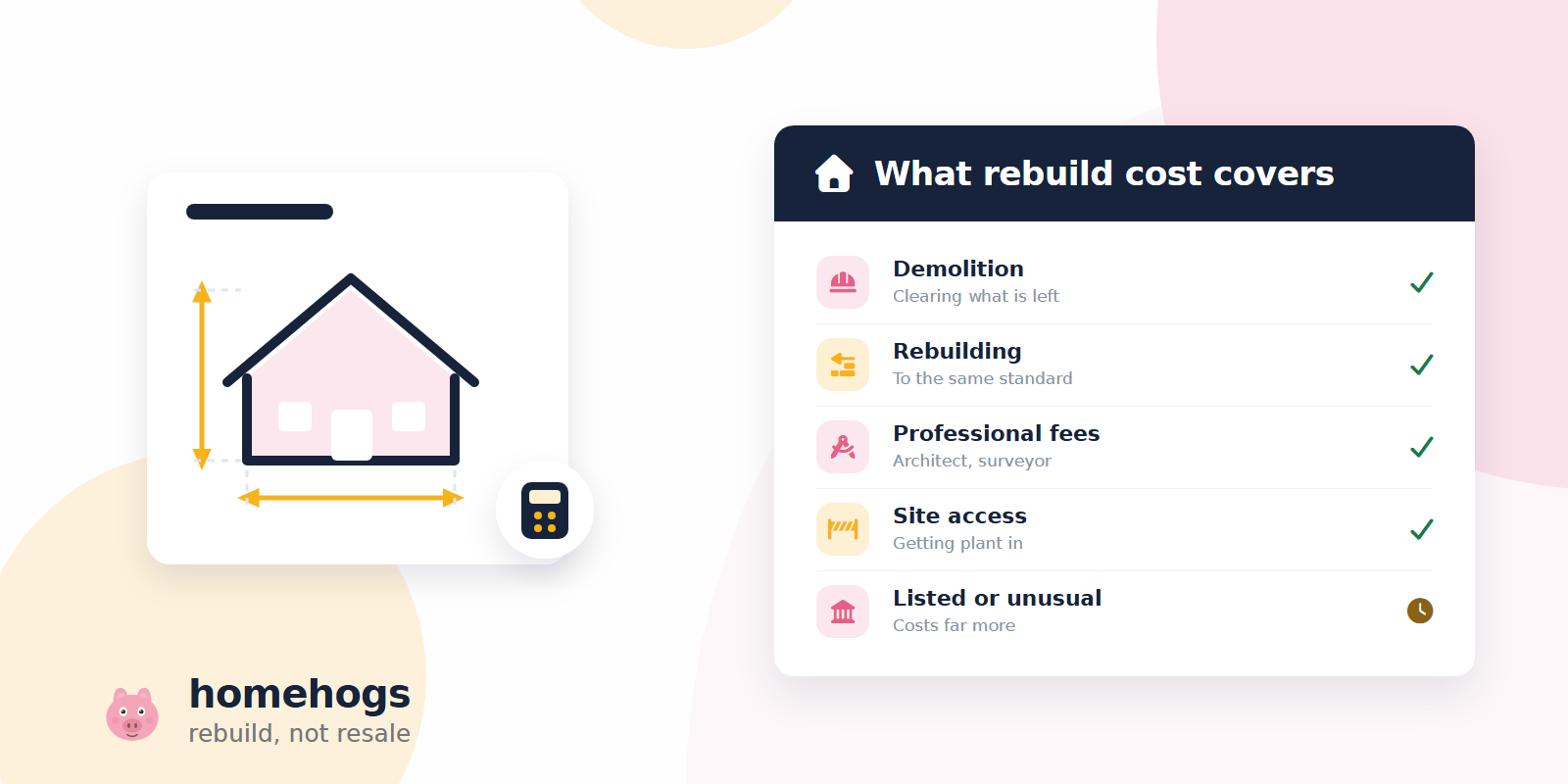
Rebuild cost, sometimes called the reinstatement value, is a construction estimate. It is what it would cost to clear the site and build the same house again to the same standard. It covers:
- Demolishing what is left and taking it away
- Rebuilding to the same specification, at current building costs
- Professional fees: architect, structural engineer, surveyor, building control
- Site access, which is a real cost when the house is on a narrow street or a hill
- VAT
For a typical UK house the rebuild figure lands somewhere well under the market value, because a substantial share of what you paid was the ground it stands on.
That ratio is not a rule, though. In expensive parts of the country the land is most of the price and rebuild cost is a small fraction of it. In cheaper areas the opposite happens, to the point where there are places it costs more to rebuild a house than you could sell it for. Both are normal, which is exactly why guessing from the purchase price does not work.
Why the wrong number is worse than it looks
Everybody assumes that insuring for too little only matters in a catastrophe. If the house is insured for £200,000 and rebuilding costs £300,000, you would expect to be £100,000 short on a total loss and otherwise fine.
That is not how it works.
Insurers apply what is usually called the average clause. If your sum insured is 70% of the true rebuild cost, the insurer can treat you as having insured 70% of your home and reduce any claim by the same proportion. A £20,000 escape of water claim becomes £14,000. A £6,000 storm damage claim becomes £4,200.
You do not find out on the day you take the policy. You find out when the loss adjuster works out what the rebuild figure should have been.
Going the other way is only expensive. Insuring for far more than the rebuild cost does not get you a bigger payout, because the policy pays to reinstate what was there. It just costs more in premium every year. So the aim is accuracy rather than a comfortable margin.
How to get the number for nothing
The Association of British Insurers funds a free rebuild cost calculator, run by BCIS, at abi.bcis.co.uk. It is the same underlying data the industry uses.
It will ask for the property type, roughly when it was built, the construction, the number of bedrooms and the floor area, along with details like whether there is a garage or a conservatory. It gives you a figure with a range around it, plus a list of what the estimate assumes.
Two things make the answer better.
Measure the floor area properly. External measurements, all storeys, including any extension. Estate agent particulars usually carry a figure and so does the EPC on the public register, though it is worth checking it against a tape measure rather than trusting either blindly.
Read the assumptions. The calculator has to assume a standard specification. If your house has a slate roof where it assumed concrete tiles, or a hand made kitchen, or original sash windows that would have to be replicated, the real figure is higher than the one on the screen.
Save the result with the date on it. When a loss adjuster asks how you arrived at your sum insured, "the ABI calculator in September 2026, with the printout to prove it" is a very different conversation from "it seemed about right".
When the calculator is not enough
The calculator is built for ordinary houses. Some homes are not. For those the answer is a reinstatement cost assessment from a chartered surveyor, which costs a few hundred pounds and is worth it:
- Listed buildings, where you may be obliged to rebuild using original materials and methods
- Thatch, timber frame, cob, stone and anything else outside standard brick or block construction
- Homes that have been substantially extended or altered
- Unusually large properties, or ones with difficult access
- Anything with a genuinely unusual feature: a turret, a vaulted roof, a swimming pool
Flats are a different case again. In most blocks the building is insured by the freeholder under a block policy and you pay a share of it through the service charge, so you insure your contents and not the structure. Check your lease before you buy buildings cover you do not need, then check the block policy actually exists, because it is one of the things a conveyancer asks about.
The things that change the number
A rebuild figure is a description of the building, so anything that changes the building changes it.
Extensions and loft conversions are the obvious ones. Conservatories, garage conversions, a new outbuilding and solar panels all count too. So does a significant upgrade in specification: if you replaced a basic kitchen with an expensive one, rebuilding to the same standard now costs more.
Tell the insurer at the time rather than at renewal. It is usually a five minute call, it rarely costs much and it removes the argument entirely.
There is a second, sharper reason to ring them during building work. Most policies restrict cover while a property is undergoing substantial renovation and almost all of them restrict it while the house is unoccupied, commonly after 30, 60 or 90 consecutive days empty. Theft, malicious damage and escape of water are the covers that usually fall away first. Escape of water is the single most common domestic claim there is. A house left empty over a renovation, in winter, with the heating off, is very nearly the textbook example of a claim an insurer will decline. One phone call before the work starts fixes it.
When to check it
Three moments, none of which take long.
At renewal, look at the sum insured rather than only the premium. The premium is the number the comparison sites shout about; the sum insured is the number that decides what you get.
After any building work, immediately.
And every few years regardless, because building costs move even when your house does not.
Write down the figure, where it came from and the date. That single line is what makes the next renewal a thirty second job instead of another guess.
Keep the policy with the house it covers
homehogs holds your buildings and contents cover against the property, with the renewal date and the sum insured, so the number gets looked at once a year instead of inherited forever.
Join the waiting list