Energy bills are written for the supplier's billing system rather than the person paying. This walks through an example bill line by line, with the price cap rates from 1 October 2026, the gas conversion worked out and the checks and complaint steps that put a wrong bill right.
An energy bill tells you four things: which meters you are being charged for, how much energy you used between two readings, what that energy cost (a daily standing charge plus a price for each kWh) and whether your payments have kept up. Most of us read only the amount due, which is the one number that tells you least.
The lines worth your attention are the readings, the rates, the VAT and the balance. Together they tell you whether the bill is right and whether your Direct Debit is anywhere near your real use.
This guide covers Great Britain, where Ofgem's rules apply. Northern Ireland has its own regulator and differs in a few places, noted as we go.
The short version
- The standing charge is a daily fee for being connected; the unit rate is what you pay for each kWh you use.
- From 1 October to 31 December 2026 the price cap's average Direct Debit rates are 26.32p per kWh and 54.83p a day for electricity and 7.97p per kWh and 29.68p a day for gas.
- VAT on household electricity is 0% from 1 October 2026 to 31 March 2027 in Great Britain; gas stays at 5%.
- An E next to a reading means it was estimated, so send a real reading and ask for the bill to be redone.
- Gas meters measure volume, so the bill converts it to kWh using a correction factor and the calorific value printed on the bill.
- A supplier generally cannot bill you for energy used more than 12 months before the bill, with narrow exceptions.
- If a complaint is not resolved in 8 weeks, or you get a deadlock letter, the Energy Ombudsman can look at it free of charge.
What a bill is actually made of
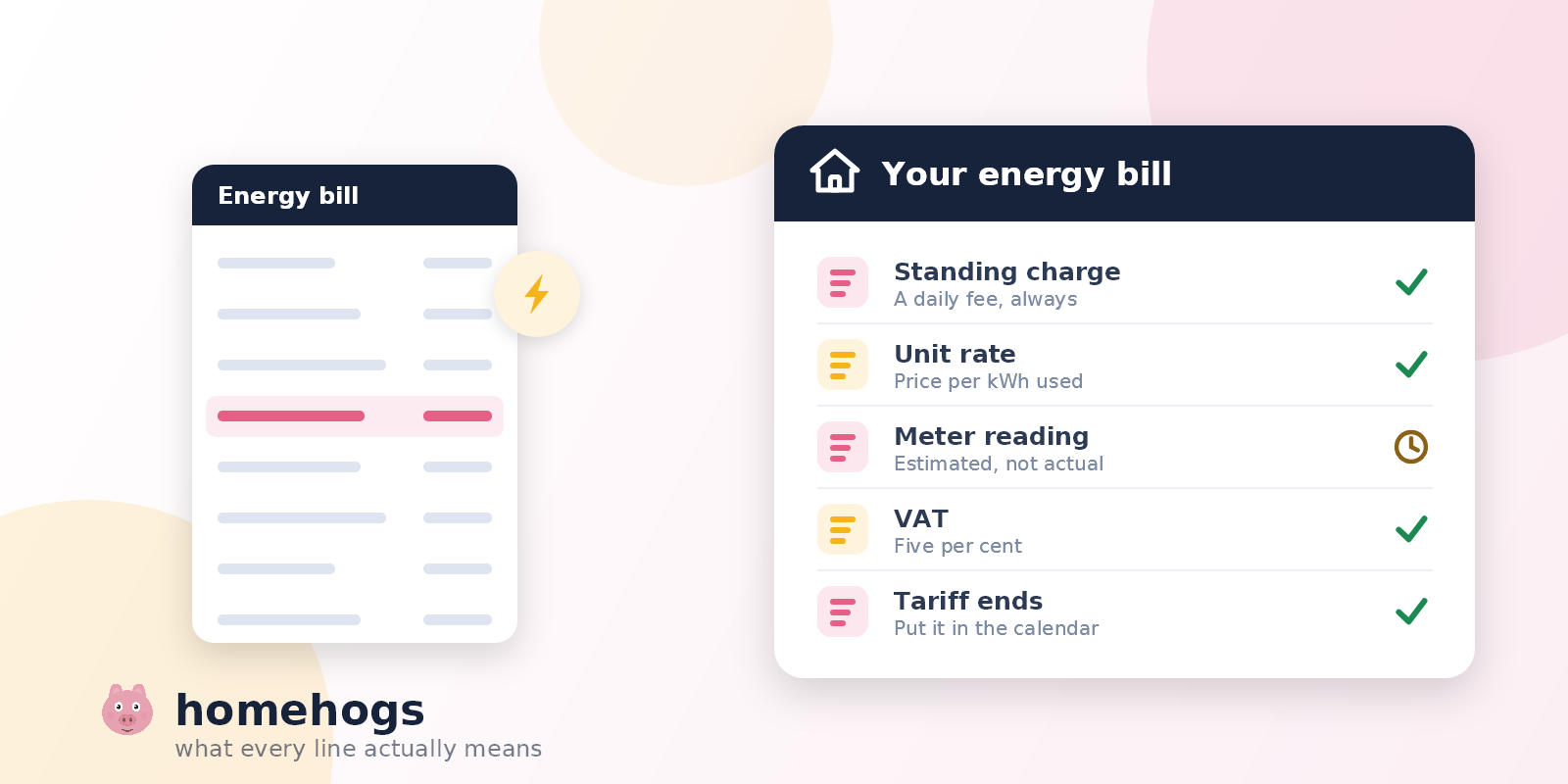
Whatever the layout, every household bill or statement contains the same things:
- Who you are and which meters you are charged for, each identified by a reference number
- The period covered and the meter readings at each end of it
- How much energy that works out as, in kWh
- What it costs: a standing charge for each day and a unit rate for each kWh
- VAT
- What you have paid and the balance, in credit or in debit
Suppliers arrange these in different orders, which is most of why bills feel confusing. A smart meter working in smart mode sends the readings for you; otherwise they come from you or from the supplier's estimate.
Every line, explained
Here is an example dual fuel bill for 1 October to 31 December 2026, a 92-day quarter, on a standard variable tariff at Ofgem's average price cap rates. The account details are made up. Gas is shown before VAT, as many bills do, with VAT added as a separate line. Your supplier's layout will differ but the lines are the same.
| Line | Example | What it means | What to check |
|---|---|---|---|
| Account number | Your account reference | Quote it whenever you contact the supplier | That it is yours |
| MPAN (electricity supply number) | A 21-digit number, often in a box starting with S | Identifies your electricity supply point; the bottom 13 digits are the core reference | It belongs to your address, especially after moving in |
| MPRN (gas meter point reference) | A shorter number | Does the same job for gas | As above |
| Meter serial number | One per meter | Identifies the physical meter | It matches the number printed on your meter |
| Tariff and end date | Standard variable, no end date | A fixed tariff shows the date its fixed price ends | Put any end date in your calendar |
| Bill period | 1 Oct to 31 Dec 2026, 92 days | The days the standing charge covers | No gap or overlap with the last bill |
| Electricity readings | Opening 23,410 (A), closing 24,060 (E) | A is an actual reading, E an estimate | Any E. Send a real reading |
| Electricity used | 650 kWh | Closing minus opening | The opening reading matches the last bill's closing one |
| Electricity unit rate | 26.32p per kWh | The price of each kWh | Whether it changed during the period |
| Electricity standing charge | 54.83p a day | A fixed daily fee | It is charged per day, for the right number of days |
| Gas readings | Opening 4,512 (A), closing 4,738 (C) | Volume in cubic metres on a metric meter; C is a reading you gave | Whether your meter is metric or imperial |
| Gas used | 226 cubic metres, 2,536 kWh | Volume converted to energy (see below) | The calorific value and correction factor |
| Gas unit rate | 7.59p per kWh before VAT | 7.97p with VAT | As for electricity |
| Gas standing charge | 28.27p a day before VAT | 29.68p with VAT | As for electricity |
| VAT | Electricity 0%: £0.00. Gas 5%: £10.92 | The reduced rates for household energy | 20% on a home bill is an error |
| Balance brought forward | £35.20 in credit | Where the account stood after the last bill | It matches the last bill |
| Payments | 3 Direct Debits of £140, £420 in all | What you paid in the period | Every payment is listed |
| Balance | £4.27 in credit | Credit means the supplier owes you; debit means you owe it | Whether it keeps growing either way |
| Direct Debit | £140 a month | What you will pay from now on | It is based on recent, realistic readings |
How the example adds up
- Electricity: 650 kWh at 26.32p is £171.08, plus 92 days at 54.83p, £50.44. Total £221.52, with no VAT.
- Gas: 2,536 kWh at 7.59p is £192.48, plus 92 days at 28.27p, £26.01. That makes £218.49, plus 5% VAT of £10.92: £229.41.
- Charges for the quarter: £450.93. The account started £35.20 in credit and £420 was paid in, so it ends £4.27 in credit.
The tariff end date is the line people miss most. Rolling off a fixed price onto a standard variable one happens without anybody doing anything, so it is worth a calendar reminder a few weeks before.
The standing charge and the unit rate
These two do different jobs.
The standing charge is a fixed daily fee. You pay it for every day you are supplied, whether you use a lot of energy or none. It covers costs such as the networks that bring energy to your door and your meter. It varies by region.
The unit rate is the price of the energy itself, per kWh. It is the part you can reduce by using less.
The price cap from 1 October to 31 December 2026
Ofgem's price cap limits the standing charges and unit rates on standard variable (default) tariffs in England, Scotland and Wales. It does not limit your total bill. Nor does it apply to fixed deals. The average Direct Debit rates for this quarter:
| Fuel | Unit rate | Standing charge | VAT |
|---|---|---|---|
| Electricity | 26.32p per kWh | 54.83p a day | 0% |
| Gas | 7.97p per kWh | 29.68p a day | 5%, included in these figures |
Your region's rates will be a little higher or lower. Ofgem's headline figure of £1,723 a year is for a typical home using 2,500 kWh of electricity and 9,500 kWh of gas on Direct Debit; it is an illustration, not a limit. The cap for 1 January to 31 March 2027 is due to be announced on 25 November 2026.
The VAT change is temporary: household electricity is zero-rated from 1 October 2026 to 31 March 2027 in Great Britain. Gas stays at 5%. Electricity in Northern Ireland is unchanged.
Comparing tariffs
Two tariffs with the same unit rate can differ a lot over a year on the standing charge alone. A low unit rate with a high standing charge can cost a low user more. Compare both numbers, or the estimated annual cost, which folds them together. Since June 2026 Ofgem has run a voluntary one-year pilot of lower standing charge tariffs with EDF, E.ON, Octopus and British Gas taking part at launch: lower daily charges, higher unit rates and eligibility set by each supplier.
Estimated or actual: why the reading matters
Codes vary by supplier, but A usually means an actual reading, E an estimate and C a reading you gave. A smart meter in smart mode sends readings automatically; one that has stopped doing so quietly puts you back on estimates.
The rules in Great Britain, from the supply licence conditions:
- Your supplier must take all reasonable steps to get a reading at least once a year. The old duty to inspect every meter every two years was removed in 2016.
- If you give a reading the supplier considers reasonably accurate, it must use it in your next bill.
- You should get a bill or statement at least twice a year, or quarterly if you ask or manage your account online. Different rules apply to smart and prepayment meters.
So the cure for estimated bills is mostly in your hands. Read the meters on the same day each month or quarter, keep a dated photo and submit the figures. If the supplier will not accept a reading you know is right, that is a complaint, not something to live with.
How a gas reading becomes kWh
A gas meter measures volume. You are charged for energy. The bill converts one into the other with figures printed on it, so you can check the sum yourself:
- Take the units used: the closing reading minus the opening reading.
- If the meter is imperial (it shows ft3 or cubic feet), multiply by 2.83 to get cubic metres. A metric meter (m3) is already in cubic metres.
- Multiply by the volume correction factor, 1.02264, which adjusts for temperature and pressure and is set in regulations.
- Multiply by the calorific value on your bill, in megajoules per cubic metre. It varies a little by area and over time, usually around 39 to 40.
- Divide by 3.6 to turn megajoules into kWh.
Worked example: a metric meter
The example bill above, with a calorific value of 39.5. Use the figure on your own bill.
- Units used: 4,738 minus 4,512 = 226 cubic metres
- 226 × 1.02264 = 231.12
- 231.12 × 39.5 = 9,129.2 megajoules
- 9,129.2 ÷ 3.6 = 2,535.9, so 2,536 kWh
Worked example: an imperial meter
Readings of 0732 and 0812 give 80 units, which on an imperial meter means 80 hundred cubic feet.
- 80 × 2.83 = 226.4 cubic metres
- 226.4 × 1.02264 = 231.53
- 231.53 × 39.5 = 9,145.4 megajoules
- 9,145.4 ÷ 3.6 = 2,540.4, so 2,540 kWh
This is where a real error shows up. If those 80 imperial units were treated as 80 cubic metres, the bill would show about 898 kWh instead of 2,540. A large catch-up bill would follow when somebody noticed. The reverse mistake, a metric meter billed as imperial, multiplies your gas by 2.83.
Credit, debit and getting a refund
The balance tells you where you stand. In credit means the supplier owes you; in debit means you owe it.
With a fixed monthly Direct Debit it is normal to build up credit in summer and use it in winter. What is not normal is credit that keeps growing year after year, or a debt that keeps getting bigger.
- Getting credit back. You can ask for a refund at any time. Send an up-to-date reading first so the balance is accurate. Your supplier must refund credit promptly unless it is fair and reasonable not to. If it refuses, it must explain why.
- Direct Debit amounts. A fixed Direct Debit must be based on the best and most current information the supplier has, which is another reason to send readings. If yours looks far too high or too low, ask for a review.
- After switching or moving. The old supplier must take all reasonable steps to send a final bill within six weeks. Check it against your final readings.
- A debit balance. Talk to the supplier early about a payment plan you can afford. Citizens Advice can help if you are struggling.
Common billing mistakes: a checklist
Work down this list with your latest bill and the one before it. Most problems turn up in the first three.
- Estimated readings. Any E? Send a real reading before anything else.
- A gap between bills. The opening reading should match the last bill's closing one. A gap means a bill was reissued or an estimate corrected.
- The wrong meter. Compare the meter serial number, MPAN and MPRN on the bill with your meters and your address. Crossed meters between neighbouring homes are rare but can run for years.
- Imperial and metric mixed up. If your gas use jumped or dropped by nearly three times, check the meter type.
- The wrong VAT. 0% on household electricity until 31 March 2027 in Great Britain, 5% on gas. 20% usually means the account is set up as a business.
- The wrong tariff. Rates that do not match your tariff confirmation, or a fixed deal that ended without you noticing.
- Price changes not split. If prices changed during the bill period, the days at each rate should be shown separately.
- The wrong number of days. Standing charges should cover exactly the days in the bill period.
- Missing payments. Every Direct Debit in the period should be listed.
- A Direct Debit out of line with your use. Compare the annual estimate on the bill with last year's actual use.
- Old energy billed late. Charges for energy used more than 12 months ago, where the supplier was at fault, may fall under the back-billing rule above.
Citizens Advice also explains how to check whether a meter is faulty.
How to complain and when the Energy Ombudsman can help
Most billing problems are fixed by one well-documented complaint.
- Complain to the supplier in writing if you can. Keep a copy. Say what is wrong and what you want done. Include meter readings with dated photos.
- Note every call: the date, the time, who you spoke to and what was agreed.
- If it is not resolved within 8 weeks, or the supplier sends a deadlock letter saying it can do no more, take it to the Energy Ombudsman. It is free.
- Do this within 12 months of the deadlock letter.
- If you accept the Ombudsman's decision, the supplier must carry it out within 28 days.
The Citizens Advice consumer helpline can help you put a complaint together. The Ombudsman covers suppliers in Great Britain only.
Northern Ireland
Ofgem's price cap, the VAT cut on electricity and the Energy Ombudsman do not apply in Northern Ireland, where energy is regulated by the Utility Regulator. Complain to your supplier first, then to the Consumer Council for Northern Ireland. The Utility Regulator can take a billing dispute the Consumer Council has not resolved within three months. We could not confirm whether the same 12-month back-billing rule applies there, so ask the Consumer Council if it matters to you.
What to keep and why it matters
A single bill tells you what you owe. A run of them tells you what your home costs to run and whether that is changing.
Keep:
- Every bill or annual statement. Twelve months covers the back-billing window; several years shows the trend.
- Dated photos of meter readings. Especially when you move in or out, switch supplier or get a new meter. The first two weeks in a new home has the move-in list.
- Your tariff confirmation. With the end date of any fixed price.
- Complaint records. Letters, emails, call notes and any deadlock letter.
- Final bills from old suppliers. With proof that any credit was refunded.
Those records answer three questions later. Is insulation or a new boiler worth it? Your own use answers that better than a brochure; what your EPC actually tells you covers the building's side. Is this bill wrong? The previous ones are your evidence. What does the house cost to run? Buyers ask. Council tax is the other big figure, covered in checking your council tax band. Water works the same way once you are metered: see should you get a water meter.
homehogs reads a bill you upload or email in, records the readings, rates and dates and keeps each figure linked to the bill it came from, so the run of bills builds itself.
Sources
- Ofgem: Changes to the energy price cap between 1 October and 31 December 2026
- Ofgem: Energy price cap explained
- Ofgem: Lower standing charge tariffs, next steps
- Ofgem: Electricity supply standard licence conditions
- GOV.UK: Temporary zero rate of VAT for domestic electricity in Great Britain
- GOV.UK: Gas meter readings and bill calculation
- legislation.gov.uk: Gas (Calculation of Thermal Energy) Regulations 1996
- Citizens Advice: Claim back credit from your energy supplier
- Citizens Advice: If you have not received a bill in a while
- Citizens Advice: If you think you have been charged too much
- Energy Ombudsman
- Energy Ombudsman: FAQs
- Utility Regulator: complaint determination setting out the Northern Ireland route
Last fact-checked 5 October 2026.
Let the bills file themselves
homehogs reads a bill you photograph, upload or forward, pulls out the readings, rates and dates and builds up what your home costs to run as you go.
See the plans