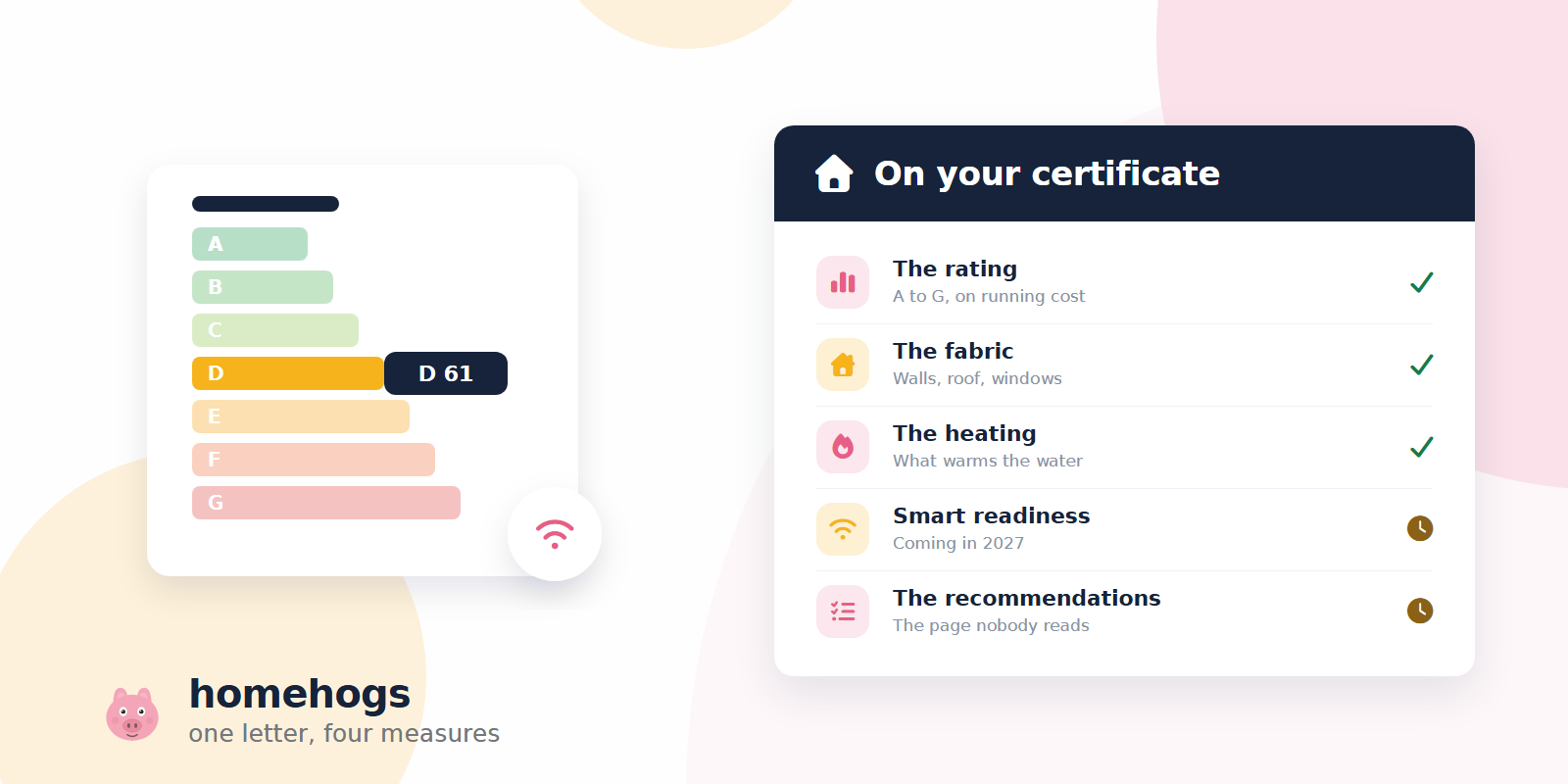
Almost every home has an EPC and almost nobody reads past the letter. This walks through each part of the certificate, which recommendations tend to be worth doing and what is changing: redesigned EPCs for England and Wales are now expected in the second half of 2027, with Scotland on its own timetable.
An Energy Performance Certificate rates a home's energy efficiency from A (best) to G (worst), estimates what it would cost to heat and light for a typical household, records how the home is built and heated and lists improvements that could lift the rating. What it does not do is predict your bills, because it measures the building with the people taken out.
Most of us look at the letter once, when we buy, then never again. The useful parts are further down: what the assessor recorded about your walls, roof and heating, plus the list of steps with their costs.
The certificate is also changing, later than first planned. The redesigned EPC for England and Wales was due in October 2026; in March 2026 the government moved the launch to the second half of 2027, with no exact date yet. Scotland is on a separate timetable. Whatever happens, the certificate you have now stays valid until the date printed on it.
The short version
- An EPC rates a home from A to G using a modelled energy cost for a standard household, so it is not a forecast of your bills.
- In England, Wales and Northern Ireland an EPC lasts ten years and you need a valid one to sell or let, not to live in your home.
- You can read any certificate free on GOV.UK's Find an energy certificate register; Scotland has its own register.
- Redesigned EPCs for England and Wales are now expected in the second half of 2027 rather than October 2026; they will still last ten years.
- Scotland plans new-style certificates with a Heat Retention Rating and five-year validity, now proposed for 30 April 2028.
- The recommendations are generated from the assessment data, so some will not suit your home and the costs are typical figures.
- Privately rented homes in England and Wales must be rated E or above; a C standard by 1 October 2030 is announced policy, not yet law.
What the letter actually measures
An EPC rating is a modelled cost of energy per square metre, worked out for a standard household with a standard pattern of heating, hot water and lighting. It measures the building, not the people in it.
That is why two identical houses on the same street get the same rating even if one is home to a couple who are out all day and the other to a family of five who like it warm. It is also why low bills and a D are not a contradiction. Your bills reflect how you live; the D reflects the walls, roof, windows and heating. For what your home really costs to run, the bills are the record; how to read your energy bill explains each line.
Behind the letter is a score. On the certificate the bands run like this:
| Band | Score |
|---|---|
| A | 92 or more |
| B | 81 to 91 |
| C | 69 to 80 |
| D | 55 to 68 |
| E | 39 to 54 |
| F | 21 to 38 |
| G | 1 to 20 |
Each certificate on the register compares the home with an average rating of D and an average score of 60. So a D is ordinary, not a warning sign.
The per square metre part tends to flatter bigger homes, which is why a large, draughty house can score better than a small flat that costs less to heat in pounds. The certificate also carries a second A to G scale for environmental impact, based on carbon dioxide emissions, which is often a different letter from the main one.
What each part of the certificate shows
Open your certificate on the register and work down it. The parts below are in the order the online certificate shows them; a PDF or printed copy has the same content laid out differently. The examples in the middle column are illustrative.
| Part | What you see (example) | What to check |
|---|---|---|
| Property details | Address, property type and total floor area in square metres | The floor area and type. A wrong figure here skews everything after it |
| Valid until and certificate number | A date ten years after the certificate was made and a reference number | The date, if you might sell or let. Quote the number if you query anything |
| Rules on letting | Whether the home can be let at its current rating | Only matters if you rent it out |
| Energy rating and score | Current D (62), potential B (84) | The potential rating is what all the listed steps could achieve together, not a promise |
| Breakdown of energy performance | Each feature (walls, roof, windows, main heating, heating controls, hot water, lighting, floor, secondary heating) with a description and a rating from very poor to very good | Whether the descriptions match your home. Insulation recorded as assumed or absent is the usual error |
| Primary energy use | A figure in kWh per square metre per year | Useful only for comparing homes |
| How this affects your energy bills | An estimated yearly cost for heating, hot water and lighting, plus what the steps could save | The price year. The estimate uses average prices from when the certificate was made |
| Impact on the environment | An environmental impact rating and the carbon dioxide produced each year, now and potentially | Nothing to act on, but it can differ from the main letter |
| Steps you could take to save energy | Each recommendation with a typical installation cost, a typical yearly saving and the potential rating after that step | Whether each step is possible on your home and whether you have done it already |
| Paying for energy improvements | Links to government schemes | Eligibility, which changes often |
| Who to contact | The assessor's name and contact details and their accreditation scheme | Who to go to if something is wrong |
| About this assessment | Date of assessment, date of certificate and type of assessment (usually RdSAP for an existing home) | How old the method was. A certificate from 2015 was produced under older rules |
| Other certificates for this property | Earlier certificates for the same address | Compare them to see what past work achieved |
The steps build on each other: the potential rating shown after each one assumes the steps above it have been done too. So the last line shows where the whole list would take you, not what that one measure is worth on its own.
Where to find yours, free
You never need to pay for a copy of an existing certificate.
- England, Wales and Northern Ireland. Search GOV.UK's Find an energy certificate service by postcode. It shows the certificate for the address and any other certificates lodged for it.
- Scotland. Search the separate Scottish EPC Register. In Scotland the certificate must also be displayed in the home, for example in the meter cupboard or next to the boiler.
- A clearer view. Our free EPC checker reads the GOV.UK register and lays a certificate out with its costs and suggestions side by side.
If nothing comes up, try other versions of the address, because flats in particular are often recorded in a different format. A home that has not been sold, let or built since EPCs were introduced may never have had one.
You do not need a new certificate just because yours has expired while you live there. You need a valid one when you sell, let or build. If that time comes and there is none, book an accredited assessor through GOV.UK's Get a new energy certificate service in England, Wales and Northern Ireland, or through the Scottish register.
What changed and what is about to
Two changes matter if you are about to have an assessment in England or Wales.
RdSAP 10, in use since June 2025
RdSAP is the method behind an EPC for an existing home. Version 10 came into use in June 2025 and records floor area, insulation and heating in more detail than before. Where an assessor cannot see something or be shown evidence of it, the method falls back on default assumptions, largely based on the age of the building. Those defaults are often less generous than the reality. A new assessment today will not necessarily reproduce the letter you were given years ago, in either direction.
The redesigned certificate: second half of 2027
A new-look EPC was planned for October 2026. On 9 March 2026 the UK Government updated its consultation page to say it had decided to move the launch to the second half of 2027. No exact date has been named. What has been decided for England and Wales, in the government's January 2026 response:
- The certificate will show four headline measures rather than one: energy cost, fabric performance (how well the walls, roof, floor and windows keep heat in), heating system and smart readiness.
- Energy demand and carbon will appear as secondary measures. Carbon is not one of the headline ones.
- Certificates will still last ten years and existing certificates keep their ten-year validity.
- A new calculation, the Home Energy Model, is planned to replace SAP and RdSAP. A consultation on using it for EPCs closed on 18 March 2026.
The government also intends to require an EPC to be in place when a home is first marketed and to bring short-term lets into scope. Those are intentions, not law yet.
Your existing certificate stays valid until its expiry date. There is nothing to do now unless you are selling or letting.
Scotland and Northern Ireland
The basics are similar across the UK. The registers and the reforms are not.
| Rule | England and Wales | Scotland | Northern Ireland |
|---|---|---|---|
| Register | GOV.UK Find an energy certificate | Scottish EPC Register | GOV.UK Find an energy certificate |
| Valid for | 10 years | 10 years now; 5 years for new-style certificates | 10 years |
| Needed when | Selling, letting or building | Selling, letting or building; must be displayed in the home | Selling, letting or building |
| What is changing | Redesigned certificate in the second half of 2027 | New-style certificate proposed from 30 April 2028 | No reform announced that we found |
| Status | Announced, no exact date | Draft regulations awaiting approval | Current rules continue |
Scotland
The Energy Performance of Buildings (Scotland) Regulations 2025 bring in a new-style certificate with three ratings: a Heat Retention Rating for the fabric, a Heating System Rating and an Energy Cost Rating. New-style certificates would last five years instead of ten. They were due on 31 October 2026, but draft amending regulations laid on 24 August 2026 would move the start to 30 April 2028. The Scottish Parliament has not approved them yet, so treat the date as proposed. Until the new rules start, today's ten-year certificates carry on. Under the draft, old or new-style certificates would both be accepted for sales and lets until 30 April 2029.
Northern Ireland
EPCs work much as they do in England and Wales: a certificate lasts ten years, is needed when a home is built, sold or let and is enforced by district councils, according to nidirect. They sit on the same GOV.UK register. We found no announced reform and no minimum rating for private rentals.
Reading the recommendations honestly
The steps are the most useful part of the certificate and the part to read most sceptically. They are generated from the assessment data by software, not designed by somebody who has thought about your house. So:
- They can suggest work you have already done, because the assessor could not verify it.
- They can suggest work that is impractical or needs consent. External wall insulation in a conservation area or on a listed building may need permission. Several measures need building regulations sign-off too; planning permission or building regulations explains which.
- The typical installation costs are broad ranges, not quotes. Real prices depend on the home, the region and the installer.
- The typical yearly savings assume the standard household and the energy prices from when the certificate was made, so they will not match your own.
- Each potential rating assumes the steps before it are done too.
What a recommendation means in practice depends on the house. Loft insulation is simple in a pitched roof with open joists and a different job altogether in a room in the roof. Cavity wall insulation suits many cavity walls but not all of them, for example walls already showing damp or badly exposed to driving rain, which is why a reputable installer surveys first. Solid wall insulation that is badly specified can trap moisture; condensation, damp or mould explains the signs to watch for.
Treat the list as the start of a conversation with an installer, not a to-do list.
Common improvements, from low cost to worth investigating
These are the improvements EPCs most often suggest, grouped by rough cost. The groups are relative, not prices: your certificate gives typical costs for your home and only a quote gives a real figure. Whether each one suits your house is always the first question.
| Cost | Improvement | Why it helps | Check first |
|---|---|---|---|
| Low | Draughtproofing doors, windows, the loft hatch and floorboards | Stops warm air escaping | Keep the ventilation you need, especially in kitchens, bathrooms and rooms with a fuel-burning appliance |
| Low | Hot water cylinder jacket | Cuts heat loss from an uninsulated cylinder | Only for a cylinder without factory-fitted foam |
| Low | LED lighting | Lower lighting costs | Very little |
| Low | Heating controls: room thermostat, programmer, thermostatic radiator valves | Heats the rooms you use, when you use them | What you have already; fitting is a job for a heating engineer |
| Low to medium | Topping up loft insulation | Cuts heat lost through the roof | Squashed insulation under storage boards works less well; eaves vents must stay clear |
| Medium | Cavity wall insulation | Fills the gap in a cavity wall | Wall suitability and any damp; ask for a guarantee |
| Medium | Suspended floor insulation | Cuts draughts and heat loss through timber floors | Access underneath; airbricks must stay clear |
| High | Replacement windows or doors | Better glazing and fewer draughts | Long payback; needs FENSA, Certass or building control sign-off |
| High | Solid wall insulation, internal or external | Large gains on solid-walled homes | Moisture risk if badly specified; planning in some areas |
| High | Heat pump | Replaces a gas, oil or LPG boiler | Insulation first; grants may help |
| Worth investigating | Solar panels | Generates electricity on site | Roof direction, shading and an MCS-certified installer |
| Worth investigating | Room in roof insulation | Warmer rooms in the roof | Usually best done as part of bigger work |
| Worth investigating | Replacing a working boiler early | A newer boiler may be more efficient | You lose the life left in one you already own |
If you do want to improve it
There is a sensible order and most people do it backwards.
- Stop the heat leaving: draughts, then the loft, then the walls where suitable. It is usually the cheapest part and makes everything after it work better.
- Then the controls, so the heating runs only where and when it is needed.
- Then the heat source, if it is near the end of its life. Doing it first risks sizing a new system for a house you are about to insulate.
Book the new assessment after the work rather than before. Keep every certificate and invoice for the one after that.
GOV.UK's Find ways to save energy in your home gives tailored suggestions for homes in England and Wales. Help with costs, as at October 2026:
- Boiler Upgrade Scheme (England and Wales): a grant towards a heat pump or biomass boiler, applied for by an MCS-certified installer.
- Warm Homes: Local Grant (England): free upgrades through councils for eligible lower-income households in homes rated D to G.
- Energy Company Obligation (ECO4): runs until 31 December 2026.
- The Great British Insulation Scheme closed on 31 March 2026.
- The Warm Homes Plan is a government strategy rather than a scheme you apply to. The low and zero interest loans it describes had not launched when we checked.
- Scotland: Home Energy Scotland grants and loans. Wales: the Welsh Government's Nest scheme. Northern Ireland: the Affordable Warmth Scheme.
Schemes open, close and change their rules often, so check the official page before you plan around one.
Landlords and the minimum rating
In England and Wales a privately rented home must currently be rated E or above unless a valid exemption is registered. Landlords need not spend more than £3,500 including VAT, most exemptions last five years and fines run up to £5,000 per property.
In January 2026 the government announced that the standard will rise to the equivalent of C by 1 October 2030 for all tenancies, with a £10,000 cost cap and the new fabric, heating and smart readiness measures. That is policy, not law: it needs new legislation first. Until then the E standard applies. Scotland has consulted on its own rental standard tied to the new Heat Retention Rating; its dates are proposals. We found no minimum rating for private rentals in Northern Ireland.
Landlord safety certificates covers the EPC alongside the gas and electrical checks.
What to keep afterwards
An EPC is only as good as the evidence behind it. Keep:
- Every EPC for the home. The old ones too. Together they show what past work achieved.
- Insulation guarantees and invoices. Cavity wall, loft, floor or solid wall, with the installer's details.
- Window and door certificates. FENSA or Certass, or the building control completion certificate.
- Boiler paperwork. The Benchmark record, the Building Regulations compliance certificate and the service history.
- MCS certificates. For a heat pump, solar panels or a battery.
- Completion certificates. For extensions and loft conversions signed off by building control.
- Dated photos of hidden work. Insulation under floors or behind walls cannot be seen once it is covered.
- Grant paperwork. If a scheme paid for any of it.
How to prove work was done on your home goes through each type of evidence and what to do if it is missing. homehogs keeps the EPC with the guarantees and certificates behind it, each attached to the job it proves, so the folder is ready the next time an assessor calls.
Sources
- GOV.UK: Energy Performance Certificates for your home
- GOV.UK: Find an energy certificate
- GOV.UK: Reforms to the energy performance of buildings regime (updated 9 March 2026)
- GOV.UK: Reforms to the energy performance of buildings regime, partial government response
- GOV.UK: Standard Assessment Procedure
- Scottish Government: EPC reform updates
- Scottish EPC Register
- nidirect: Energy performance certificates
- GOV.UK: Domestic private rented property minimum energy efficiency standard
- GOV.UK: Improving the energy performance of privately rented homes, government response
- GOV.UK: Find ways to save energy in your home
- GOV.UK: Boiler Upgrade Scheme
- GOV.UK: Warm Homes: Local Grant
- Ofgem: Energy Company Obligation
- Ofgem: Great British Insulation Scheme
Last fact-checked 5 October 2026.
Keep the certificates that prove the work
homehogs keeps your EPC with the insulation guarantees, window certificates and boiler records behind it. It can also remind you before the certificate runs out.
Start free