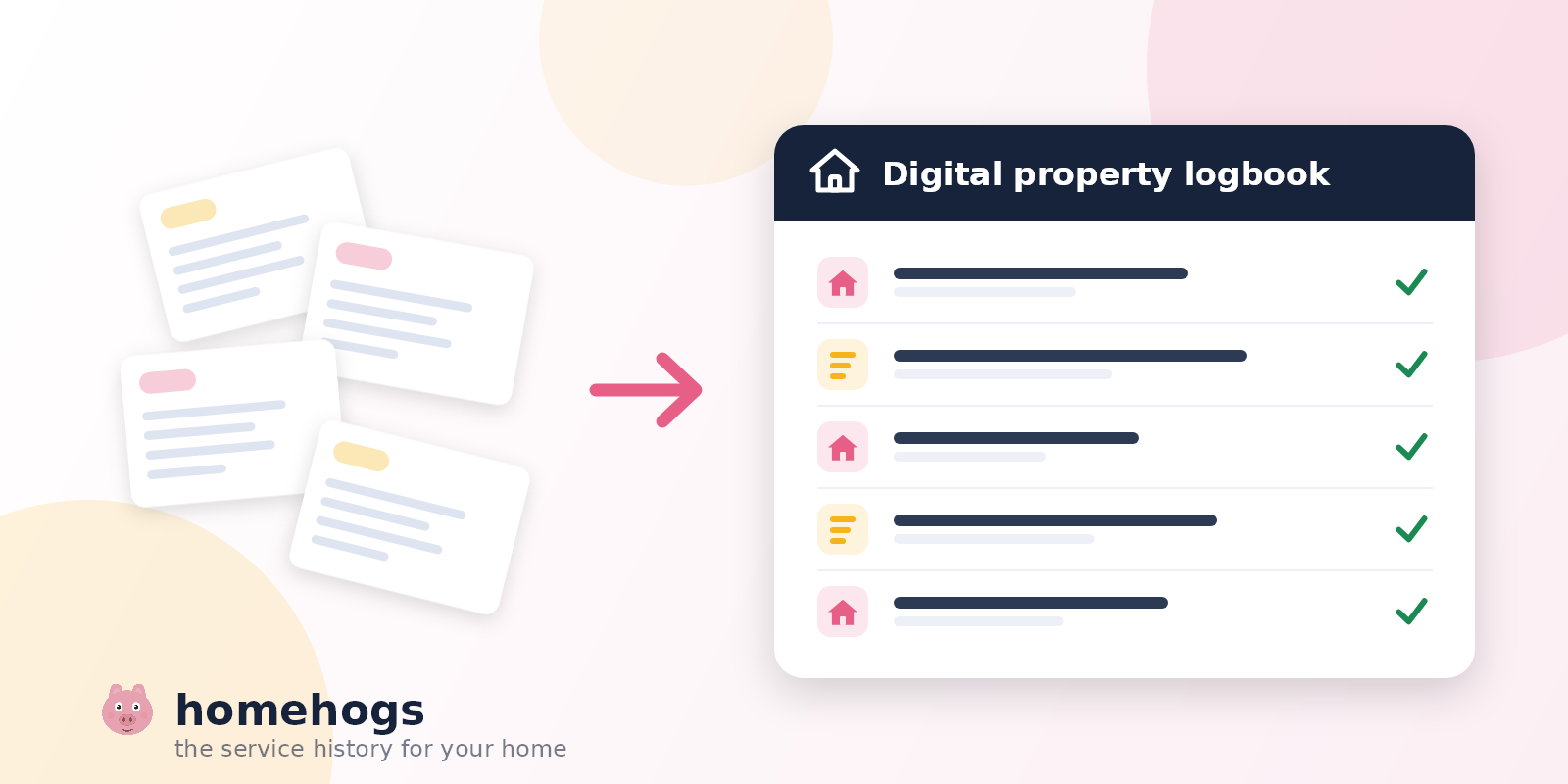
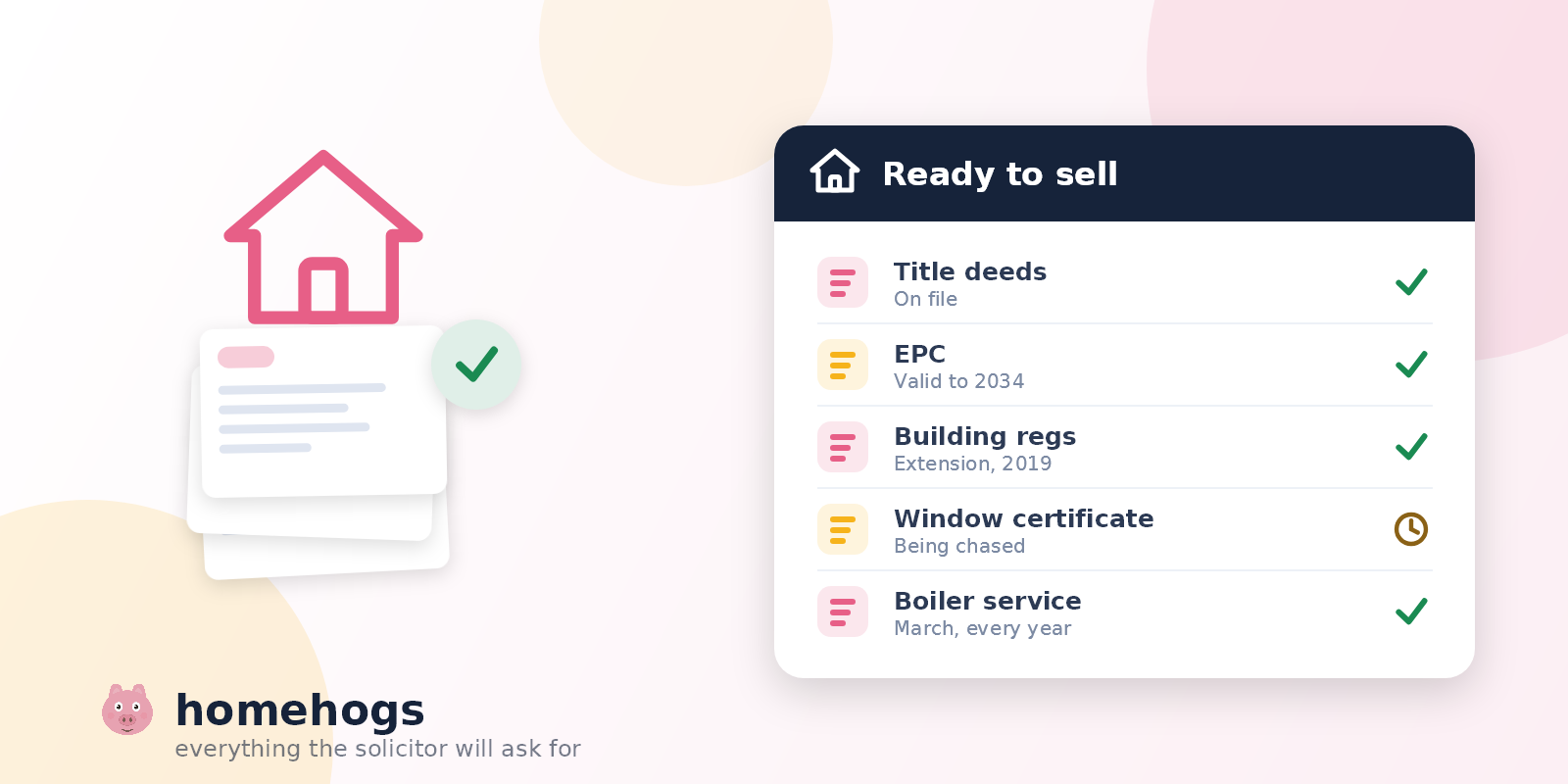
A home logbook is one record of everything about your home: the paperwork, the certificates, the work done, what's installed and what it costs to run, each with its date. You add to it as things happen, so the answer is already written down when a buyer, an insurer or a plumber asks.
The short version
- A home logbook keeps a home's documents, certificates, work and running costs together, with their dates.
- You'll also hear it called a property logbook or a digital property logbook. They're the same idea.
- No law asks homeowners to keep one today. The government has said digital property logbooks will play a part in how homes are bought and sold.
- Start with what you already have: the title register, the EPC, the boiler's paperwork and a list of work done.
- homehogs builds a logbook from the records you keep anyway and shows you what's still missing.
Home logbook, property logbook or log book?
They're all names for the same thing. Home logbook is what most homeowners call it. Property logbook and digital property logbook are the names the property industry and the government use. A house log book or home maintenance log book is usually the paper version: a folder or a notebook filled in by hand. (Not the car kind. That one's a V5C.)
The Residential Logbook Association, the trade body for the companies that provide logbooks, describes a property logbook as a digital service that keeps the useful information about a home securely and in a standard shape. Its own explainer, What is a property logbook?, is worth a read. homehogs is an associate member of the association. Here's why we joined.
Whatever you call it, the job is the same. When somebody asks a question about your home, the answer is written down, with a date and the paperwork behind it.
What goes in a home logbook
Most of it is paperwork you already have somewhere. A useful logbook sorts it into six areas. These are the ones homehogs uses, with what tends to go in each.
Ownership and legal
- The title register and title plan from HM Land Registry
- For a flat or another leasehold home: the whole lease, the last three years of service charge accounts, the latest ground rent demand and the managing agent's pack
- For a share of freehold: the share certificate as well
- Anything particular to your home, such as the paperwork for a septic tank or an estate charge
Compliance and safety
- The Energy Performance Certificate (EPC), which lasts ten years
- Gas safety records and electrical reports (EICRs), which landlords have to keep up to date
- Any surveys you've had done
Works and planning
- Planning permissions and building regulations completion certificates for extensions, lofts and structural work
- FENSA or similar certificates for windows and doors replaced since April 2002
- Certificates for electrical work, such as a new consumer unit or a rewire
- The Building Regulations compliance certificate for a new boiler
- A dated list of every job: what was done, who did it and what it cost
Energy and retrofit
- Your EPC rating and how it has changed over the years
- The heating, the insulation and any solar panels or heat pump, with the installer's certificates
- Meter readings
Systems and guarantees
- Each appliance with its manual, receipt and serial number
- Guarantees for work such as damp proofing, timber treatment, insulation or roofing, many of which pass to the next owner
- The new-home warranty, if the home is under ten years old
- Service records, starting with the boiler
- Where things are: the stopcock, the fuse box and the meters
Running costs
- The council tax band
- Who supplies the gas, electricity and water
- Home insurance and when it renews
- What the bills come to over a year
The detail here is written for England and Wales. Scotland and Northern Ireland have their own land registers and building rules, though what's worth keeping is much the same.
Why keep one
Nobody keeps their paperwork perfectly. We've all got that drawer. A logbook just means the important bits stop depending on memory, which helps in some very ordinary moments.
- Selling. The questions a buyer's solicitor sends ask what's been done to the home, when and with what permission. Answering from a record is quicker than answering from memory. The certificates go out with the answers.
- Insurance claims. When an insurer asks what you owned and what it cost, the receipts are already filed.
- Repairs and servicing. You know when the boiler was last serviced, which appliances are still under warranty and the name of the plumber you'd use again.
- Handing over. The next owner gets the manuals, the guarantees and where the stopcock is, rather than a guessing game.
- Letting. Landlords have certificates to renew and copies to give tenants. A logbook keeps the dates and the documents in one place.
Nobody can promise a logbook adds to what your home sells for. What it does is take the scramble out of the moments that need the paperwork.
Paper, spreadsheet or app?
Any of them beats nothing. The best one is the one you'll actually keep up. Here's how they compare.
| Paper folder | Spreadsheet | An app like homehogs | |
|---|---|---|---|
| Cost | Free | Free | Free to start, with paid plans |
| Adding things | Write it in | Type it in | Upload a photo or forward an email |
| Finding things | Leafing through | Search the list, then find the file | Search, with each file kept on its room, appliance or job |
| The documents themselves | In the folder | Saved somewhere else | Attached to the record they prove |
| Reminders | None | Only if you set them up | Before renewals and services fall due |
| Sharing with a solicitor or buyer | Photocopies | Email the file | A PDF or a private link |
| Safe from a leak or a lost laptop | Only as safe as the drawer | If it's backed up | Stored online, away from the house |
Paper and spreadsheets are fine if they suit you. An app earns its keep when you want the reminders, the sharing and everything in one search.
How to start a home logbook
You don't have to do it all at once. An evening gets the backbone in place, then it grows as life happens.
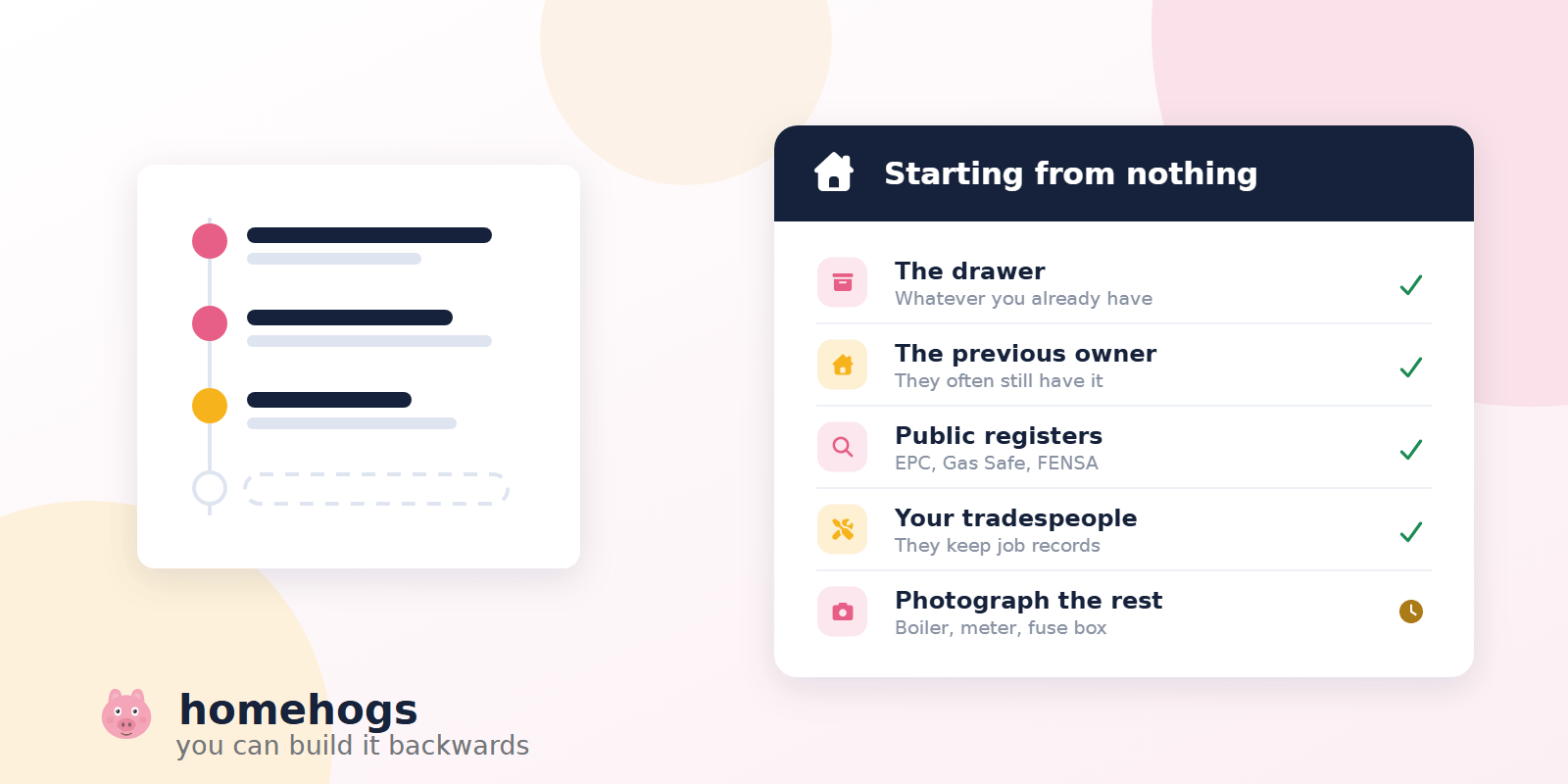
- Empty that drawer. Gather the certificates, guarantees, manuals and receipts you can find. Search your email for words like certificate, guarantee, warranty and invoice.
- Get your title register. Download the title register and plan from HM Land Registry.
- Find your EPC. Look your home up on our free EPC checker, which reads the official register.
- Write down the work. List what's been done since you moved in, with rough dates and who did it. Rough is fine.
- Add the dates that matter. The next boiler service, when the insurance renews and when each warranty ends.
- Keep adding as you go. File the receipt the day you buy something and the certificate the day the work finishes.
Getting ready to sell? The free sale-ready check shows which of the usual documents you already have.
How the homehogs logbook works
homehogs builds your logbook from the records you keep anyway. Add a bill, a certificate, a job or an appliance and it's in the right section a moment later, so there's no second copy to keep up.
- Six sections, from ownership and legal to running costs, laid out the way a buyer, a solicitor or a tradesperson looks for things.
- What's missing sits beside what's there. A gap is a line of its own, with why it matters and a button to add it, so the logbook fills up a step at a time.
- Every fact says where it came from. Each line is marked Checked (read from an official source such as the EPC register), From a document or You said, so a reader knows how far to trust it.
- A PDF on every plan. Download the whole logbook as a PDF on any plan, Free included.
- Sharing when you need to. On plans that include the packs you can share your logbook by private link and choose which sections each person sees. The sections about ownership and money only open with a code sent by email. You can also download a zip of the PDF with every file behind it, or export the logbook as Property Data Trust Framework data for another system.

Do you need a home logbook to sell?
Not today. No law asks homeowners to keep a logbook. Plenty of homes sell without one.
What a sale does ask for is the paperwork a logbook would hold: the title, a valid EPC, certificates for work that needed them, guarantees that pass to the buyer and answers to the questions a buyer's solicitor sends about the home. A logbook means you gather it once, as you go, rather than all at once with a buyer waiting.
That may change. On 18 June 2026 the government announced reforms to how homes are bought and sold. Under the plans, sellers and estate agents will have to provide key information upfront in a sales pack when a home is listed. The announcement says digital property logbooks and sales packs will let trusted information be shared securely between the people involved in a sale. Legislation to require sales packs and the digital systems behind them is planned by the end of this Parliament, so as of October 2026 none of it is law yet.
Our guide to digital property logbooks goes into the policy in more detail.
Start your home's logbook
Add your home and the first bit of paperwork. Your home hog builds the logbook from there and tells you what's still missing.
Join the waiting list