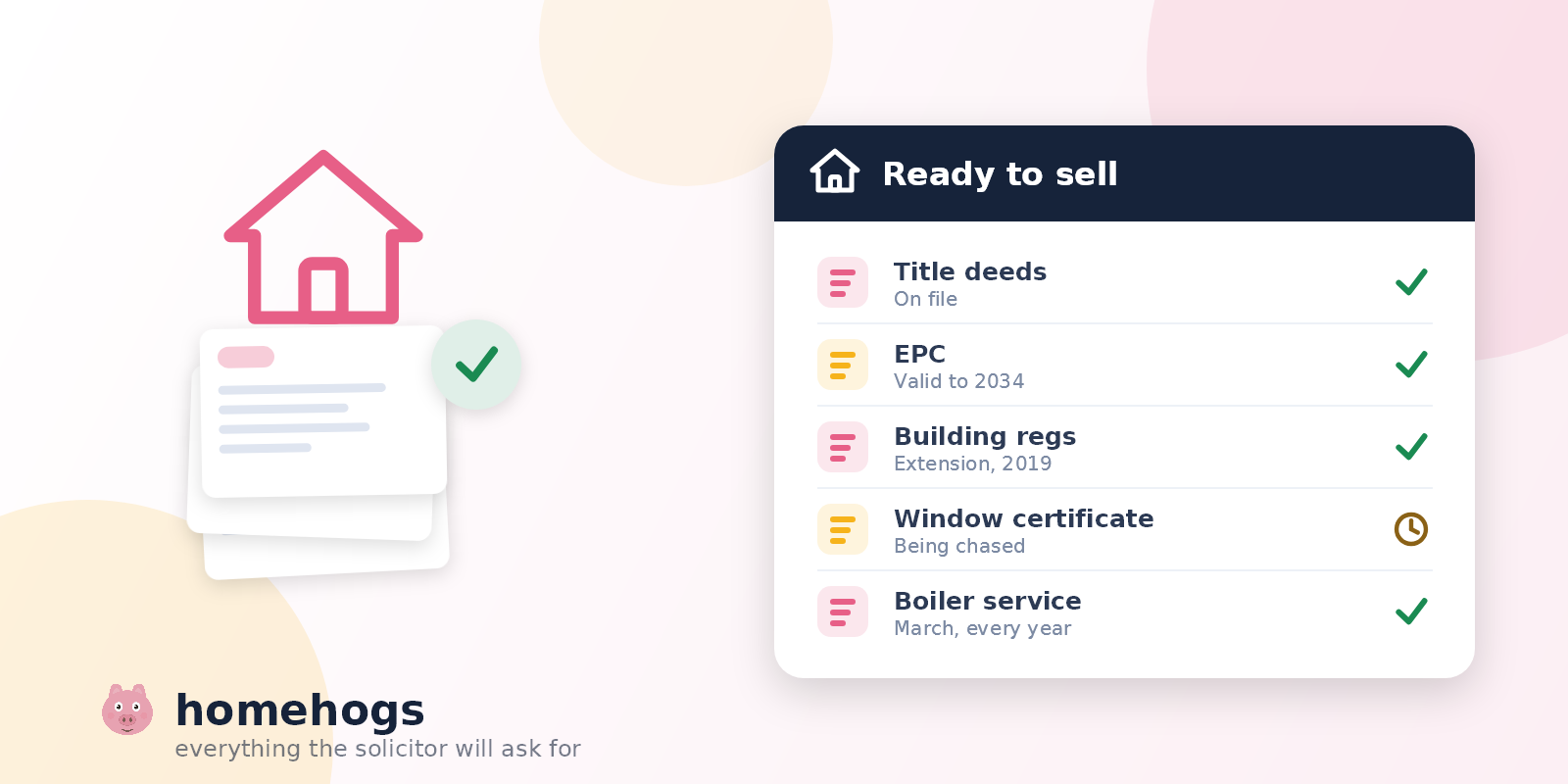
To sell a home in England or Wales you'll need your ID, the title, an EPC, the property information forms and the paperwork behind any work done to the house. Here's every document, where it comes from, what to do if it's missing and when you'll need it, with a 12-week plan to gather it all before you list.
To sell a house in England or Wales you'll need proof of who you are, the title to the property, an Energy Performance Certificate ordered before the home is marketed and the property information forms your conveyancer sends you: the TA6 and TA10, plus the TA7 if the home is leasehold. Then comes the paperwork behind any work done to the house, such as planning permission, building regulations sign-off and the certificates for new windows, boilers and electrics. Leasehold sellers also need a management pack from the managing agent.
Almost all of it can be found or replaced. The catch is timing. A missing window certificate is a ten-minute errand before you list. Once a buyer's solicitor is waiting for it, it's a fortnight of emails while the buyer wonders what else is missing.
Below is every document, grouped the way a sale uses them, with what it is, why it matters, where it comes from, what to do if it's missing and when you'll need it. This covers England and Wales, which share the same forms and land register. Scotland and Northern Ireland have their own section near the end.
The short version
- Every seller needs ID, the title, an EPC ordered before marketing and the TA6 and TA10 forms from their conveyancer
- Work done to the house needs its evidence: planning permission, a building regulations completion certificate or a competent person certificate such as FENSA
- Leasehold sellers also complete the TA7 and need a management pack from the managing agent, which can take weeks to arrive
- A copy of the title register costs £7 from HM Land Registry and a replacement FENSA certificate costs £30 online
- The TA6 6th edition, in use since 30 March 2026, no longer asks for the EPC: the estate agent deals with it at marketing
- Start gathering 12 weeks before you list, because replacing paperwork takes far longer than finding it
- In Scotland the seller provides a Home Report instead, which must be no more than 12 weeks old when the home goes on the market
The documents almost every seller needs
These apply to nearly every sale. Tick them off as you go.
Proof of identity and address
What it is: a passport or driving licence and something recent showing your address, or an online ID check.
Why it matters: under the money laundering rules estate agents must verify the seller, usually when the home goes on the market. Your conveyancer and any lender check you too.
If it's missing: renew an expired passport or licence early, because nobody can act for you until the check is done.
Needed: required, as you instruct the agent and the conveyancer.Title register and title plan
What it is: HM Land Registry's record of who owns the home, any mortgage, rights of way and covenants, with a plan of the general boundaries.
Why it matters: it proves you can sell and it's the starting point for the contract.
Where it comes from: HM Land Registry, £7 each to download. Your conveyancer will order official copies anyway.
If it's missing: nothing is lost, because the register is the record. If the home has never been registered, find the old paper deeds and tell your conveyancer at once.
Needed: required, at the start of conveyancing.Energy Performance Certificate (EPC)
What it is: the home's energy rating from A to G, valid for ten years.
Why it matters: you must order one before you market the home and buyers must be shown it.
Where it comes from: download a valid one free from Find an energy certificate, or book an accredited assessor. Which? puts the average cost at £65.
Needed: required, ordered before marketing. More in the energy section below.TA6 Property Information Form
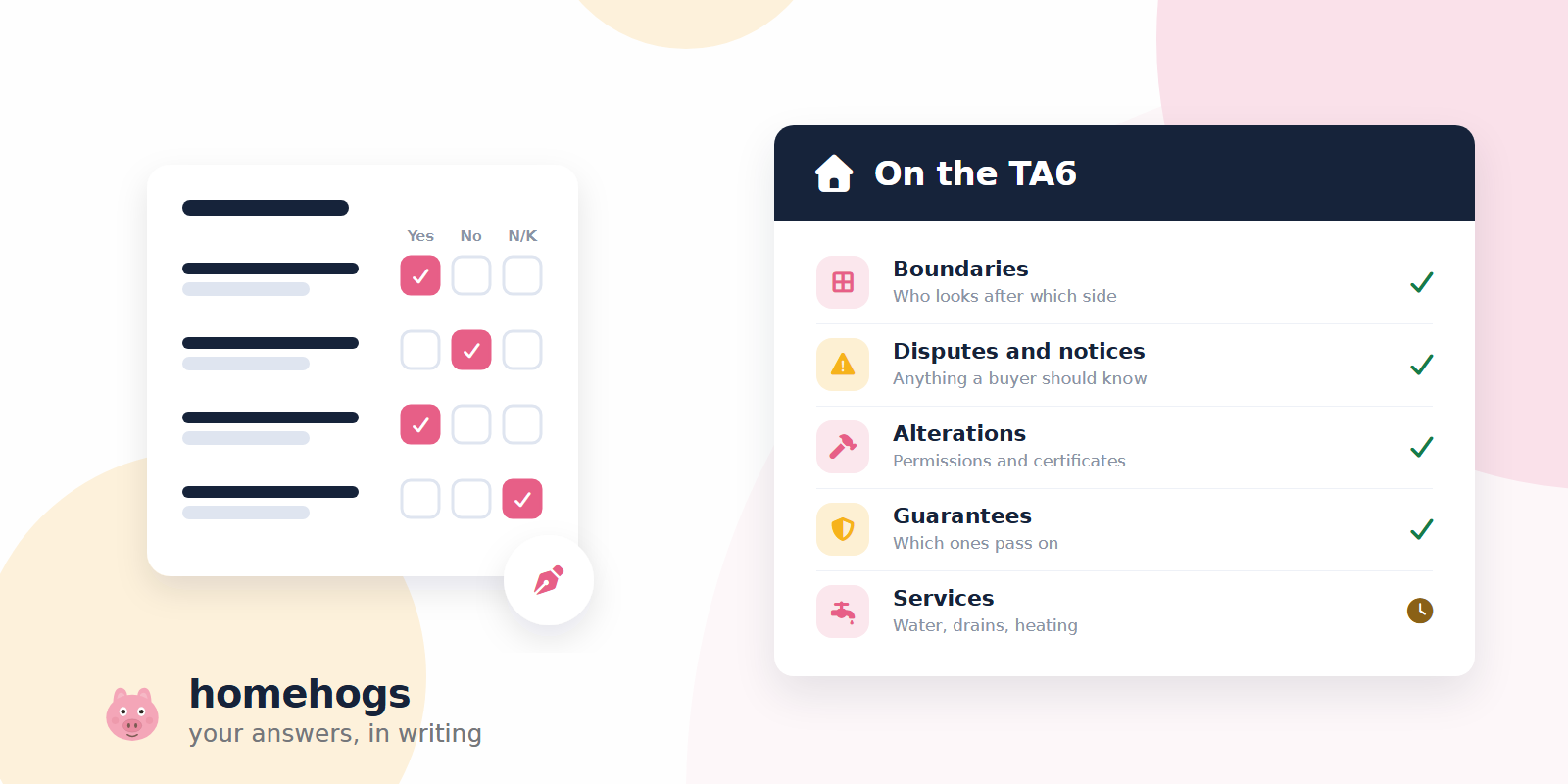
What it is: the Law Society's standard questionnaire about the home: boundaries, disputes, notices, alterations, guarantees, insurance, environmental matters, rights, parking, services and the move itself.
Why it matters: the buyer is entitled to rely on your answers. The 6th edition is required for Law Society Conveyancing Quality Scheme firms on sales instructed from 30 March 2026.
Where it comes from: your conveyancer. The forms aren't sold to the public, but the Law Society publishes explanatory notes for sellers.
What to have to hand: the documents in this article, plus recent utility bills for the supplier and meter details it asks about.
Needed: standard in almost every sale. It's designed for after an offer, but you can complete it before a buyer is found.TA10 Fittings and Contents Form
What it is: a room-by-room list of what's included in the price, what you're taking and what you'd sell separately, from curtain poles to the shed.
Why it matters: it becomes part of the deal, which heads off arguments on completion day.
Needed: standard in almost every sale, completed with the TA6. Decide before you list, because buyers ask at viewings.Mortgage details
What it is: your lender's name and the mortgage account number.
Why it matters: your conveyancer asks the lender for a redemption statement, the exact figure to clear the loan, which is paid from the sale money at completion. GOV.UK suggests checking what you owe and any early repayment charges before you sell.
Needed: required if any loan is secured on the home. The statement is ordered as completion approaches.
What your conveyancer prepares or orders
Some documents you never have to find yourself. Your conveyancer gathers them into the contract pack sent to the buyer's conveyancer once an offer is accepted, along with your forms and certificates.
| Document | What it is | Who gets it | When |
|---|---|---|---|
| Official copies of the title | The register and plan, plus any deeds filed with them | Your conveyancer, from HM Land Registry | Start of conveyancing |
| Draft contract | The legal terms of the sale | Your conveyancer drafts it | In the contract pack after an offer |
| Management pack (leasehold) | The managing agent's replies to the LPE1 enquiry form, with accounts, budgets and insurance | Your conveyancer requests it; you pay | As early as possible |
| Redemption statement | The exact amount to clear your mortgage on a given day | Your conveyancer, from your lender | Before exchange and completion |
| Searches | Local authority, water and drainage, environmental | Usually the buyer's conveyancer | After an offer |
| TA13 completion information | Paying off mortgages, handing over keys, vacant possession | Your conveyancer, for the buyer's | Shortly before completion |
| Completion statement | Money in, money out and what reaches your account | Your conveyancer | Before completion |
Today the buyer orders the searches. The government's June 2026 reform roadmap says it will legislate, when parliamentary time allows, to make sellers provide a sales pack, searches included, before a home is listed. That's announced policy, not the law.
Documents needed if they apply to your home
These are required if they apply, because the TA6 asks about every one of them and they go to the buyer with the contract pack. If one applies and you can't find it, tell your conveyancer early rather than leaving the answer blank.
| Document | When it applies | Where it comes from | If it's missing |
|---|---|---|---|
| Party wall notices or awards | Work on or near a shared wall or boundary | You, your neighbour or the surveyor who acted | Your conveyancer will advise |
| Boundary agreements or plans | A boundary was moved, agreed or disputed | Your records or your solicitor at the time | Describe what you know; GOV.UK explains property boundaries |
| Solar panel paperwork | Panels or a battery: MCS certificate, Feed-in Tariff or Smart Export Guarantee agreement, any roof lease | The installer and your energy supplier | MCS issues copies if the installer has gone |
| Septic tank or treatment plant records | The home isn't on mains drainage | The firm that empties or services it | Ask that firm for its records |
| Japanese knotweed survey or plan | Knotweed has been found or treated | The specialist firm | Ask the firm for a copy |
| Radon test results | The home has been tested | Your own records | Tell your conveyancer what you know |
| Green Deal plan | Improvements repaid through the electricity bill | Your electricity bill and the EPC | Ask your electricity supplier |
| Indemnity policies | Any taken out when you bought | Your purchase file | Ask the firm that acted for you |
| Tenancy paperwork | The home is let or being sold with a tenant | Your records or your letting agent | Talk to your conveyancer early |
| Probate or power of attorney | You're selling for somebody else | The court or the Office of the Public Guardian | Your conveyancer will need to see it |
Planning and building control
A buyer's conveyancer looks for evidence that anything built or changed was allowed and signed off. Planning permission and building regulations are separate systems and a project can need both: our guide to planning permission or building regulations explains which applies to what.
Planning permission decision notice
What it is: the council's written permission for an extension, a dormer or a change of use, with any conditions.
Where it comes from: your council's online planning register, searchable by address (find your local council). Where conditions applied, the conveyancer may ask for proof they were met.
If it's missing: the register usually holds it. If the work relied on permitted development, a lawful development certificate from the council is the formal proof, though it's optional.
Needed: required for any work that needed permission, in the contract pack.Building regulations completion certificate
What it is: confirmation from building control that work was inspected and complied, usually issued within 8 weeks of finishing. GOV.UK is blunt that without approval you won't have the certificates you may need when you sell.
Where it comes from: the council's building control team, or the registered approver who inspected (they tell the council about the work).
If it's missing: ask building control for a copy. If the work was never signed off, the council can consider retrospective approval, called regularisation, for work done after 11 November 1985. That may mean opening work up. The alternative is an indemnity policy. Your conveyancer will say which fits.
Needed: required for extensions, loft conversions, structural work and anything else that needed approval.Listed building, conservation area and tree consents
Required if the home is listed, in a conservation area or has protected trees, because the TA6 asks about all three. The Law Society's notes point out that enforcement for unauthorised work to a listed building has no time limit and can fall on a new owner. Ask the council's planning team for anything missing before you list.
Certificates and evidence for work on the property
Most everyday work is signed off by the tradesperson rather than a council inspector, through a competent person scheme. GOV.UK says the installer gives you a certificate within 8 weeks and that it shows up in solicitors' searches when you sell. Window certificates, building regulations sign-off and old guarantees are the three that go missing most often, usually because the work was done before you owned the house.
| Work done | What the buyer's conveyancer asks for | Where a copy comes from | If there's no record |
|---|---|---|---|
| Replacement windows or external doors | FENSA or Certass certificate | FENSA (£30 online, search by address) or Certass | Building control inspection or an indemnity policy |
| New boiler or other gas appliance (from 1 April 2005) | Gas Safe Building Regulations Compliance Certificate | The engineer, or Gas Safe Register | Building control or an indemnity policy |
| New circuits, a new consumer unit or work near a bath or shower (from 1 January 2005) | A completion certificate, the electrician's compliance certificate or an Electrical Installation Certificate | The electrician, their scheme or building control | An EICR shows the wiring's condition today, though it isn't sign-off |
| Solar panels, battery or heat pump | MCS certificate, plus typically a completion certificate for a heat pump | The installer first, then MCS for a fee | Ask your conveyancer |
| Cavity wall insulation | 25-year guarantee | CIGA for registered installers | Ask the installer |
| Knocked-through wall or other structural work | Completion certificate and the structural engineer's calculations | Building control and the engineer | Regularisation or an indemnity policy |
Two things a seller is often asked for but doesn't legally need for an ordinary sale: a gas safety record and an Electrical Installation Condition Report. Both are landlord duties, which a buyer purchasing with tenants in place will want to see. A dated run of boiler service records is always worth having. For the full picture of what proves what, see how to prove work was done on your home.
Guarantees and warranties
The TA6 asks about every guarantee and warranty on the home and whether any claims have been made. Copies go to the buyer with the contract pack. The originals pass to them at completion.
- Damp proofing, timber treatment and roofing. Check the length, whether it's insurance-backed (so it survives the firm closing) and whether it transfers to a new owner.
- Cavity wall insulation. Work by registered installers carries a 25-year CIGA guarantee.
- Windows and doors. FENSA says its certificate also means the installer's warranty is insured.
- Boiler and heat pump warranties. Manufacturers' warranties commonly depend on yearly servicing, so keep the service sheets with the warranty.
- Appliances you're leaving. Manuals and any remaining warranty, listed on the TA10.
Start with the pack from when you bought, then the firm that did the work. The Law Society's notes warn buyers that guarantees run for set periods, may depend on maintenance and may not transfer, so hand your conveyancer what you have and let them judge what it's worth.
Leasehold and new build documents
Leasehold flats and houses
- The lease. The contract setting out the term, ground rent, service charge and rules. From your purchase file, or HM Land Registry if a copy is filed with the title (£11 for an official copy of a document). Needed at the start of conveyancing.
- TA7 Leasehold Information Form. The Law Society's leasehold questionnaire, completed with the TA6. The 5th edition replaced older versions on 30 March 2026. It asks about how the building is managed, the charges, consents and any disputes, with a building safety section for blocks of flats only.
- Management pack. The managing agent's replies to the LPE1 enquiry form with service charge accounts and budgets, buildings insurance and any planned major works with their section 20 notices. A buyer's conveyancer will need it before their client can commit. Your conveyancer orders it and you pay. There's no legal cap on the fee: Foxtons puts it at £200 to £500 with a wait of up to six weeks. Order it the day you instruct your conveyancer.
- Service charge and ground rent records. Recent demands, receipts and correspondence about disputes or major works. Our guide to leasehold service charges explains the figures.
- Landlord's consent for alterations. If the lease required permission for changes you've made, the buyer's conveyancer will want the written consent, often called a licence for alterations.
- Leaseholder deed of certificate. If your landlord asks for one when you sell, it shows whether your lease qualifies for the Building Safety Act's protections against remediation costs. The landlord must give you at least 8 weeks and can't charge you to complete it. You can send one before you're asked.
Free leasehold advice comes from LEASE, the Leasehold Advisory Service.
New build and nearly new homes
If your home is under about ten years old, a buyer's conveyancer will expect its build paperwork:
- New home warranty certificate. NHBC's Buildmark gives two years of builder cover then eight years of insurance for structural defects. Premier Guarantee, LABC Warranty and Checkmate have their own terms. If the certificate is lost, ask the provider for a copy.
- Building regulations completion certificate for the build, from the council or the developer's approver.
- Gas and electrical installation certificates from the handover pack.
- Home user guide. Homes built to the 2021 standards in England should have one explaining the heating and ventilation (there's a government template).
- Estate management papers if a management company looks after roads or green space.
- Snagging or defects correspondence still open with the developer.
The TA6 isn't designed for buying a brand-new home from a developer: the Law Society's TA8 form asks the developer's questions instead.
Energy information
The EPC is the one energy document every seller needs.
- It lasts ten years. Check the register or our free EPC checker before paying for a new one. If you've added insulation, a new boiler or new glazing since the last one, a new certificate may rate the home better.
- It's no longer on the TA6. The 6th edition leaves the EPC to the estate agent at marketing, but you still must order it before the home is marketed.
- Have the evidence ready. Assessors can only credit what they can see or you can show, so put the paperwork for insulation, glazing and the boiler out for the visit.
- Reform is later than first planned. The government now expects redesigned EPCs in England and Wales in the second half of 2027. Existing certificates keep their ten-year validity.
Other energy paperwork to gather where it applies: solar and battery paperwork with any Feed-in Tariff or Smart Export Guarantee agreement, heat pump certificates and any Green Deal plan, which a buyer takes over through the electricity bill. Our guide to what your EPC actually tells you walks through each section of the certificate.
Start preparing 12 weeks before listing
There's no rule about when to start, but replacing a document can take weeks and a buyer's solicitor asks for everything at once. Twelve weeks before you list gives you room.
- 12 weeks out: find what you have. Open the pack from when you bought, search your email and check the loft. Make one folder, paper or digital, with a list of every piece of work done to the house.
- 11 weeks out: check the title. Download the register and plan for £7 each. Check the names, boundaries, rights and covenants. Note anything that looks wrong for your conveyancer.
- 10 weeks out: check the EPC. Look it up on the register and book an assessor if it's expired or missing.
- 9 weeks out: chase the certificates. Match each piece of work on your list to a planning decision, a completion certificate or a competent person certificate. Order replacements now.
- 8 weeks out: gather guarantees and service records. Damp, roofing, insulation, boiler and appliances, plus the boiler's service history.
- 7 weeks out (leasehold): ask the managing agent what the management pack costs and how long it takes. Find your lease and recent service charge demands.
- 6 weeks out: choose and instruct a conveyancer. Ask for the TA6, TA10 and TA7 straight away and, for a leasehold home, for the management pack to be ordered.
- 4 weeks out: fill in the forms. Answer from the documents in your folder rather than from memory. Say "not known" where that's the truth.
- 2 weeks out: deal with the gaps. Anything still missing goes to your conveyancer now, so they can plan for regularisation or an indemnity policy before a buyer asks.
- Listing day. EPC in hand, forms drafted and certificates in one place, ready to send the day an offer is accepted.
Our free sale-ready check asks the same questions in a few minutes and shows where your gaps are.
What to do if you cannot find something
Very little is genuinely unrecoverable. Work through it in this order.
- Your purchase pack. Whatever the previous owner handed over is usually the richest source. The firm that acted on your purchase may still hold the file, including the forms the last seller filled in.
- The issuer. HM Land Registry, the council's building control and planning teams, FENSA, Certass, Gas Safe Register, MCS and warranty providers keep records by address. Our guide to building your home's service history goes through who holds what.
- The contractor. A firm still trading can usually reissue a certificate or guarantee.
- Your conveyancer. Where a document is genuinely lost, they'll advise on retrospective approval, an indemnity policy or simply explaining the gap to the buyer.
An indemnity policy insures the buyer and their lender against the consequences of a specific defect, such as missing building regulations sign-off. It doesn't fix anything or replace the document. The one thing not to do is leave it and hope nobody asks: the TA6 asks.
Scotland, Northern Ireland and Wales
Scotland
Before a home goes on the market the seller must have a Home Report in three parts: a single survey with a valuation, a property questionnaire and an energy report that includes the EPC. Trading standards guidance says it must be no more than 12 weeks old when the home is put on the market. The seller pays for it, buyers can be charged only a reasonable amount for copying and postage and it must be provided within nine days of a request. The EPC must be displayed in the home, for example by the boiler. Scottish certificates sit on a separate register. The Law Society's TA forms aren't used, though your solicitor will still want the evidence for work done to the house.
Northern Ireland
An EPC is needed when a home is marketed for sale. The land register is held by Land and Property Services, where an uncertified copy of a folio or map costs £7. The process and forms differ from England and Wales, so ask a local solicitor what they need.
Wales
Wales uses the same forms and land register as England. Building regulations have differed since 2014 and planning is run by Welsh councils, so check the detail with your council.
What to keep after the sale
Selling hands most of your paperwork to the buyer, which is how it should be: certificates, guarantees, manuals and the boiler's service history belong with the house. Keep your own copies of these, plus:
- the TA6, TA10 and TA7 as you signed them, because questions about an answer can come up after completion
- the contract and the completion statement, which show the price and every cost
- the redemption statement showing the mortgage cleared
- if the home wasn't your main home for the whole time you owned it, your purchase and improvement costs: GOV.UK says Capital Gains Tax on most UK property sales must be reported and paid within 60 days
If you're buying next, this is the moment to start the new home's file, so the next sale is a matter of handing it over. That's the idea behind a digital property logbook. homehogs keeps each certificate, guarantee and receipt attached to the job or appliance it proves, shows what's still missing and turns it into a Sale-Ready Property Record PDF and a handover pack for the next owner.
Sources
- GOV.UK: Selling a home
- GOV.UK: Energy Performance Certificates when selling
- GOV.UK: Find an energy certificate
- GOV.UK: Search the land and property register
- GOV.UK: Get a copy of the deeds
- GOV.UK: Building regulations approval, how to apply
- GOV.UK: Use a competent person scheme
- GOV.UK: Estate and letting agency business guidance for money laundering supervision
- GOV.UK: Leaseholder deed of certificate FAQs
- GOV.UK: Home buying and selling reform roadmap
- GOV.UK: Tax when you sell your home
- The Law Society: TA6 Property information form (6th edition)
- The Law Society: TA6 explanatory notes for sellers and buyers
- The Law Society: Transaction (TA) forms
- FENSA: Find and order your FENSA certificate
- MCS: Certificate queries
- CIGA: Cavity Insulation Guarantee Agency
- NHBC: Buildmark cover
- mygov.scot: Home Report
- Business Companion: Home Reports and EPCs in Scotland
- nidirect: Energy Performance Certificates
- nidirect: Searching the land registry
- Which?: The cost of buying a house
Last fact-checked 5 October 2026.
Have it ready before anyone asks
homehogs keeps your certificates, guarantees and service records attached to the work they prove and shows what's still missing, so answering a solicitor's question takes minutes rather than a fortnight.
Start free