A receipt proves you paid somebody. It does not prove the work met building regulations or that the guarantee is still worth anything. This guide sets out what counts as evidence for each kind of job, where to replace a lost certificate and what to keep the day a job finishes.
Proving that work on your home was done properly takes more than a receipt. You need the paper trail from whoever checked it: the planning decision if there was one, the building regulations certificate or the installer's competent person certificate, plus any guarantee and your own record of what was done.
There is a moment in most house sales when somebody asks for proof of something that happened years ago. The boiler, the wiring, the windows, the wall that is not there any more. The honest answer is usually that the work was done by somebody competent and there is a receipt somewhere. A receipt proves a payment. It does not prove the work was inspected, met any standard or still carries a guarantee.
Most of that evidence is easy to collect on the day and harder to get every year afterwards. This guide covers what each document proves, where to get a lost one replaced and what to keep when a job finishes. It is written for England and Wales; Scotland and Northern Ireland run their own building control systems.
The short version
- An invoice proves you paid for a job; a completion certificate or a competent person certificate proves it met building regulations.
- Windows, boilers, electrics, solar panels and heat pumps are usually certified through the installer's own scheme, which should send a certificate within eight weeks.
- Lost certificates can often be replaced: FENSA charges £30, Gas Safe £8.40 and MCS £36.
- Gas Safe can currently supply copies only for work notified from 5 October 2011 onwards.
- A guarantee from a firm that has closed is usually worth little unless it was insurance-backed.
- Photographs taken before work is covered up are evidence nobody can reissue later.
- Where approval was never given, regularisation (for work since 11 November 1985) and indemnity insurance are the usual routes; they do very different jobs.
Planning and building regulations are not the same thing
Planning permission is about whether you were allowed to make the change: its size, appearance, use and effect on the neighbours. Building regulations are about whether it was built properly: structure, fire safety, insulation, ventilation, drainage and electrics. A great deal of work needs building regulations approval and no planning permission at all, so being told you did not need planning is not the same as being told you needed nothing.
They also leave different evidence. Planning leaves a decision notice and approved drawings, or nothing if the work was permitted development. Building regulations leave a certificate. A buyer's solicitor will ask about both. Planning permission or building regulations? has a project-by-project table of what common jobs need.
What counts as proof, strongest first
Not all paper proves the same thing. Roughly from strongest to weakest:
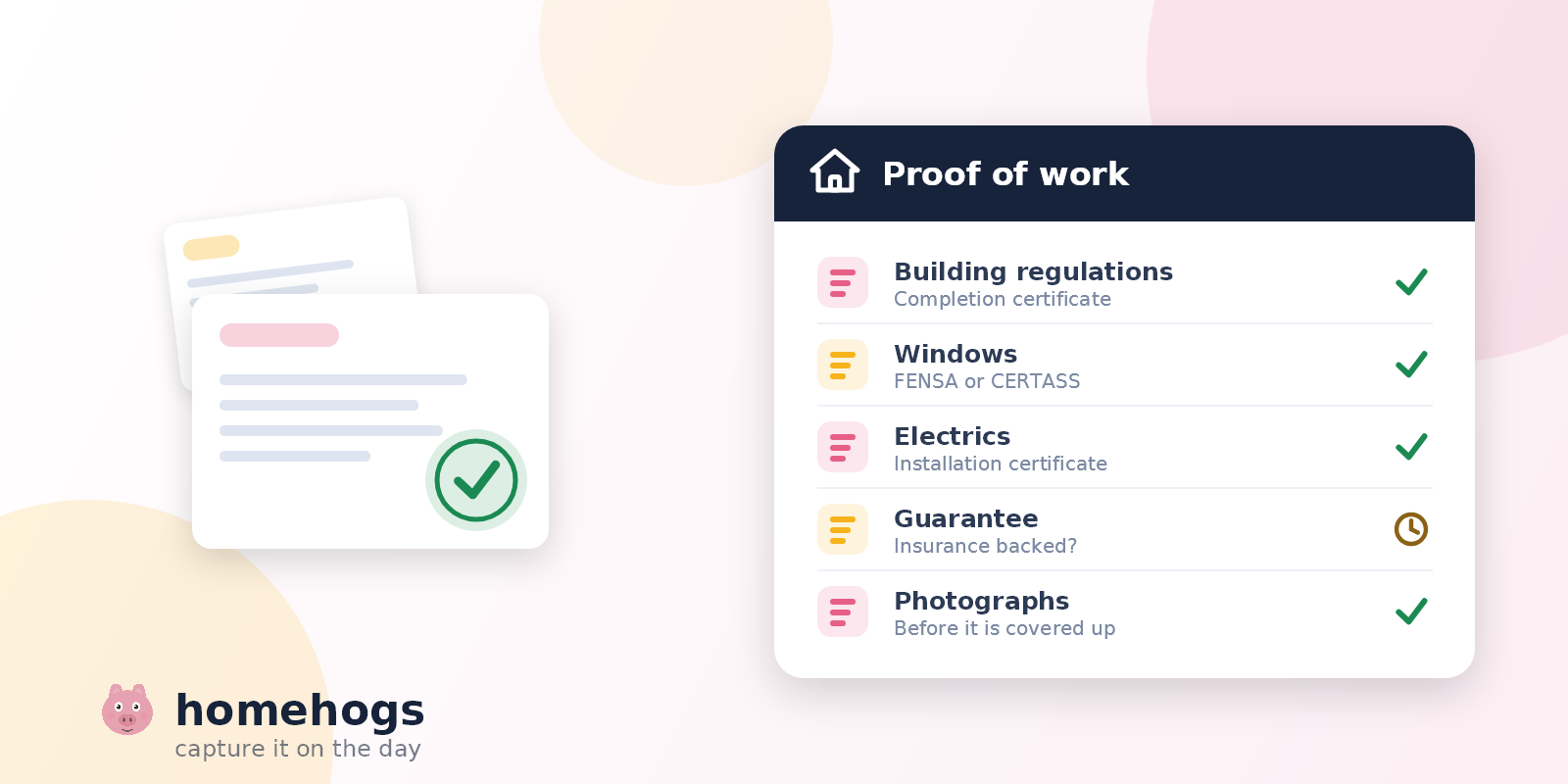
- A certificate from whoever checked the work. A building control completion certificate, a private approver's final certificate or a competent person scheme certificate says the work met building regulations. Nothing else on this list does.
- The planning decision and approved drawings. These prove the work was allowed, as long as what was built matches the drawings.
- A specialist's certificate. An Electrical Installation Certificate, the Benchmark checklist for a boiler or a structural engineer's calculations show the work was designed or tested by somebody qualified.
- A guarantee or warranty. It shows somebody stands behind the work, for as long as they exist or an insurer backs them.
- The quote, contract and invoice. They show what was agreed, what was charged and who did it. They do not show it was done well.
- Photographs and your own notes. Dated photos of work before it was covered up are the only record of what is inside the walls.
Most jobs need several of these together. A rewire with an invoice and no Electrical Installation Certificate is a question waiting to be asked.
Which certificate goes with which job
Most everyday work is signed off by the trade itself through a competent person scheme. The installer notifies the scheme, the council is told and you receive a certificate, normally within eight weeks. The certificate also shows up in a buyer's solicitor's searches. If nobody notified anybody, there is nothing to find later.
| Work | Proof to hold | Replacement from | Cost of a copy |
|---|---|---|---|
| Windows and doors (FENSA installer) | FENSA certificate | FENSA online search by address | £30 |
| Windows and doors (CERTASS installer) | Building Regulations Compliance Certificate | CERTASS replacements portal | Ask CERTASS |
| Gas boiler or other gas appliance | Gas Safe Building Regulations Compliance Certificate | Gas Safe online or 0800 408 5500 | £8.40, work from 5 October 2011 only |
| Notifiable electrical work | Electrical Installation Certificate plus a compliance certificate | The electrician; Check My Notification (NICEIC, ELECSA) or NAPIT | Not published |
| Solar panels or heat pump | MCS certificate | The installer, then MCS | £36 from MCS |
| Wood or multi-fuel stove | HETAS Certificate of Compliance | HETAS online | £36 |
| Oil boiler or tank | OFTEC certificate | OFTEC online | £40 plus VAT |
| Extension, loft or structural work | Completion or final certificate | The council or approver that inspected it | Varies |
| Work that needed planning permission | Decision notice and approved plans | The council's planning register | Free to view online, where held |
| Unapproved work since 11 November 1985 | Regularisation certificate | Apply to the council's building control | Council fee |
A few details that catch people out:
- Gas. The engineer must notify Gas Safe within 30 days; the certificate then arrives by post in 10 to 15 working days. Because of Gas Safe's data retention policy, copies are not available for work before 5 October 2011. The certificate belongs to the property, so a buyer can ask the seller for it.
- Electrics. The electrician gives you an Electrical Installation Certificate, or a Minor Works certificate for a small addition to an existing circuit. Their scheme sends the compliance certificate, usually within 30 days. Check My Notification warns it may not hold notifications more than six years old. For NAPIT, wait a further week past the 30 days and then call 0345 543 0330. Electrical work only came under building regulations on 1 January 2005, so older work never had a compliance certificate.
- Solar and heat pumps. MCS issues a copy only if the installer has stopped trading or is no longer certified. It goes to the current owner, with proof of address, within 10 working days of payment.
- Council records. Councils search by address and usually email a copy for a fee. Some will also write a letter confirming what their records show when the certificate itself cannot be found.
Quotes, contracts and invoices
These are the weakest evidence of quality and the best evidence of who did what. Keep all three, because together they show what was agreed against what was charged, which is not always the same thing.
A useful invoice shows:
- the business's trading name, address and company number if it has one
- any scheme registration number (Gas Safe, FENSA, NICEIC and so on) and VAT number
- the date the work finished and the address where it was done
- a description of the work and the make and model of anything fitted
- the price, with what it includes
Under the Consumer Rights Act 2015 a trader must carry out a service with reasonable care and skill. What they said or wrote about the work can become part of the contract, which is one more reason to keep the quote and the emails. Keep proof of payment with them. How to check a tradesperson covers contracts, deposits and paying by card.
Warranties, guarantees and manuals
- Manufacturer's guarantee. Many boiler and appliance guarantees depend on registering within a set time and, for boilers, on servicing. Worcester Bosch and Vaillant both ask for registration within 30 days and an annual service recorded in the service record or Benchmark logbook; Vaillant's guarantee reverts to 12 months if the registration is missed. Keep the registration confirmation and every service record.
- Benchmark checklist. For a new boiler, the installer completes the Benchmark commissioning checklist. The householder signs it. The engineer fills in the service record after each service. Both usually live in the manual, which is a good reason to keep it.
- Workmanship guarantee. The installer's promise to put their own work right. On its own, it ends when the firm does.
- Insurance-backed guarantee. An insurer stands behind the workmanship guarantee if the firm stops trading. Keep the policy document with the guarantee itself.
- Manuals and labels. Note the model and serial number of anything fitted. Register appliances with the manufacturer or through Register My Appliance, run by the manufacturers' association AMDEA, so you hear about safety recalls. Our free appliance recall checker searches the GOV.UK product recall register.
What to capture while the work is happening
This is the part that costs nothing and is worth the most, because some of it can never be recreated.
Before
- Photos of the area as it is, including any damage the job is meant to fix. If there is a dispute later, this is the only record of the starting point.
- The firm's full details: trading name, address, company number, scheme registration numbers and the name of the person doing the work. A number in your call history will not find a firm in five years.
- The quote and the written contract.
During
- Photographs of anything about to be hidden: pipe and cable runs before walls are closed, insulation before plasterboard, foundations and drains before they are filled, steels before they are boxed in. Note the room and the wall.
- Any change agreed along the way, in writing, with its price.
- Building control inspection dates, if the council or an approver is involved.
After
- The finished work, plus the labels on anything fitted: the boiler's data plate, the consumer unit, the heat pump.
- The date the work actually finished, which matters for guarantees and time limits.
- Each certificate the moment it arrives. They come by post or email weeks later, when the job feels over. That makes them the most commonly lost item of all.
Job finished: what should I keep?
Run through this the day the builders leave, or the week after:
- What was done. A sentence or two in plain words, with the date the work finished.
- Who did it. Business name, address, company number and scheme registration number; the engineer's name.
- The paper trail. Quote, contract, invoice and proof of payment.
- Approval. The planning decision and drawings if needed; the building regulations completion, final or competent person certificate. If it has not arrived within eight weeks, chase it now rather than at a sale.
- Specialist certificates. Electrical Installation or Minor Works certificate, Gas Safe certificate, Benchmark checklist, MCS, HETAS or OFTEC certificate, engineer's calculations.
- Cover. The guarantee, any insurance-backing policy and the manufacturer's warranty registration.
- Manuals. With model and serial numbers noted.
- Photographs. Before, during and after.
- Next dates. When the first service is due, when the guarantee ends and any condition attached to it.
homehogs keeps all of that against the job itself, with reminders before a service or a guarantee falls due, so the evidence is filed on the day rather than hunted for later.
If the paperwork does not exist
Sometimes the work was done by a previous owner who left nothing behind. There are still options, roughly in this order.
- Ask the issuer. The schemes and councils in the table above search by address. A surprising amount comes back this way. Building your home's service history goes through each record and who holds it.
- Ask building control. Where the council inspected the work but the certificate is lost, it can usually issue a copy or confirm what its records show.
- Regularisation. Where work needed building regulations approval and never got it, the council can inspect it and issue a regularisation certificate, for work carried out on or after 11 November 1985. Parts may have to be opened up, tested or sampled. The certificate is evidence of compliance, though not conclusive evidence. It costs more than approval at the time would have.
- Indemnity insurance. On a sale, the seller's conveyancer may arrange a one-off policy that covers the buyer and their lender against the cost of enforcement action over the missing approval. It does not make the work compliant or check that it is safe. Most policies are void if anybody has already contacted the council about the issue, which is why conveyancers want to be asked before anybody does.
- A Lawful Development Certificate. For planning rather than building regulations, the council can confirm that existing work is lawful, for example because the time for enforcement has passed.
Which route suits a particular job depends on what it is, when it was done and whether there is any doubt about safety. That is a conversation for your conveyancer. Have it early, not the week a buyer's solicitor asks. If the worry is safety, have the work checked by a qualified professional regardless.
Why this is the whole point of a logbook
Everything above has the same shape. The evidence is cheapest the day it is created and costs more every year after, until some of it cannot be had at all. A photograph of an open floor is the clearest example.
It also changes what you can say later. "The wiring was done in 2021" is a claim. The Electrical Installation Certificate, the electrician's registration number and a photograph of the consumer unit are evidence. That is the case for a digital property logbook, put as plainly as it can be. Our home logbook guide explains what one holds.
Sources
- GOV.UK: Use a competent person scheme
- GOV.UK: Competent person schemes, current schemes
- GOV.UK: Building regulations approval, how to apply
- FENSA: Get a FENSA certificate
- CERTASS: Replacement certificates
- Gas Safe Register: Building Regulations Compliance Certificate
- Gas Safe Register: Order a replacement certificate
- Check My Notification (NICEIC and ELECSA)
- NAPIT: Advice for households
- Electrical Safety First: What is Part P?
- Welsh Government: Building regulations, electrics
- MCS: Certificate queries
- HETAS: Certificates of compliance
- OFTEC: Order certificates
- West Northamptonshire Council: Completion certificates and proof of works (an example council service)
- legislation.gov.uk: Building Regulations 2010, regulation 18 (regularisation)
- legislation.gov.uk: Consumer Rights Act 2015, Part 1, Chapter 4
- Planning Portal: Lawful Development Certificates
- Benchmark: What is Benchmark?
- Worcester Bosch: Guarantee terms and conditions
- Vaillant: Domestic boiler guarantee
- TrustMark
- Register My Appliance (AMDEA)
Last fact-checked 5 October 2026.
Capture it while it is still capturable
homehogs keeps the certificate, the photographs and the invoice against the job itself, so the evidence is filed on the day rather than hunted for years later.
Start free