The boxes can wait. There is a short list of jobs that take minutes on the day you get the keys and turn into a small research project six months later. Almost none of them cost anything at all, which is the best argument for doing them now.
The day you get the keys you will want to do exactly one thing, which is work out where the kettle is.
Fair enough. But there is a short list of jobs that are trivial in an empty house on day one and genuinely annoying later, once the furniture is in, the previous owner has stopped answering the agent and nobody can remember what the meter said when you arrived.
None of this is about unpacking faster. It is about the handful of things that only get harder.
The short version
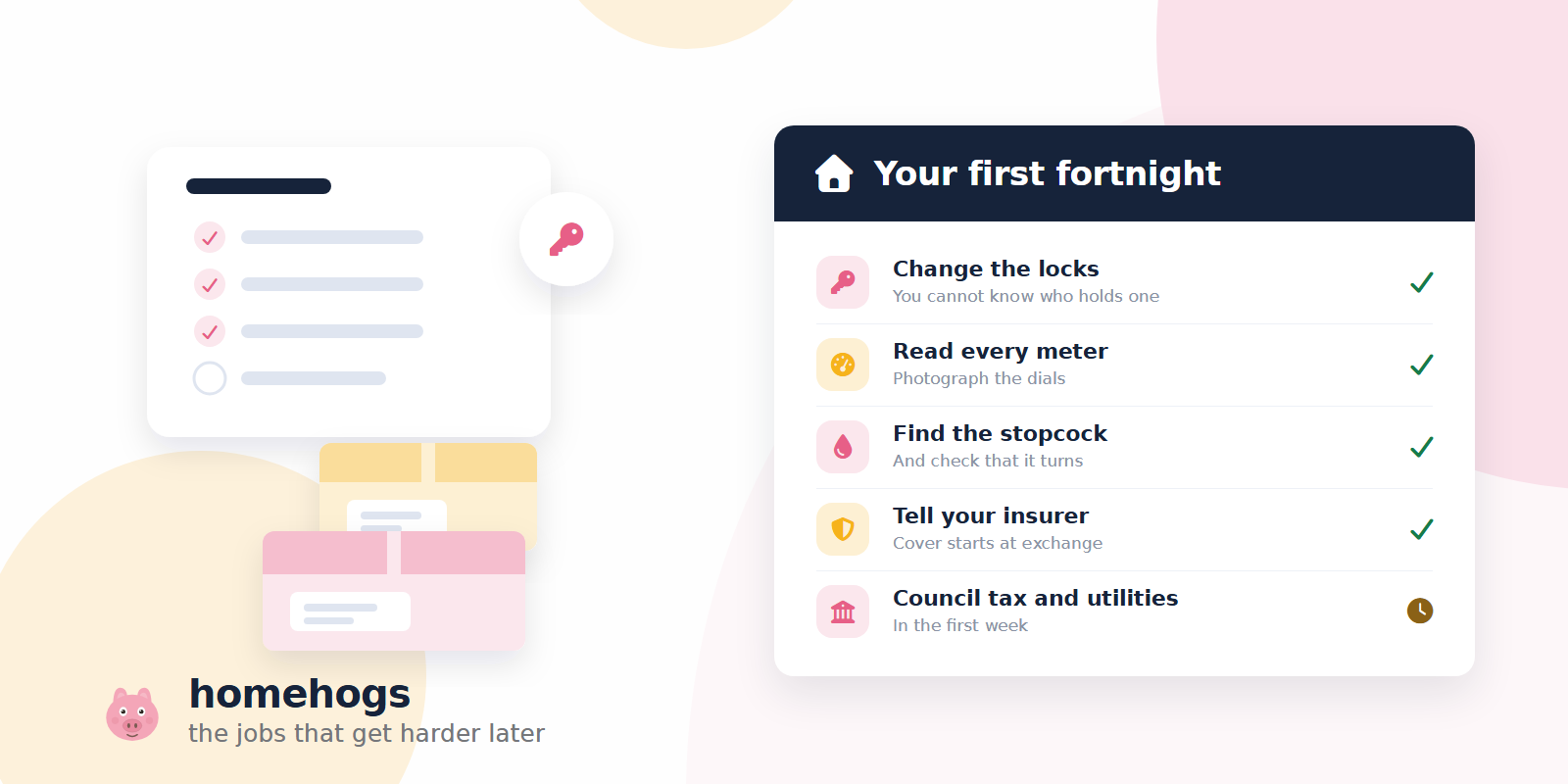
- Read and photograph every meter on the day you arrive, with the serial number in shot
- Change the locks, because you cannot know how many keys exist
- Find the stopcock and check it actually turns before you need it in a hurry
- Your buildings insurance normally has to start at exchange, not completion
- Council tax, water and energy want telling in the first week, with the date you moved
- Photograph the empty rooms and everything with a serial number on it, while you still can
Day one: the readings
Do this before the removal van is unloaded, because it takes four minutes and it is the only version of this evidence you will ever get.
Find the electricity meter, the gas meter and, if there is one, the water meter. Photograph each of them so that the dial and the serial number are both in the picture, then note the date and time.
That photograph is what settles an argument later. Opening bills from a new supplier are very often estimated. An estimate built from the previous occupant's habits can be hundreds of pounds out in either direction. Sending a dated picture of the meter on the day you took over ends the discussion in one email.
While you are there, note which meter is which if there is more than one, then check whether there is a prepayment meter, an Economy 7 meter with two registers, or a second meter for a converted flat. If the numbers on the bill never seem to match the dial, how to read your energy bill goes through what each register is doing.
Day one: the locks
Think about who has held a key to this house.
The sellers. Their grown-up children. The neighbour who fed the cat. The cleaner. The estate agent and whoever the estate agent lent it to for a viewing. The builder who did the bathroom in 2019. If the house was let at any point, an agent and a series of tenants.
Nobody in that list is a criminal. The point is that the number is unknowable and the sellers cannot tell you either, because they do not know how many copies were cut in twenty years.
Changing a euro cylinder on a uPVC door is a cheap part and a screwdriver. A mortice lock on a wooden door is a locksmith and still not expensive. Do the front and back door at least.
The same logic applies to anything else with a code: the burglar alarm, a key safe, a garage door remote, an electric gate. Change what you can and find out from the sellers how to change what you cannot.
Day one: four things to find
Walk round and locate these before you need them.
The stopcock, which turns the water off. Usually under the kitchen sink, sometimes in a downstairs loo or a utility. Turn it gently, then turn it back. A stopcock that has not moved since 1998 is often seized. The moment you discover that should not be the moment a pipe has burst. If it will not move, get it replaced now while it is a scheduled job.
The consumer unit, the box with the breakers in it. Work out which switch does what and write it on a label, because the version already written on it is usually wrong and always faded.
The gas emergency control valve, next to the gas meter, which is the handle that turns the gas off.
The external stop valve, usually a small metal cover in the pavement or the front path, which is the water company's tap for the property. Worth knowing where it is even though you will rarely touch it.
If you find yourself unable to locate any of these, that is itself worth knowing on day one rather than on a wet Tuesday in February.
Week one: the admin
Not glamorous, all quick. Every one of them is worse if left.
Council tax. Tell the council the date you moved in. They will set up the account and bill you from the right day. If you are the only adult in the property, claim the single person discount, which is 25% and is not applied automatically.
Water. Contact the water company with your reading. You cannot switch supplier, so this is purely about getting the account in your name from the right date.
Energy. You are automatically on the previous occupier's supplier under a deemed contract, which is usually not a good rate. Give them the opening reading, set up the account, then look at switching once the account exists rather than before.
Broadband. Book it early. It is the one with a lead time, because engineer appointments are often weeks out.
Post. A Royal Mail redirection from the old address, plus a direct word to the people who matter.
Electoral roll and the driving licence. Both quick online, both easy to forget for a year.
One thing you do not need to do: registering the change of ownership at the Land Registry is your conveyancer's job. It is worth checking a few months later that the title actually shows your name, because it occasionally does not.
Week two: record it while it is empty
An empty house is the easiest it will ever be to document and you will never see it this way again.
Photograph every room empty, including the ceilings and the floors. This is your before and it settles any argument about what was already damaged.
Photograph the data plates. The boiler has one, usually behind the front panel, giving the make, model and serial number. So do the consumer unit, the meters, the shower, the oven and the hob. Twenty minutes with a phone turns a house full of anonymous equipment into a list you can actually work with.
Find the documents that already exist. The EPC is free on the public register. The searches, the survey you paid for and the seller's property information form are in your conveyancer's file, which they will usually copy for you at little or no cost. It is by far the biggest single haul of paperwork available to you.
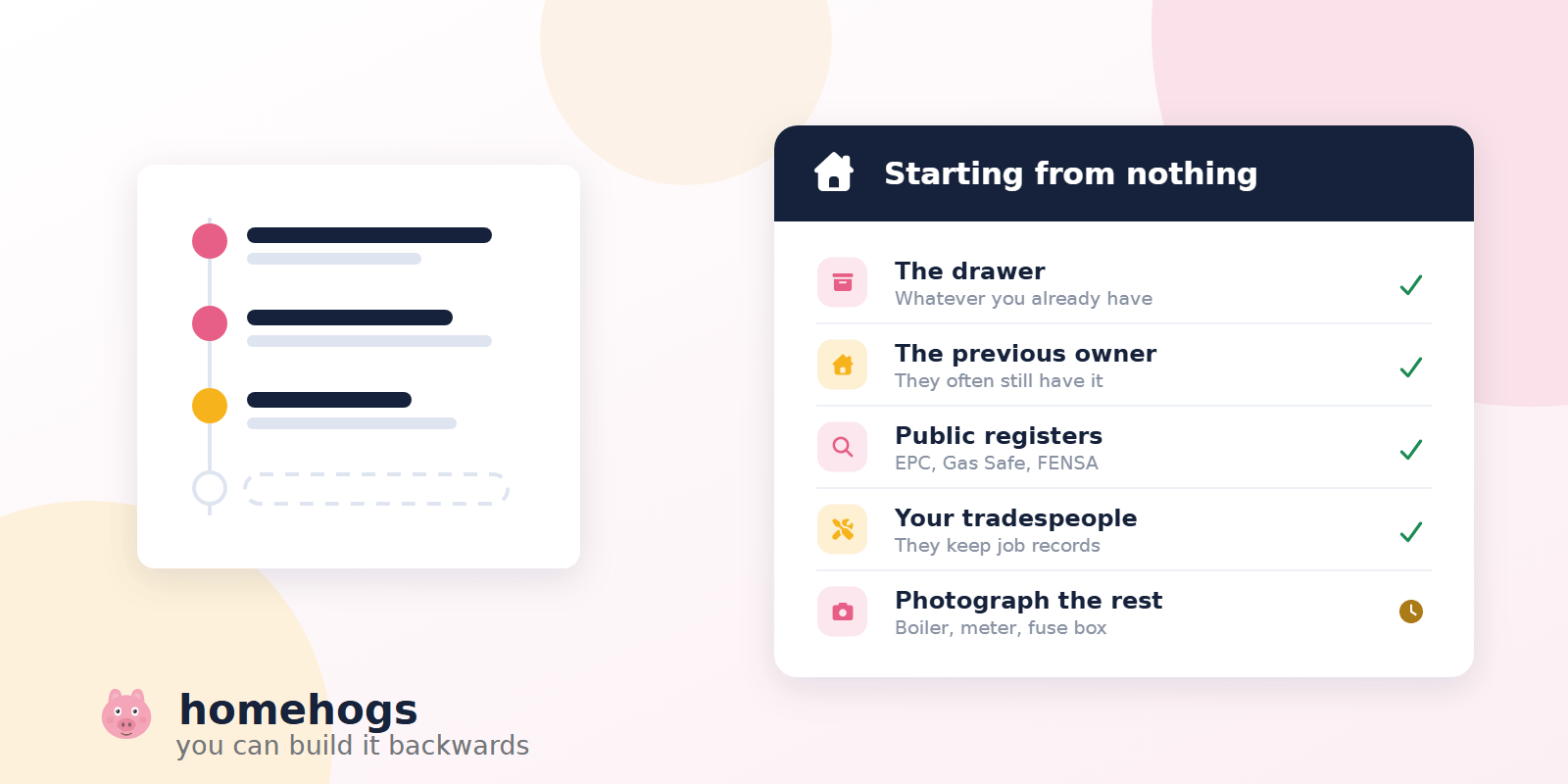
If the previous owner left nothing at all, that is a normal starting point rather than a disaster: how to build your home's service history from scratch walks through the registers you can search yourself.
Why any of this matters
Because you are going to sell this house.
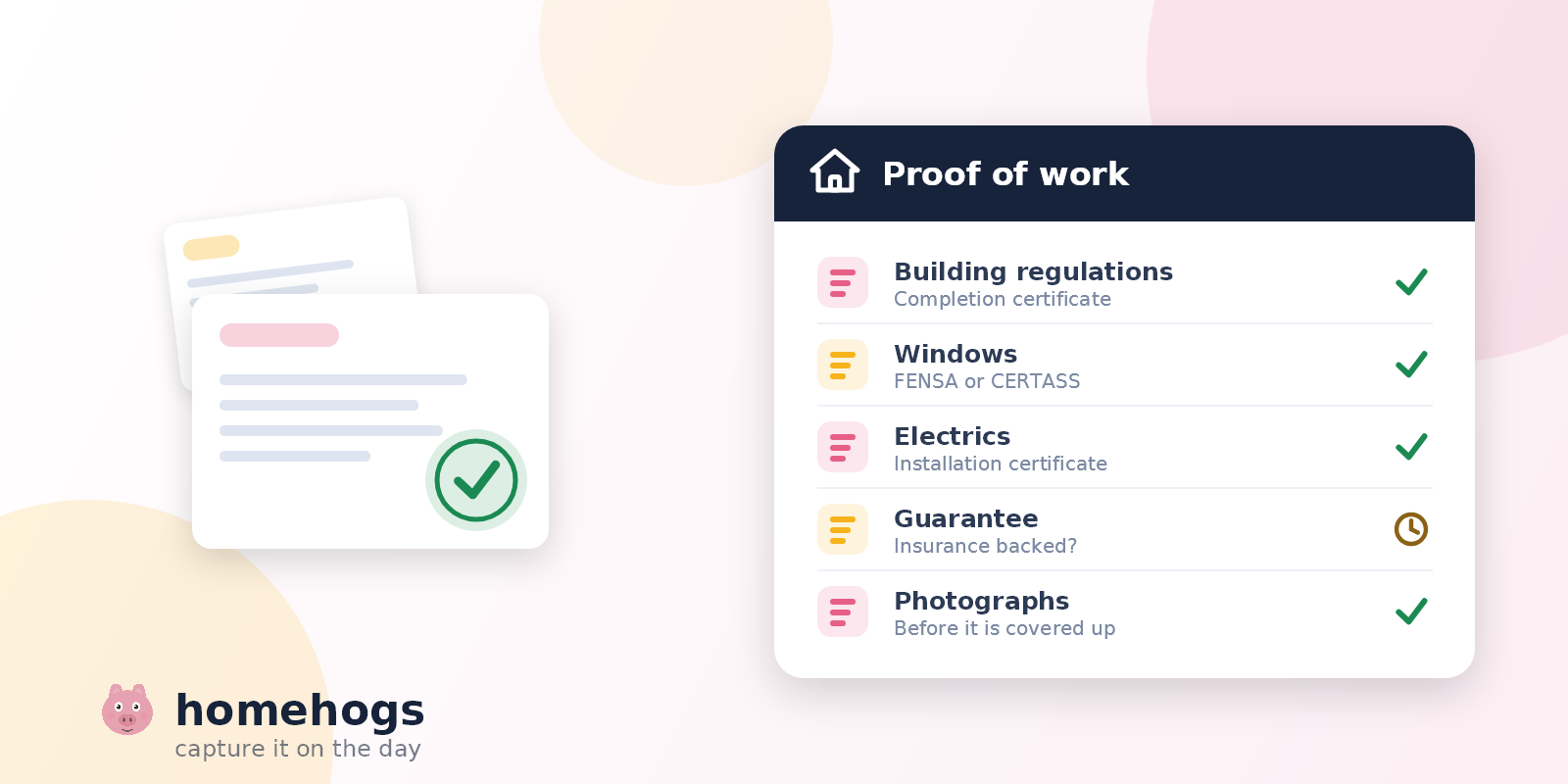
Maybe not soon. But when you do, somebody's solicitor will ask whether the boiler has been serviced, whether the electrics have been checked, whether the extension had building regulations approval and what the meter said when you took over. Every one of those questions is trivial if the answer was recorded at the time and a small archaeological dig if it was not.
The unglamorous truth is that the most valuable thing you can do in your first fortnight is write things down. The boxes will get unpacked either way.
Start the record on day one
homehogs gives your home a place to keep the readings, the photographs and the paperwork from the moment you get the keys, so the record starts full rather than empty.
Join the waiting list