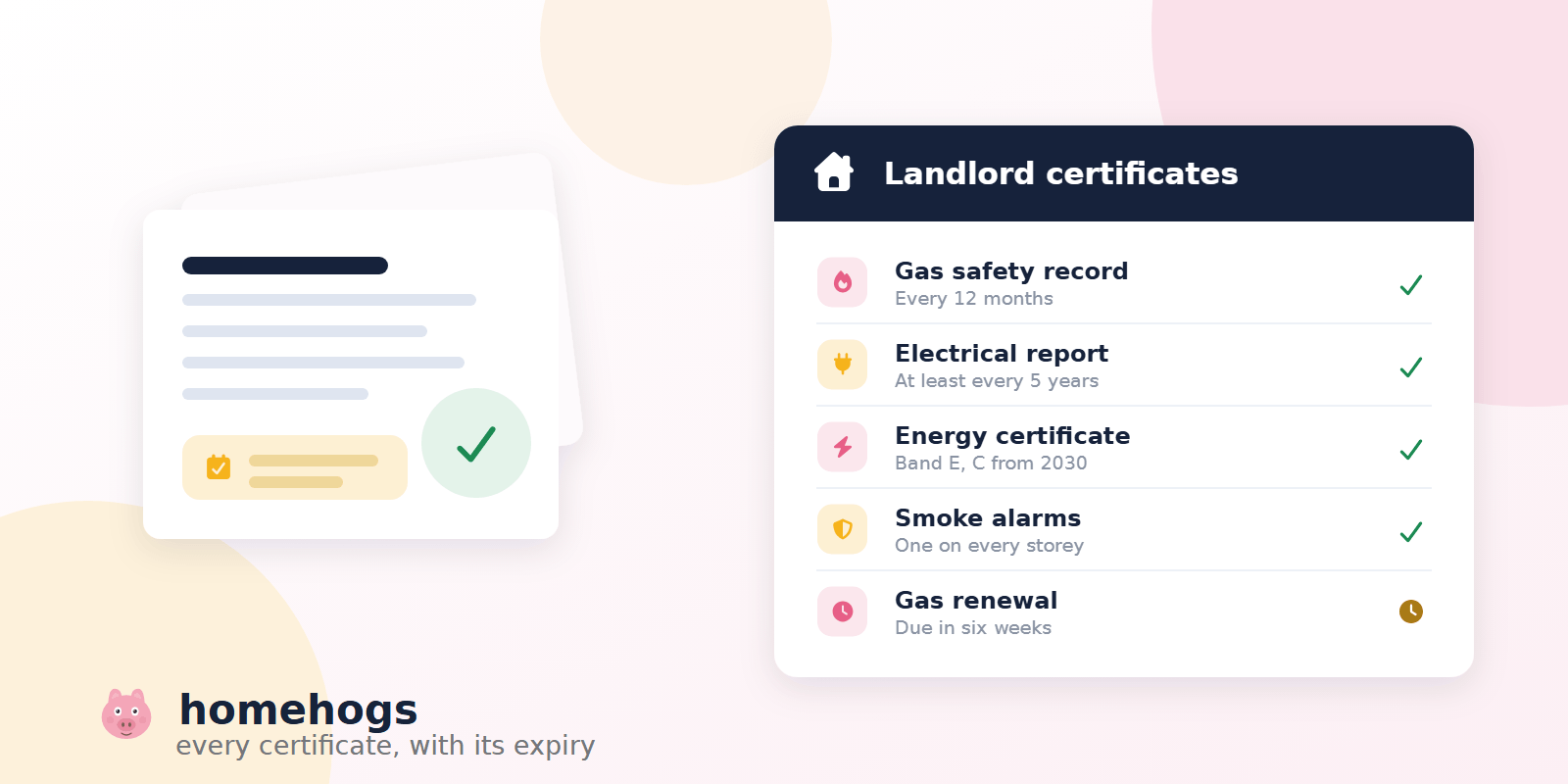
Each record runs on its own clock: a gas check every year, an electrical report at least every five, an EPC every ten and alarms checked on the first day of every tenancy. Here's each one as a calendar entry, with who may do it, when the tenant gets a copy and what to keep, for England first and then Wales and Scotland.
A landlord in England needs a gas safety record renewed at least every 12 months, an electrical installation condition report (EICR) at least every five years, a valid EPC rated E or better and smoke and carbon monoxide alarms checked on the first day of every tenancy, plus a licence where the council requires one. Tenants are entitled to copies of the gas record, the EICR and the EPC, on deadlines set in law.
Nobody fails at this because they didn't know a gas check was a thing. They fail because the check happened, the certificate went into an email in March 2024 and nothing reminded anybody that it ran out. Out of date counts the same as never done.
So below is each requirement as a calendar entry: how often, who may do it, when the tenant gets a copy, what to keep and the official source. Then a landlord's year, month by month. This page covers England; Wales and Scotland differ in places, set out in a table near the end.
The short version
- Gas: every appliance and flue you provide is checked at least every 12 months by a Gas Safe registered engineer; a check up to two months early keeps the same anniversary date.
- Electrics: an EICR at least every five years, or sooner if the report says so, with any urgent remedial work done within 28 days.
- EPC: valid for ten years and rated E or better to let; band C by 1 October 2030 has been announced but isn't law yet.
- Alarms: a smoke alarm on every storey with living accommodation and a carbon monoxide alarm by most fixed combustion appliances, checked on the day each tenancy begins.
- A new tenant gets the gas record and the EICR before moving in; an existing tenant gets each new one within 28 days.
- There's no such thing as a legionella certificate: the duty is to assess the risk.
Gas: a record every twelve months
| Gas safety record | What the law says |
|---|---|
| How often | Within 12 months of installation, then at least every 12 months |
| Who may do it | A Gas Safe registered engineer |
| Tenant's copy | Existing tenants within 28 days of the check; new tenants before they move in |
| What to keep | Each record for at least two years and until two later checks have been done |
| If it lapses | A criminal offence that HSE can prosecute |
| Official source | Gas Safety (Installation and Use) Regulations 1998, regulation 36 |
Every gas appliance and flue you provide has to be checked. What you get back is a gas safety record, still widely called a CP12. Three things are worth knowing.
- Check the engineer's registration. The Gas Safe Register lets you look an engineer up by their licence number. Their card lists the work they're qualified for: registered for cookers isn't the same as registered for boilers.
- Renew early without losing time. A check done in the two months before the deadline counts as done on the deadline date, so the record keeps its anniversary. Booking in January for a March deadline costs nothing. That rule is regulation 36A.
- If a tenant won't let the engineer in, keep trying and keep notes. HSE looks for at least three documented attempts.
Appliances a tenant brings with them aren't covered by your check. A gas safety check isn't a full boiler service either, though many landlords book both in one visit; what a boiler service includes explains the difference.
Electrics: a report at least every five years
| Electrical installation condition report (EICR) | What the law says |
|---|---|
| How often | At least every five years, or sooner if the report says so |
| Who may do it | A qualified, competent person, usually a member of a competent person scheme |
| Tenant's copy | Existing tenants within 28 days; new tenants before they move in; prospective tenants within 28 days of asking in writing; the council within 7 days of asking |
| What to keep | The report until the next inspection is due or done, whichever is later, with confirmation of any remedial work |
| If it lapses | A council penalty of up to £40,000 |
| Official source | Electrical safety standards guidance |
Since 1 April 2021 every private tenancy in England has needed an EICR on the fixed wiring: the consumer unit, the circuits, the sockets and the switches. Not the appliances and not the tenant's extension leads. Private landlords in England have no legal duty to have the appliances they supply PAT tested, though some choose to.
Five years is the maximum, not the default. If the inspector writes a shorter interval on the report, that's your date. The report grades what it finds:
- C1: danger present, risk of injury
- C2: potentially dangerous
- FI: further investigation needed without delay
- C3: improvement recommended
A C1, C2 or FI means the work must be done within 28 days, or sooner if the report says so. Then, within 28 days of the work being finished, you send the tenant and the council written confirmation from the electrician that it's done, whether or not the council has asked. A C3 is only a recommendation and doesn't make the report unsatisfactory, though it usually tells you what the next inspection will grumble about. The duty is in regulation 3 of the 2020 regulations.
The EPC and the band that changes in 2030
| Energy Performance Certificate (EPC) | What the law says |
|---|---|
| How often | Valid for ten years; needed when you market the home to let or sell |
| Who may do it | An accredited domestic energy assessor |
| Tenant's copy | Free to prospective tenants as early as possible, at the latest at the first viewing or written details |
| What to keep | The current certificate and any exemption you've registered |
| If it lapses | A £200 penalty charge for not providing one; letting below E without an exemption can cost up to £5,000 |
| Official source | GOV.UK minimum energy efficiency standard guidance |
Today a rented home in England or Wales must be rated E or better unless you've registered an exemption on the PRS Exemptions Register. You needn't spend more than £3,500 including VAT to get there. Most exemptions last five years, so they need diarising like a certificate.
The bigger change is announced but not yet law. In January 2026 the government confirmed that privately rented homes in England and Wales should reach the equivalent of band C by 1 October 2030, one date for every tenancy, with a cost cap of £10,000 per property (the government's response). It still needs new powers from Parliament and then regulations, which the government aims to have in force in 2027. A home rated C or above on a certificate lodged before 1 October 2029 counts as meeting it until that certificate expires or is replaced.
Under the current rules a new EPC is needed when you next market the home rather than on the day the old one runs out, though the government is considering requiring renewal on expiry for rented homes. Redesigned certificates are expected in the second half of 2027 and will still last ten years.
The useful thing to do now is read the recommendations on the certificate you have: what your EPC actually tells you walks through them and our free EPC checker finds the certificate on the register.
Alarms are a duty with no certificate
| Alarms | Smoke | Carbon monoxide |
|---|---|---|
| Where | Every storey with a room used as living accommodation, bathrooms and toilets included | Any room used as living accommodation with a fixed combustion appliance other than a gas cooker |
| How often | Checked working on the day each new tenancy begins | The same |
| Who may do it | You or your agent; no qualification needed | The same |
| Type | Battery or mains; interlinking not required in England | Battery or mains |
| If one fails | Repair or replace as soon as reasonably practicable once told | The same |
| If you don't comply | A remedial notice, then a penalty of up to £5,000 per breach | The same |
| Official source | The 2015 regulations | The government's Q&A booklet |
Since 1 October 2022 the carbon monoxide rule has covered gas boilers and gas fires as well as wood burners; only gas cookers are left out.
Nothing issues a certificate, nothing has an expiry date and nothing lands in your inbox, which is why this is the duty people struggle to prove. The government's booklet suggests testing the alarms as you go through the inventory on the first day and asking the tenant to sign the inventory to record it. A renewal of the same tenancy isn't a new tenancy for this purpose, though testing anyway costs nothing.
Licensing: HMO and selective licences
| Property licence | What the law says |
|---|---|
| Who needs one | Every HMO with five or more people in more than one household sharing a toilet, bathroom or kitchen; councils can add additional or selective schemes |
| How often | A licence lasts up to five years |
| Who issues it | Your council |
| Tenant's copy | No general duty, though licence conditions may ask for documents or information |
| What to keep | The licence, its conditions and anything a condition asks you to produce |
| If you don't have one | Prosecution and an unlimited fine for an unlicensed HMO |
| Official source | GOV.UK: HMO licence |
Since 23 December 2024 councils in England have been able to bring in a selective licensing scheme of any size without the government's approval, so a home that needed no licence when you bought it may need one now. Check your council's website once a year and before every new let.
A landlord year: the renewal calendar
Here's how one let fits together. The example is invented: a two-bedroom flat with a gas boiler, a gas safety record due by 20 March each year, an EICR done in June 2024 and an EPC lodged in May 2019.
Every year
| When | What to do | Why then |
|---|---|---|
| From 20 January | Book the gas safety check | Any day in the two months before 20 March keeps the anniversary |
| By 20 March | Gas check done, record in hand | The legal deadline |
| Within 28 days of the check | Email the tenant the new record as an attachment | Existing tenants are owed it within 28 days |
| April | Check the council's website for licensing schemes and reread the EPC recommendations | Councils can start schemes at any time |
| September | Boiler service if it wasn't done with the gas check; ask the tenant whether every alarm still sounds when tested | Before the heating season; a reported fault must be fixed promptly |
| When the water system changes | Review the legionella assessment | HSE expects a review when circumstances change |
Every few years
- EICR due June 2029. Book it in spring 2029 so any remedial work fits inside the deadline, then send the tenant a copy within 28 days.
- EPC reaches ten years in May 2029. Under today's rules you'll need a new one before you next market the home.
- A licence lasts up to five years: diary its end date the day it arrives.
On the first day of any new tenancy
Hand over the gas record and the EICR before move-in (the EPC went with the listing), test every alarm and record the test on the inventory the tenant signs. What you have to give a new tenant has the full move-in list.
The register's dates
England's landlord register adds dates of its own. It takes registrations from 15 December 2026, then calls each region forward a month apart with three months to register, the last deadline being 14 November 2027. For each home it asks for the gas safety record, the EICR and the EPC with their dates, so a calendar like this one is most of the preparation. Our free landlord register checker shows which dates apply to a home from its postcode.
Wales and Scotland: what's different
| Requirement | Wales | Scotland |
|---|---|---|
| Gas safety | The same as England | Annual check by a Gas Safe registered engineer |
| Electrics | Electrical condition report at least every five years; copy within 14 days of the occupation date | EICR plus PAT tests on your appliances at least every five years and before a tenancy; keep the EICR six years |
| Alarms | Mains-powered, interlinked smoke alarm on every storey; CO alarm in rooms with gas, oil or solid fuel appliances | Interlinked smoke alarms in the living room, hallways and landings, a heat alarm in the kitchen and CO detectors by carbon-fuelled appliances |
| EPC | The same as England: E or better | Valid ten years and displayed in the home; shorter five-year certificates are planned |
| Registration | Rent Smart Wales registration, plus a licence if you manage the let yourself; each lasts five years | Scottish Landlord Register before you let, renewed every three years |
| Legionella | Assess the risk, as in England | A legionella risk assessment, as part of the Repairing Standard |
In Wales the electrical report and the alarms are part of the fitness for human habitation rules, so rent isn't payable while a home is unfit. In Scotland the Repairing Standard sets the safety duties and letting without registering is a criminal offence with a fine of up to £50,000.
Northern Ireland has its own rules again, including an electrical check at least every five years for all private tenancies since December 2025 and its own landlord registration. The Department for Communities' checklist is the place to start.
What to keep and for how long
The test of a record is whether it would satisfy somebody who wasn't there: a council officer, a tribunal, a buyer's solicitor. For each home, keep:
- Gas: every record for at least two years and until two later checks are done, plus proof each copy reached the tenant
- Electrics: the latest EICR until the next one is due or done, whichever is later, any remedial work confirmation and the emails that took it to the tenant and the council
- EPC: the current certificate, any exemption you've registered and the advert or details that show it was provided
- Alarms: the signed inventory recording the day-one test, plus any repair or replacement with its date
- Licence: the licence, its conditions and its end date
- Legionella: the assessment and the date you last reviewed it
- Refused access: a dated note of each attempt to get the gas check done
Put the expiry date somewhere that reminds you, not just the certificate. They're different fields and only one of them warns you in time. A spreadsheet row saying 'done, Feb 24' is not evidence of anything; the document is.
If you use homehogs, each certificate sits on the home's record with its own expiry date and a reminder before it runs out. Copies you've shared with your tenant stay with the tenancy. For the rest of a home's upkeep, the home maintenance checklist runs season by season.
Sources
- legislation.gov.uk: Gas Safety (Installation and Use) Regulations 1998, regulation 36
- legislation.gov.uk: Gas Safety (Installation and Use) Regulations 1998, regulation 36A
- HSE: Gas safety, landlords and letting agents
- HSE: Landlords' frequently asked questions
- GOV.UK: Electrical safety standards in the private and social rented sectors guidance
- legislation.gov.uk: Electrical Safety Standards Regulations 2020, regulation 3
- GOV.UK: Domestic private rented property minimum energy efficiency standard
- GOV.UK: Improving the energy performance of privately rented homes, government response
- legislation.gov.uk: Energy Performance of Buildings (England and Wales) Regulations 2012, regulation 6
- legislation.gov.uk: Smoke and Carbon Monoxide Alarm (England) Regulations 2015, regulation 4
- GOV.UK: Smoke and carbon monoxide alarms Q&A booklet
- GOV.UK: House in multiple occupation licence
- GOV.UK: Selective licensing in the private rented sector
- HSE: Legionella, landlords' responsibilities
- GOV.UK Housing Hub: Get ready to register your rental property
- Welsh Government: Renting homes, frequently asked questions for landlords
- Rent Smart Wales: Landlord registration
- mygov.scot: Landlord repairs
- Scottish Government: Fire safety guidance for private rented properties
- mygov.scot: Landlord registration
- Department for Communities: Electrical safety standards for private tenancies in Northern Ireland
Last fact-checked 5 October 2026.
Keep the dates somewhere that nags you
homehogs holds each certificate with its own expiry date and tells you before it runs out, so the gas record doesn't lapse while you're watching the five-year one.
See landlord plans