Since 1 May 2026 the start of a tenancy in England looks different: no fixed term, no section 21 and no How to Rent guide, with a written statement of terms that has to come before the tenancy is agreed. Here's everything a new tenant must be given or checked, with the deadline and the proof to keep for each.
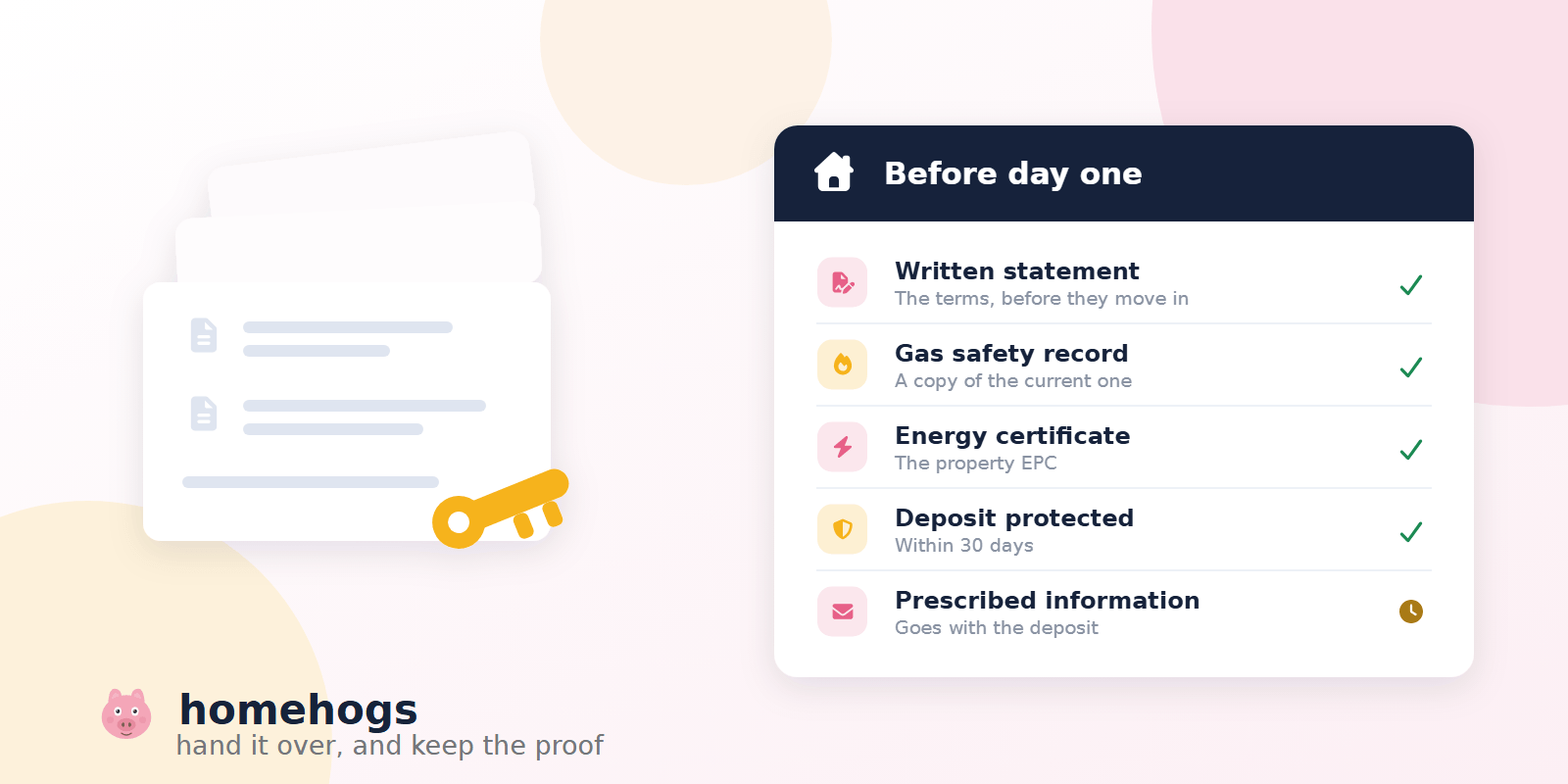
In England, a landlord must give a new tenant a written statement of the tenancy's terms before the tenancy is agreed, then copies of the current gas safety record and the latest electrical safety report (EICR) before they move in. The EPC goes to them free of charge while they're still deciding. The deposit must be protected with the prescribed information sent within 30 days, the smoke and carbon monoxide alarms checked on the first day and every adult's right to rent checked beforehand. The How to Rent guide is no longer on the list: it was withdrawn on 1 May 2026.
This guide covers England, where the Renters' Rights Act 2025 changed the paperwork for every private tenancy on 1 May 2026. Wales and Scotland run different systems, summarised near the end.
Most of what goes wrong at the start of a tenancy isn't an argument. It's a date: a deposit protected on day 31, a gas record handed over the week after somebody moved in, a document that was definitely sent, probably, in an email nobody can now find. Several of those decide later whether you can get the home back, so when you hand something over matters as much as what it is.
The short version
- In England the written statement of terms must reach the tenant before the tenancy is agreed, or the council can impose a penalty of up to £7,000.
- The How to Rent guide was withdrawn on 1 May 2026, so new tenants no longer get it.
- A new tenant gets copies of the gas safety record and the latest EICR before they move in.
- The EPC must be given free of charge as early as possible and no later than the first viewing or written details.
- A deposit must be protected and the prescribed information given within 30 days of receiving it.
- Smoke and carbon monoxide alarms must be checked as working on the day the tenancy begins.
- Every adult who will live there needs a Right to Rent check before the tenancy starts.
The documents a landlord must give a new tenant: the checklist
The table runs in roughly the order things happen, from the advert to the end of the first month. The first column says who provides each item; the last says what can happen if it's missed, using the figures the government publishes.
| Document or duty | Required? | When | Proof to keep | If you miss it |
|---|---|---|---|---|
| EPC, by an accredited energy assessor | Yes | Free, as early as possible and by the first viewing or written details | The certificate and a copy of the advert or details | £200 penalty charge; the home must be rated E or better to let |
| Property licence, from the council | Only for an HMO or where the council runs a scheme | Before you let | The licence and its conditions | Prosecution and an unlimited fine for an unlicensed HMO |
| Right to Rent check, by you or your agent | Yes, for every adult who will live there | Before the tenancy starts | A dated record of each check, kept for the tenancy plus a year | Up to £10,000 per occupier for a first breach |
| Written statement of terms, from you (it can sit inside the agreement) | Yes, for every new tenancy | Before the tenancy is signed or agreed | The signed agreement or statement and the email it went with | Penalty up to £7,000 |
| Gas safety record, by a Gas Safe registered engineer | Yes, where there's a gas appliance or flue | Before they move in | The record and the email it went with | A criminal offence that HSE can prosecute |
| EICR, by a qualified electrician | Yes | Before they move in | The report and proof any remedial work was done | Penalty up to £40,000 |
| Smoke and CO alarms checked, by you or your agent | Yes | On the day the tenancy begins | An inventory the tenant signs noting each alarm tested | Remedial notice, then a penalty up to £5,000 |
| Deposit protection, by you or your agent | Yes, if you take a deposit | Within 30 days of receiving it | The scheme's protection certificate | Up to three times the deposit; no possession order on most grounds |
| Prescribed information, from you or your agent | Yes, if you take a deposit | Within 30 days of receiving the deposit | The signed copy or the sent email | As for deposit protection |
| How to Rent guide | No: withdrawn on 1 May 2026 | Not for new tenancies | Nothing | Nothing |
The certificates behind three of these rows renew on their own cycles, set out in landlord safety certificates and when they expire.
The written statement of terms
This is the one most likely to be missed, because it replaced something familiar.
Since 1 May 2026 a landlord in England has to give the tenant written information about the key terms of the tenancy before signing a tenancy agreement or otherwise agreeing the tenancy, a spoken agreement included. Not on the day, not with the keys. It can be part of the tenancy agreement or a separate document, on paper or electronic. The duty is set out in the government's guidance on written information for tenants and the contents are listed in the 2026 regulations.
The main things it has to cover:
- Your name and a postal address in England or Wales where the tenant can send notices
- Every tenant's name, the property's address and the date they're entitled to move in
- The rent, when it's due and that any increase will be proposed by a notice under section 13 of the Housing Act 1988
- Which bills the rent includes and any separate bill payments
- The amount of the deposit
- The tenant's notice period, which can be no more than two months
- That you will usually need a court order to get the home back and will give notice on the correct form, naming the grounds
- Your duties on repairs, fitness for habitation, gas safety, electrical safety and disability adaptations
- That the tenant can ask to keep a pet, which you can't unreasonably refuse
That's a summary; check the government's full list before you rely on a template. Most standard agreements from a reputable source now build the statement in, so in practice it's usually part of the agreement rather than a separate sheet. What doesn't work is a pre-2026 template, which will still talk about a fixed term and a rent review clause. Missing the statement can bring a council penalty of up to £7,000.
If the tenancy began before 1 May 2026
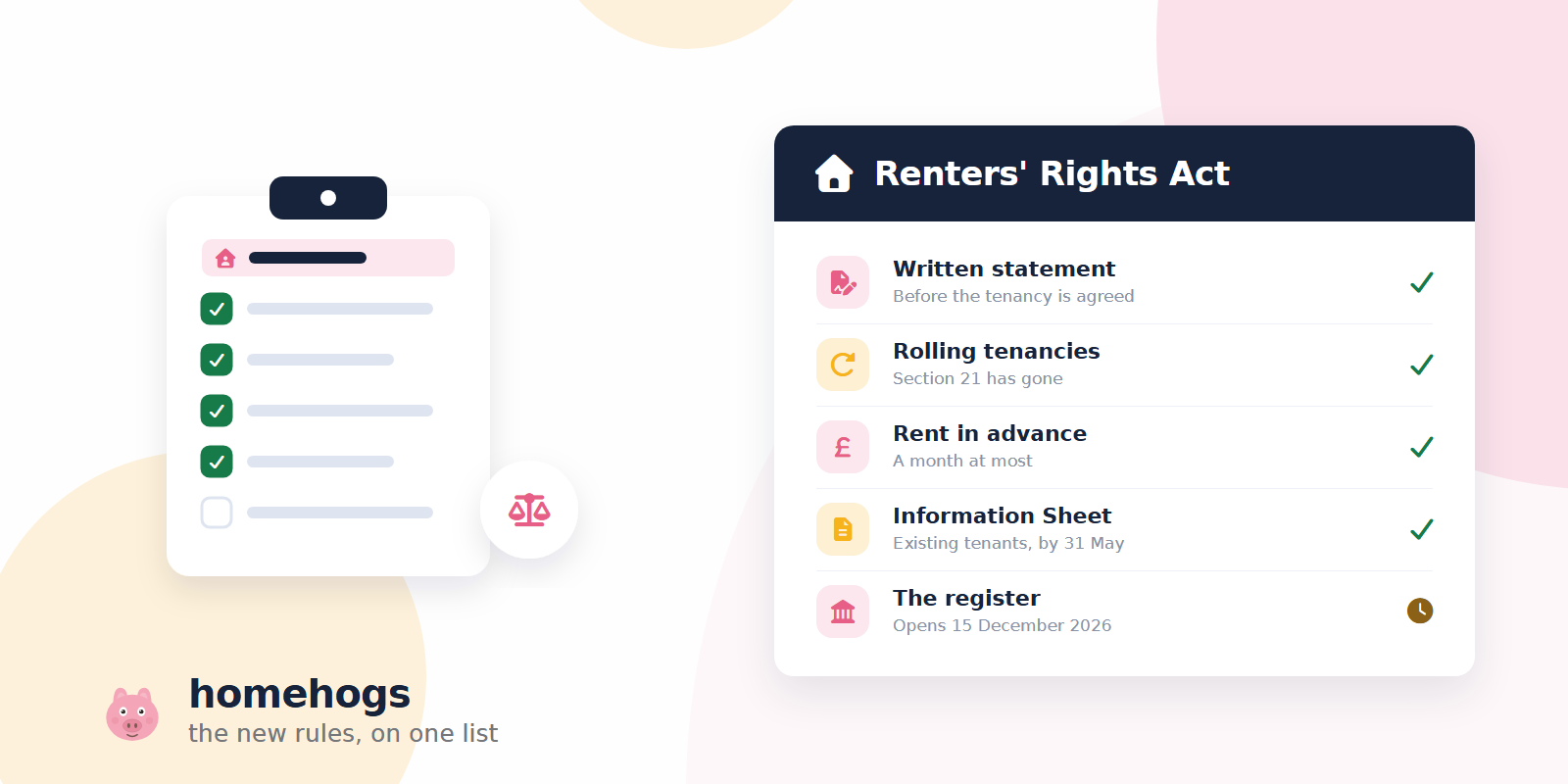
Existing tenancies didn't need a new agreement. Where there was a written tenancy agreement, the landlord had to give every tenant The Renters' Rights Act Information Sheet 2026 by 31 May 2026. A letting agent managing the home had to give it too, even if the landlord already had.
The format matters. A printed copy handed over or posted counts, as does the PDF attached to an email or a text. A link to the PDF doesn't count, which is easy to get wrong and hard to argue about later.
Where a tenancy was only ever agreed out loud, the duty was different: a written statement of its terms, by the same date. And where a valid section 21 or section 8 notice had been served before 1 May 2026, the sheet is due within one month of the notice expiring or the court proceedings ending.
Missing the deadline can mean a penalty of up to £7,000. If it passed you by, giving the sheet now doesn't undo a missed date, but it does put the tenant where the law intended; a landlord association or a solicitor can tell you where that leaves you.
Gas, electrics and the EPC
Three certificates go to a new tenant, each on its own timing.
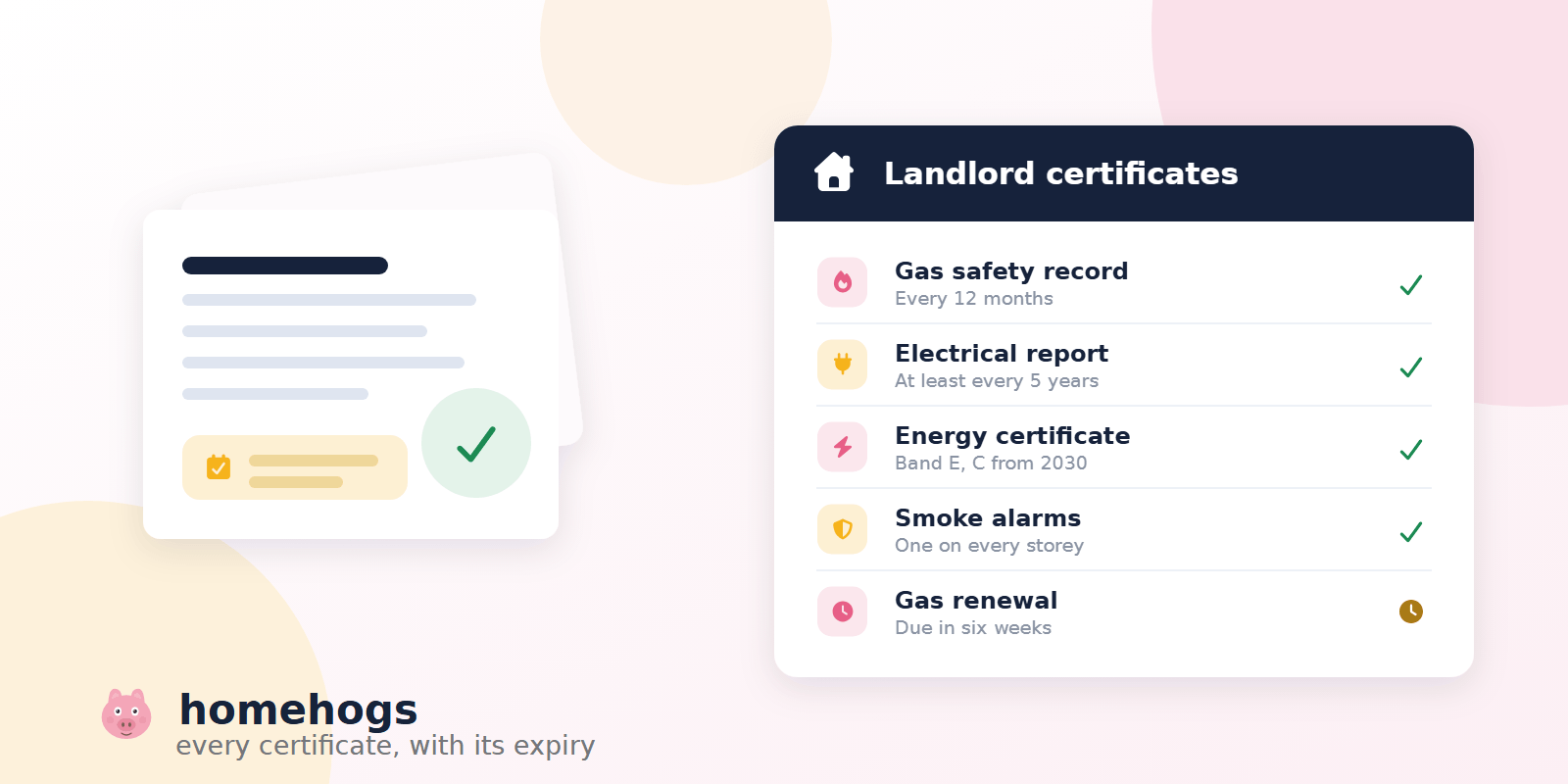
- The gas safety record. Where there's a gas appliance or flue, a new tenant gets a copy of the current record before they move in. The 28-day window is for existing tenants after each annual check, not for new ones. The check is done by a Gas Safe registered engineer and isn't the same thing as a boiler service: what a boiler service includes explains the difference.
- The electrical safety report (EICR). A new tenant gets a copy of the latest report before they occupy the home. An existing tenant gets one within 28 days of each inspection and a prospective tenant who asks in writing gets one within 28 days of asking. The rule is in regulation 3 of the Electrical Safety Standards in the Private Rented Sector and Social Rented Sector (England) Regulations 2020. If the last report found work that needed doing, keep the written confirmation that it was done with it.
- The Energy Performance Certificate. This one comes earliest. It must be given free of charge to a prospective tenant as early as possible and no later than when you first give them written details or show them round, so in practice it belongs on the listing. The home must be rated E or better to let unless you've registered an exemption. What your EPC actually tells you explains the rest of the certificate and our free EPC checker finds the one on the register.
Check the engineer's or electrician's credentials before they start; how to check a tradesperson covers the Gas Safe card and the electrical schemes.
Smoke and carbon monoxide alarms on day one
The Smoke and Carbon Monoxide Alarm (England) Regulations 2015 ask for three things:
- A smoke alarm on every storey with a room used wholly or partly as living accommodation, bathrooms and toilets included
- A carbon monoxide alarm in any room used as living accommodation with a fixed combustion appliance other than a gas cooker, which takes in gas boilers and wood burners
- A check that each alarm works on the day the tenancy begins, then a repair or replacement as soon as reasonably practicable once you're told one is faulty
Battery and mains alarms both count and England doesn't require them to be interlinked.
Nothing issues a certificate for any of this, which makes the day-one check the hardest duty on this page to prove. The government's Q&A booklet suggests a simple answer: test the alarms as you go through the inventory on the first day and have the tenant sign the inventory to record it. A council that finds a breach serves a remedial notice and can charge up to £5,000 if it isn't met.
The deposit and the money up front
Three separate limits, then two deadlines for the deposit itself. GOV.UK sets out the rules on rent in advance and deposits.
- Rent in advance. Nothing can be asked for, accepted or encouraged before the tenancy agreement is signed. After signing, the most you can take before the tenancy starts is one month's rent, or 28 days' rent where the rent period is shorter than a month. Asking a tenant with a thin credit file for six months up front is no longer allowed.
- The deposit. At most five weeks' rent where the annual rent is under £50,000 and six weeks where it's £50,000 or more.
- A holding deposit. At most one week's rent.
Once you take a deposit, two clocks start. Within 30 days you must protect it in one of the three government-backed schemes (the Deposit Protection Service, mydeposits or the Tenancy Deposit Scheme) and give the tenant the prescribed information.
That information isn't the same as protecting the money. It tells the tenant how much was paid, which scheme holds it and how its dispute service works, who you are, why you might make deductions and how to get the money back. Both have to happen. The second is the one people forget, because the money already feels dealt with.
The check that comes before all of it
In England you must check the right to rent of every adult who will live in the home, before the tenancy starts. Every adult, not just the person whose name is on the agreement. Never check only the people you think might need it: GOV.UK is plain that selective checks are against the law. Where someone has permission to be in the UK for a limited time, do the check in the 28 days before the tenancy starts and diary a follow-up before their permission runs out.
Most people with immigration permission now have an eVisa and give you a share code, which you check online through the Home Office service. British and Irish citizens can also be checked digitally, through a registered digital verification service provider. Others show original documents, which you check and copy following the Home Office's steps. A new code of practice for landlords has applied since 1 October 2026.
Keep a dated record of each check for the length of the tenancy and one year after it ends. That record is your defence if it later turns out somebody had no right to rent. Without it, a first breach can cost up to £10,000 per occupier.
If the home needs a licence
Some homes can't be let until the council has licensed them. A mandatory HMO licence is needed where five or more people forming more than one household share a toilet, bathroom or kitchen. Councils can also require licences for smaller shared homes (additional licensing) or for every rented home in a chosen area (selective licensing). Since 23 December 2024 they've been able to bring in a selective scheme of any size without the government's approval.
So check your council's website before the first tenancy, not after. A licence lasts up to five years and comes with conditions, some about safety records and paperwork, so read them alongside this list. Letting an unlicensed HMO can mean prosecution and an unlimited fine.
Wales and Scotland
Everything above is England's. Wales and Scotland have their own tenancy systems, so the paperwork differs.
| Topic | Wales | Scotland |
|---|---|---|
| Tenancy | Occupation contract under the Renting Homes (Wales) Act 2016 | Private residential tenancy |
| Written terms | A written statement within 14 days of the occupation date | The signed agreement plus the government's notes by the end of the first day |
| Electrical report | Copy within 14 days of the occupation date | EICR and appliance tests, copy before the tenancy starts |
| Alarms | Mains-powered, interlinked smoke alarm on every storey; CO alarm by gas, oil or solid fuel appliances | Interlinked smoke and heat alarms; CO detector by carbon-fuelled appliances |
| Registration | Rent Smart Wales, plus a licence if you manage the let yourself | Scottish Landlord Register before you let |
| Deposit | Protected in an approved scheme | At most two months' rent, lodged within 30 working days |
Gas safety works the same way across Great Britain and England and Wales share the EPC rules. In Wales a contract-holder given the written statement late can claim a day's rent for each day it's late, up to two months' rent; the Welsh Government's guidance for landlords has the detail. Scotland's rules are on mygov.scot. Northern Ireland has its own again, starting with the Department for Communities' checklist for new private tenancies.
Keep proof that you handed it over
Every duty on this page is a duty to give somebody something, so the question is never really 'did I do it' but 'can I show I did it'. That sounds pedantic until you're answering a council about a tenancy that started three years ago through an agent who has since closed.
Three habits cover most of it:
- Send the documents in one email rather than five, so there's a single dated record. Attach the files rather than linking to them.
- Ask the tenant to sign or acknowledge receipt where you reasonably can, including the inventory that records the alarm tests.
- Keep the sent email, not just the files.
What to keep and for how long:
- Gas safety records: each one for at least two years and until two later checks have been done
- The EICR: until the next inspection is due or done, whichever is later, with any confirmation of remedial work
- The EPC: the copy the tenant was given, even though the register keeps one too
- The deposit: the protection certificate and the prescribed information as served
- Right to Rent: each check for the tenancy plus one year
- The written statement or agreement: for the whole tenancy and after it ends
- A licence: the licence and its conditions
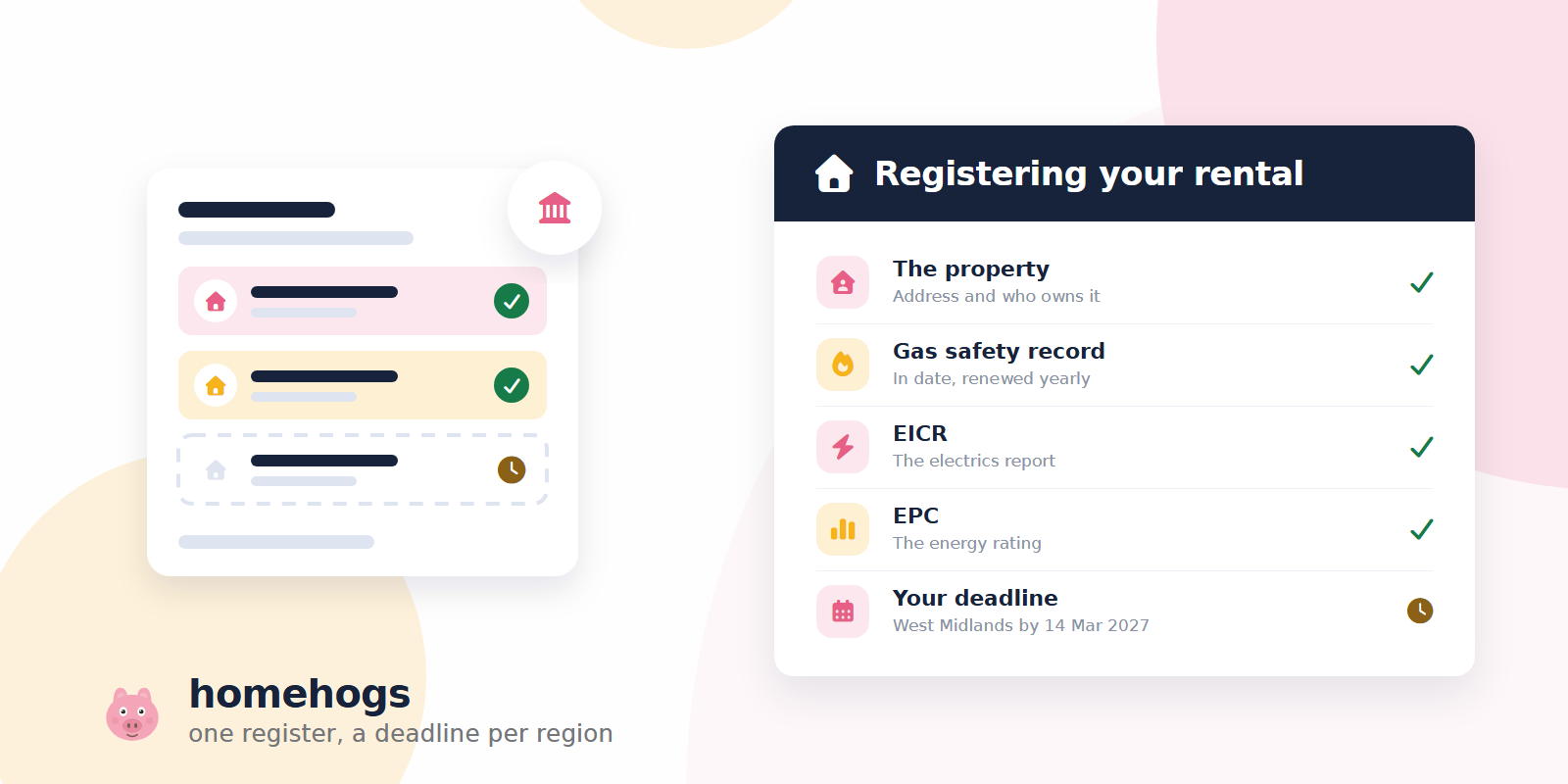
England's landlord register opens on 15 December 2026 and asks for each home's gas safety record, EICR and EPC with their dates, so one tidy folder answers the tenant and the register alike. Our free landlord register checker shows which dates apply to a home.
If you use homehogs, the tenancy, its certificates and the documents you've shared with the tenant sit on the home's record, with a reminder before each certificate is due.
Sources
- GOV.UK: Written information you need to give to your tenant
- legislation.gov.uk: The Assured Tenancies (Private Rented Sector) (Written Statement of Terms etc and Information Sheet) (England) Regulations 2026
- GOV.UK: The Renters' Rights Act Information Sheet 2026
- GOV.UK: How to Rent (withdrawn 1 May 2026)
- GOV.UK: Enforcement measures for landlords and letting agents
- GOV.UK: Rent in advance and deposits
- HSE: Gas safety, landlords and letting agents
- legislation.gov.uk: Electrical Safety Standards Regulations 2020, regulation 3
- legislation.gov.uk: Energy Performance of Buildings (England and Wales) Regulations 2012, regulation 6
- GOV.UK: Domestic private rented property minimum energy efficiency standard
- GOV.UK: Smoke and carbon monoxide alarms Q&A booklet
- GOV.UK: Deposit protection schemes and landlords
- legislation.gov.uk: Housing Act 2004, section 215
- GOV.UK: Check your tenant's right to rent
- GOV.UK: Right to Rent code of practice for landlords, 1 October 2026
- GOV.UK: House in multiple occupation licence
- Welsh Government: Renting homes, frequently asked questions for landlords
- mygov.scot: What your landlord needs to give you
- Department for Communities: Landlords' checklist for new private tenancies
Last fact-checked 5 October 2026.
One place for the tenancy and its paperwork
homehogs keeps the tenancy, its certificates and the documents you've shared with the tenant on the home's record, with a reminder before each certificate is due. The file is still there when the agent, the tenant or the council asks for it.
See landlord plans