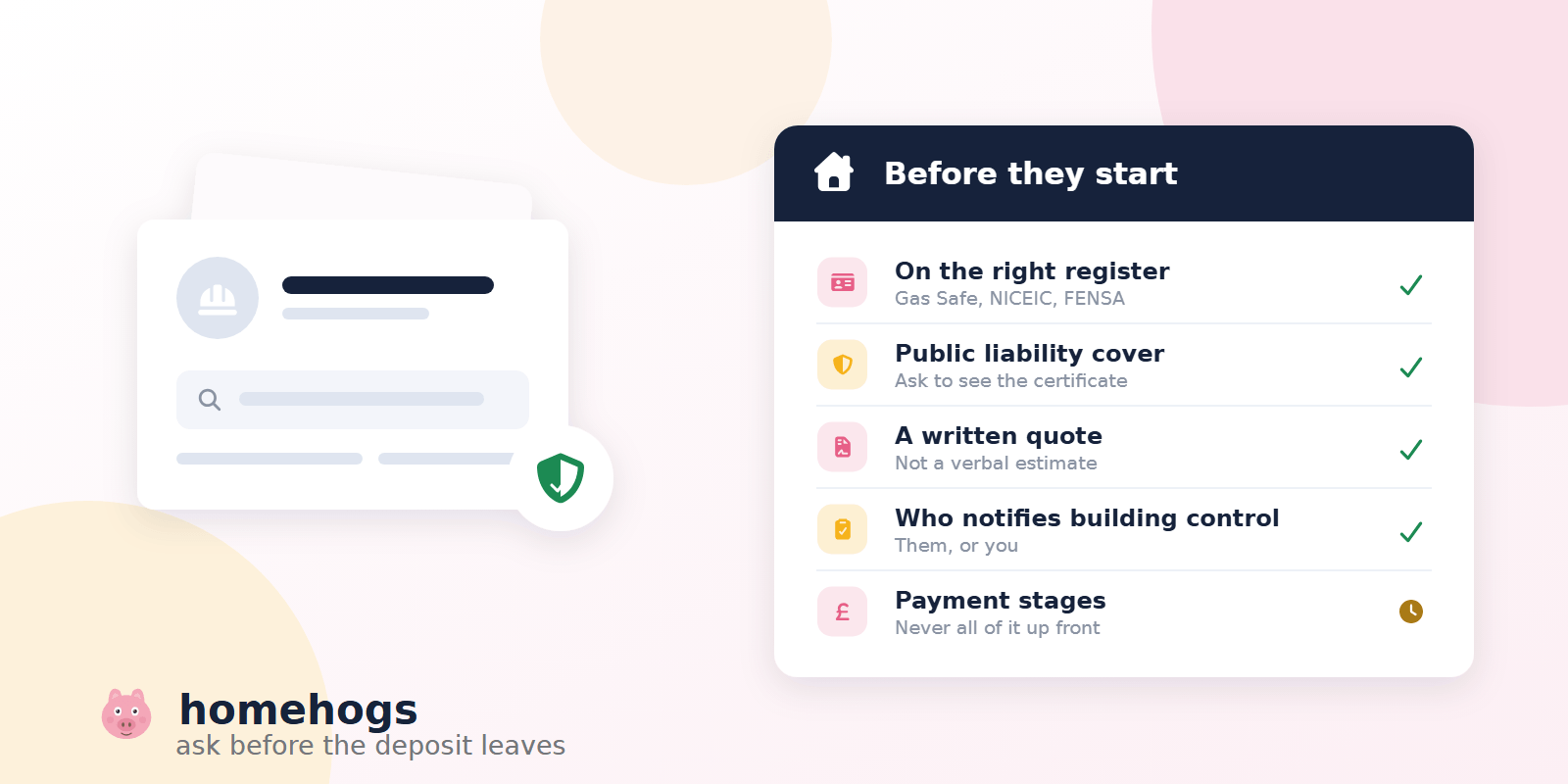
Two engineers can charge the same money for an hour of work and only one of them takes the casing off. This is what is supposed to happen at a service, how to tell which kind you are getting and why the piece of paper at the end matters more than most people realise.
There is a version of a boiler service that takes twenty minutes. The engineer looks at the boiler, turns it on, watches it light, writes something on a pad and leaves a sticker on the casing.
There is another version that takes the best part of an hour, involves the front coming off and ends with a page of numbers.
Both get called a service. Both get charged for. Only one of them tells you anything about the condition of the most expensive appliance in your house and only one of them keeps your warranty alive.
Knowing which you are getting takes about thirty seconds of watching.
The short version
- A service and a landlord's gas safety check are two different jobs and neither one is the other
- For an owner occupier an annual service is not a legal duty, but it is usually a condition of the warranty
- A real service means the casing comes off and a flue gas analyser goes in the flue
- The output is readings written down, not a sticker with a date on it
- Anyone touching gas must be on the Gas Safe Register, which is free to search
- Book it in late summer. In the first cold week of the year every engineer in the county is busy
A service is not a safety check
These get muddled constantly, partly because the same engineer does both in the same visit.
A gas safety check asks one question: is this appliance safe to use right now. It checks that the boiler is burning correctly, that the flue is clearing the products of combustion and that the safety devices work. A landlord has to have one every twelve months and gets a gas safety record for it. An owner occupier has no such duty.
A service asks a different question: what condition is this boiler in and will it still be working next winter. It includes everything the safety check covers, then adds the cleaning and inspection that stops small problems becoming a breakdown.
So a landlord's certificate is not evidence that the boiler has been serviced, which is worth knowing if you are buying a flat that has been let. The renewal cycles behind those certificates are in landlord safety certificates and when they expire.
What is supposed to happen
A proper service runs roughly like this.
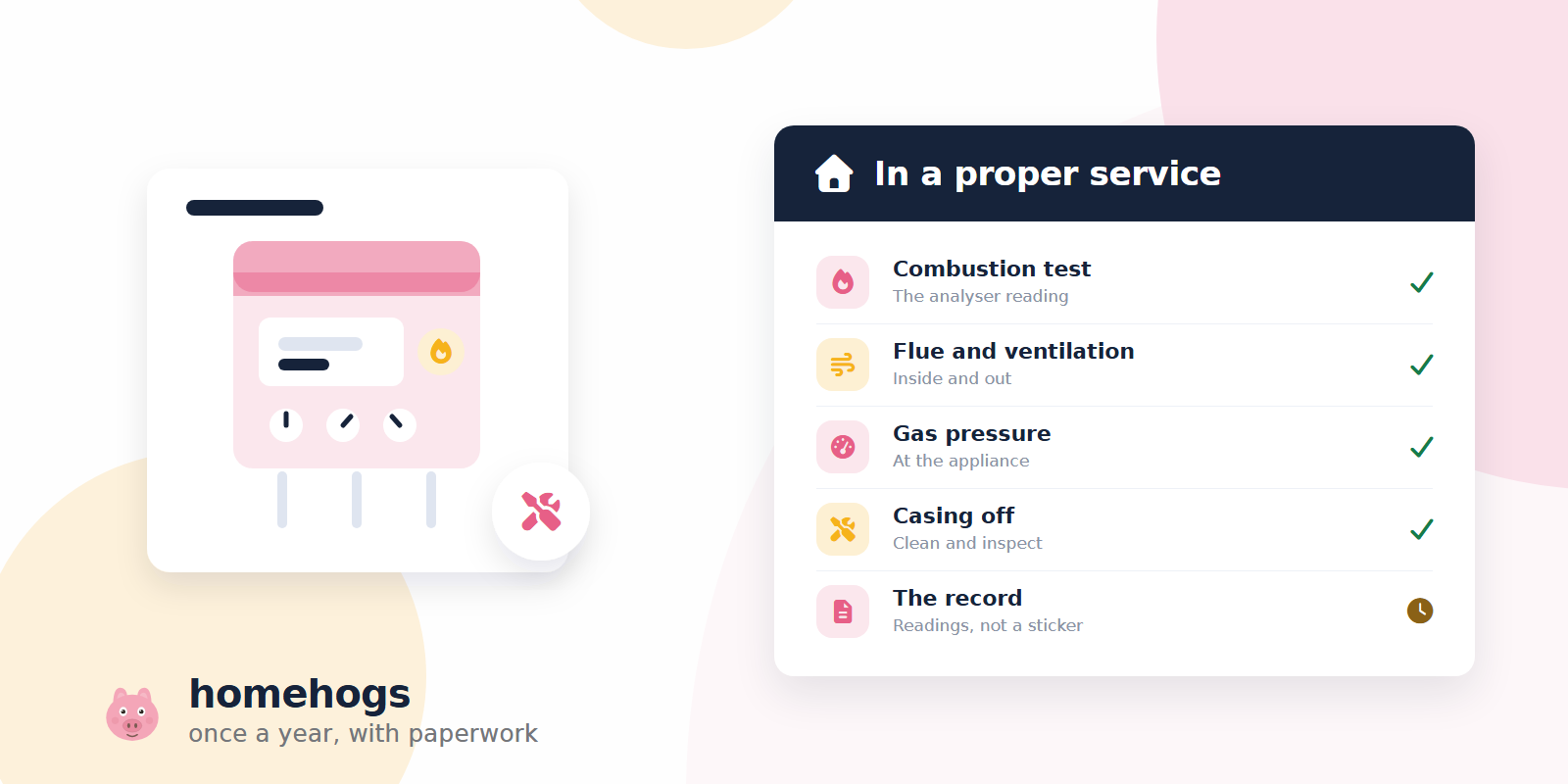
The engineer isolates the boiler safely and takes the front casing off. That is the first tell, because most of what follows cannot be done with it on.
Inside, the burner, the heat exchanger and the condensate trap are inspected and cleaned. The condensate trap in particular is a common cause of a boiler locking out in the first hard frost of the year.
The seals on the combustion chamber are checked, because a boiler that is drawing air where it should not is both inefficient and unsafe.
The flue is inspected along its whole length, inside the house and outside it, along with the ventilation to the room.
The gas pressure and the gas rate are measured at the appliance, not assumed from the meter.
Then the part that separates the two kinds of service: a flue gas analyser goes into the test point and reads what is actually coming out. The engineer records the carbon monoxide figure and the ratio of carbon monoxide to carbon dioxide, then compares them to what the manufacturer says they should be. This is not optional extra diligence. For a condensing boiler it is how the manufacturer's instructions say the appliance is to be checked.
Finally the safety devices and the controls are tested, the system pressure is set and everything is written down.
So is it actually required?
Legally, if you own and live in the house, no. There is no law obliging you to service your own boiler.
What there is instead is a set of conditions that bite harder than most laws.
The manufacturer's warranty normally requires an annual service by a suitably qualified engineer, recorded. Skip two years and a claim in year six is a conversation you will lose.
Some home insurance policies expect appliances to be maintained. A claim arising from a boiler that has never been touched is an argument you do not want to be having.
And the installation itself had to be notified to building control by a Gas Safe registered installer, who should have given you a Building Regulations Compliance Certificate. That one is not about servicing, but it is the other piece of boiler paperwork a buyer's solicitor asks for. Gas Safe will reissue it if it has gone missing.
Oil is its own world: the engineer is OFTEC registered rather than Gas Safe, the servicing interval follows the manufacturer and the appliance, the burner work is rather different. The principle is identical.
The readings are the point
One service tells you the boiler was working on the day somebody visited. Three services tell you something considerably more useful.
Combustion figures drift. Gas pressure drifts. If this year's analyser reading sits where last year's did, the appliance is in the same condition it was. If it has moved, something is changing and you have found out in September rather than in January.
The same goes for the system. A boiler that needs topping up every few weeks has a leak somewhere. The pressure noted at each service is what turns "I think it has been dropping" into a fact with dates on it.
None of this works if the record is a sticker. Ask for the numbers.
Book it before the weather turns
Everybody rings in the same fortnight. The first properly cold week of the year is when boilers that have been quietly struggling since March finally give up and it is also the week every heating engineer has a full diary.
Late summer and early autumn are the cheap, calm, well-attended months. A boiler serviced in September has a full winter ahead of it rather than a wait for a part.
There is a second reason to be early. If the service turns up something that needs a part or a decision, you have time to get a second opinion, which is a thing you will not do on the coldest night of the year with a quote in your hand.
What to keep and why
Keep the service record with the readings, the Benchmark book, the Building Regulations Compliance Certificate from the installation, the manual and the name of whoever did the work.
Two of those pay off within a year, because the next fault is faster and cheaper to fix when the engineer can see what was measured last time and who fitted the thing.
The rest pay off when you sell. A boiler with a documented history is a boiler a buyer does not have to worry about. A surveyor's report that says "no evidence of servicing" is a line that gets used to negotiate. What counts as evidence, as opposed to a memory, is covered in how to prove work was done on your home.
A gas boiler lasts somewhere around ten to fifteen years. Which end of that you land on is mostly decided by whether anybody ever took the front off.
Keep the readings where you can find them
homehogs records each service against the boiler itself, with the readings and the engineer, so next year's visit starts with last year's numbers instead of a shrug.
Join the waiting list