From 15 December 2026 landlords in England register themselves and each home they let on the government's Register your rental property service, with regions called forward a month apart and the last deadline on 14 November 2027. Here's every deadline, how the £65 fee works and what to have ready before your turn comes.
England's landlord register, the government's Register your rental property service, is at heart a form. The hard part is what it asks you to attach.
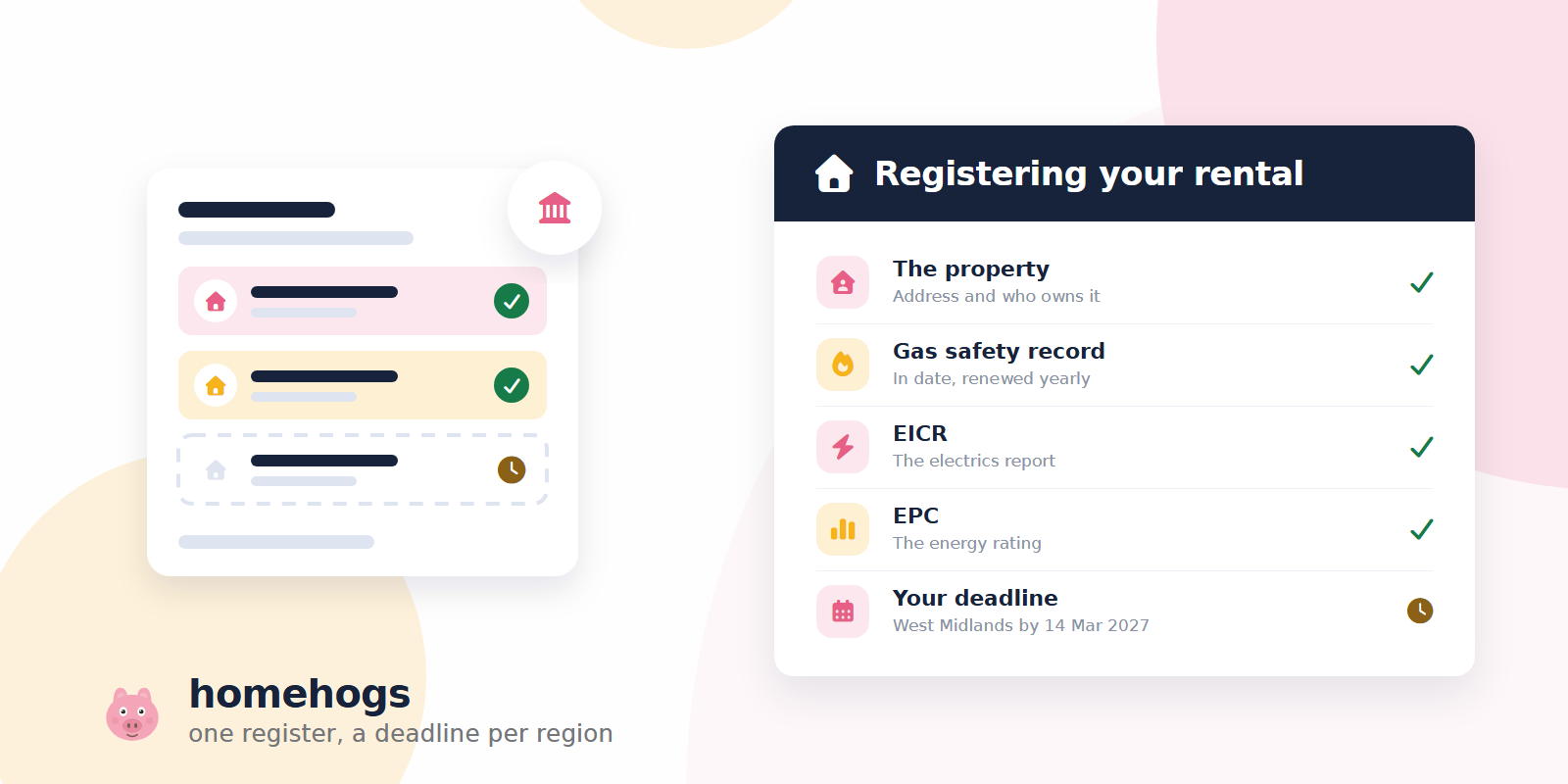
For each home it wants the gas safety record with its issue date, the electrical report with its expiry date and the EPC your tenant was given. For plenty of landlords those live in three places: an engineer's email, a folder in the loft and a PDF downloaded in 2022.
So this isn't a walkthrough of the service. It's the dates that apply to you, what the register asks for and how to have it together before your region's turn comes. Our free landlord register checker tells you which dates are yours.
The short version
- Any landlord in England can register from 15 December 2026, whichever region their homes are in
- Each region's turn starts a month after the last and gives it three months, ending with the South West's deadline on 14 November 2027
- The government says the fee is £65 a property, every year, pro-rated during the rollout so registering early costs no more
- For each home the register asks for the gas safety record where there's gas, the EICR and the EPC
- For now only homes that are let need registering; empty homes follow later under future legislation
- The deadline follows the home, not you: a Londoner letting a flat in Birmingham works to 14 March 2027
What the landlord register is: the Private Rented Sector Database
The Renters' Rights Act 2025 provides for a national database of private landlords in England and the homes they let, formally the Private Rented Sector Database. The service you'll use to join it comes from the Ministry of Housing, Communities and Local Government and is called Register your rental property.
You register yourself, then each home you let. Each landlord and each home gets its own unique identifier.
For now it's a register rather than a shop window. The government says tenants will later be able to use it to check whether a landlord meets key legal requirements. Adverts carrying the identifiers come later too, with guidance first.
Who has to register a rental property and who doesn't
If you privately let a home in England on an assured or regulated tenancy, you register yourself and each of those homes (social housing isn't covered). One flat or forty makes no difference, except to the fee.
- Empty homes can wait. For now only homes that are let need registering, including any that become let during the rollout. Future legislation will require empty homes to be registered before they're marketed, with guidance first.
- Supported exempt accommodation is left out, as set out in the Supported Housing (Regulatory Oversight) Act 2023.
- An agent doesn't take it off your hands. You start the registration. Your agent or property manager can upload some of the information, but you stay responsible for all of it.
Not sure what kind of tenancy you've granted? A letting agent, the NRLA or a solicitor can tell you.
When your region's turn comes
The service takes registrations from 15 December 2026, from any region. Regions are then called forward a month apart, each with three months to register. Once a region's three months are up, its councils can start enforcement.
- West Midlands: 15 December 2026 to 14 March 2027
- East of England: 15 January 2027 to 14 April 2027
- East Midlands: 15 February 2027 to 14 May 2027
- South East: 15 March 2027 to 14 June 2027
- Yorkshire and the Humber: 15 April 2027 to 14 July 2027
- North West: 15 May 2027 to 14 August 2027
- North East: 15 June 2027 to 14 September 2027
- London: 15 July 2027 to 14 October 2027
- South West: 15 August 2027 to 14 November 2027
The first date is when registering becomes a requirement; the second is the last day to do it. Because the windows overlap, three regions are inside theirs at once from 15 February to 14 September 2027. The dates come from the government's Get ready page and can change, so check there before relying on one. Our checker can also email you reminders: one four weeks before your region's deadline, plus one when its turn starts if that's still ahead.
The fee: £65 a home, every year
The government says the fee is £65 a property, every year. It's charged per home rather than per landlord, so three flats mean three fees. During the rollout it's pro-rated so that those who sign up first don't pay more; the government had not published the pro-rated amounts by the end of September 2026.
The figure isn't set in law: the Act leaves it to regulations and the draft regulations leave it to whoever runs the database.
The draft regulations laid before Parliament say the fee is paid before a home's entry is made. An entry not renewed by its renewal date stops being active. A landlord's later homes take the same renewal date as their existing ones, so a portfolio renews once a year rather than on twelve different days.
What to have ready for each home
You register yourself first, with your name, date of birth, home address, phone number and email (a company gives more). Then, for each home you let:
- The gas safety record and its issue date, where there's a gas supply
- The electrical report: the EICR and its expiry date (or, where an appropriate electrical installation certificate (EIC) stands in for it, the EIC and its issue date)
- The EPC your current tenant had to be given. If that EPC has since expired, the tenancy's start date too; if its rating is below the minimum, any registered exemption
- The home: address, ownership type, type of home, bedrooms and whether it's let now
- The let: how many people and households live there, whether it's furnished, the rent, how often it's paid and which bills it includes
- Licences and contacts: any HMO, additional or selective licence numbers, plus names and emails for any freeholder, superior landlord or property manager
If a certificate has gone walkabout, you're in good company: we've all got that drawer. Most EPCs can be looked up on the government's EPC register. For the others, the engineer or electrician who did the check may still have a copy.
What happens after a deadline
Once a region's deadline has passed, councils there can start enforcement. The Renters' Rights Act 2025 sets the limits:
- up to £7,000 for letting a home that isn't registered (the Act also covers advertising one, which the government says will apply once the marketing rules arrive under future legislation)
- up to £40,000 or prosecution for carrying on after a penalty, for a further breach within five years of one or for knowingly or recklessly giving the register information that is false or misleading in a material respect
- no possession order from a court while the landlord is in breach of the duty to register, except on the anti-social behaviour grounds (Grounds 7A and 14)
The GOV.UK guide to the Renters' Rights Act summarises these, though it was last updated in November 2025. The Act comes into force in stages, so for the current position check the government's Get ready page and the Act itself on legislation.gov.uk, which marks what's in force. For your own situation, a solicitor or a landlord association such as the NRLA can advise.
Three months is a fair window for a job that's mostly finding paperwork.
Getting ready before your turn
Registering needs the service, which takes registrations from 15 December 2026. Most of the getting ready needs nothing from it.
- Gather each home's certificates and check their dates. Each renews on its own cycle, set out in landlord safety certificates and when they expire.
- Find the details in other people's inboxes: licence numbers and any freeholder's or property manager's email.
- Know that you'll need a GOV.UK One Login. If you already have one from another government service, you can use it; if not, you create one the first time you use the register.
- Ask your agent what they'll upload and what they need from you.
Offline routes and a contact centre will be there for anyone who needs them once the service is running.
The draft regulations say an entry must be updated within 28 days of anything in it going out of date, so expect each renewed gas safety record or EICR to mean uploading the new one.
A new tenant has to be given the gas safety record, the EPC and the latest EICR too, so one tidy folder answers both.
Keep every home's certificates in one place
The landlord register wants each home's gas safety record and EICR with their dates, plus a copy of the EPC. homehogs keeps each gas safety record and EICR with its dates, reminds you before they're due and fetches the EPC from the government's EPC register.
Start free