If fewer people live in your home than it has bedrooms, a water meter will often cut your bill. This explains how unmetered and metered bills are worked out, gives a quick decision guide with a worked example and sets out the safety net that lets you switch back.
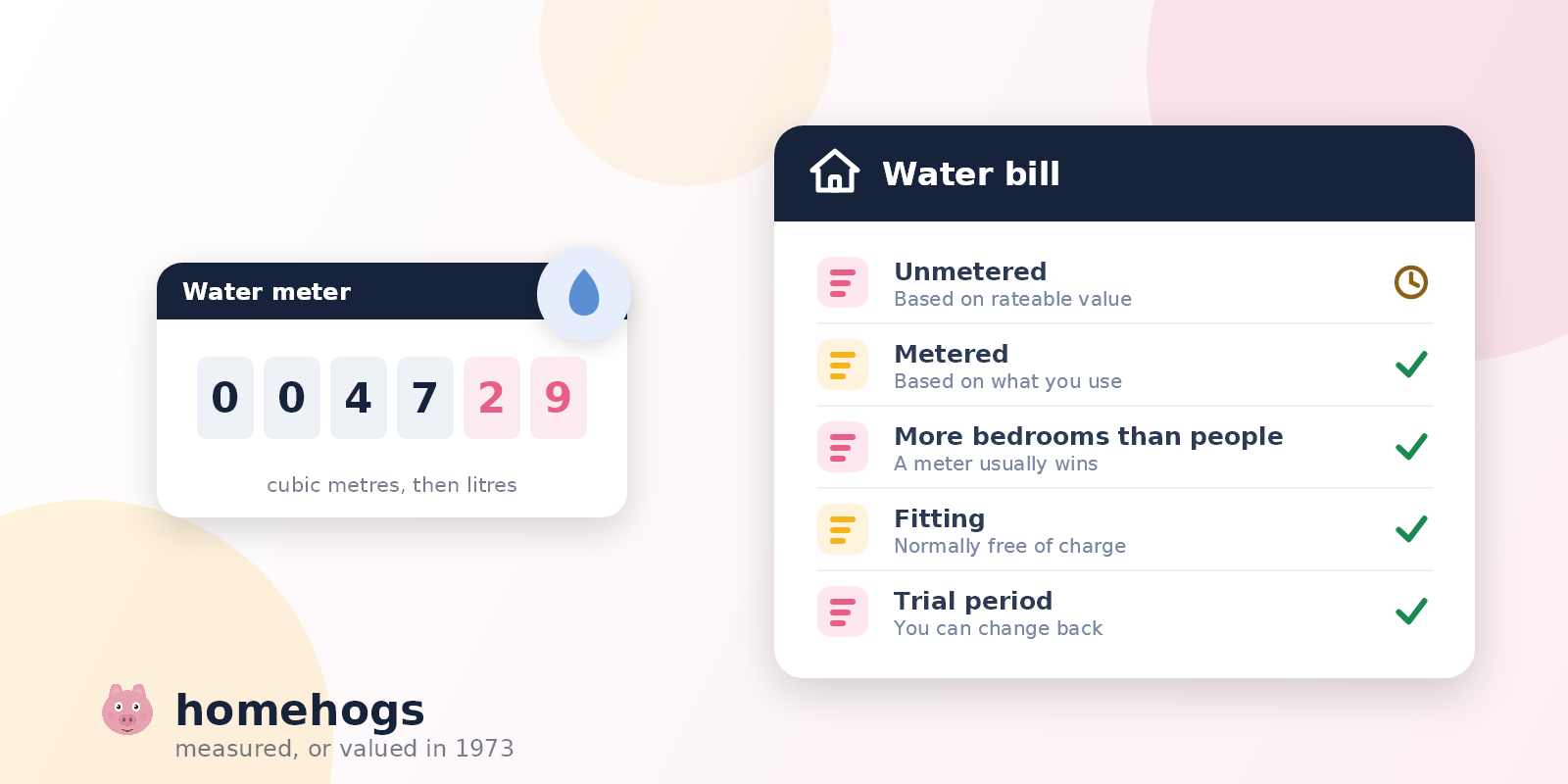
In England and Wales a water meter usually saves money if fewer people live in your home than it has bedrooms. An unmetered bill is based on the property, while a metered bill is based on what you use. The meter is free to fit and you can normally change your mind: the legal minimum window for switching back is 12 months, while the Consumer Council for Water says it is now two years.
Water is the household bill nobody examines. It arrives once or twice a year and you cannot change supplier, so there is only one real decision to make. With the average water and sewerage bill in England and Wales at £639 for 2026-27, it is worth ten minutes to check which side of it you are on.
Scotland and Northern Ireland work differently and are covered near the end.
The short version
- Without a meter, bills in England and Wales are based on your home's rateable value, set before April 1990 and impossible to reassess.
- The usual rule of thumb is that a meter is likely to save money if fewer people live in your home than it has bedrooms.
- Water companies in England and Wales fit meters free on request, normally within three months.
- By law you can switch back within 12 months of your first metered bill and many companies allow two years, but not if you moved into a home that already had a meter.
- If a meter cannot be fitted, you can ask for an assessed charge, an estimate of what a metered bill would be.
- The average water and sewerage bill in England and Wales for 2026-27 is £639, up £33 on the year before.
- Most households in Scotland pay for water with their council tax; Northern Ireland has no household water charges.
How an unmetered bill is worked out
Without a meter, your bill is based on your home's rateable value. Before April 1990 every property in England and Wales was given one: an assessment of what it could have been let for, used for the old system of local rates. When rates were abolished the values were frozen. They cannot be reassessed, so an extension or a loft conversion since then makes no difference.
The bill is often a standing charge plus a charge that rises with the rateable value, both set by your water company each year.
So the amount bears no relation to how much water you use. A large house with one person in it pays a lot; a small house with five people in it pays comparatively little. Using less water does not reduce an unmetered bill at all.
How a metered bill is worked out
A metered bill charges for what passes through the meter, measured in cubic metres. One cubic metre is 1,000 litres. Your company sets a price per cubic metre for supplying water and another for taking it away as sewerage, plus standing charges. Its charges scheme, published each year, lists them.
For comparison, Water UK puts the average household water and sewerage bill in England and Wales at £639 for 2026-27, up £33 (5.4%) from 1 April 2026. Rises ranged from 0.4% at Thames Water to 11% at Sutton and East Surrey, so the average hides a lot. Your own bill and your own company's rates are what matter.
The test that answers it for most people
The rule of thumb, which Citizens Advice uses too, is simple: if fewer people live in your home than it has bedrooms, a meter is likely to save you money. Unmetered charges follow the size of the property; metered charges follow the people using the water.
This table shows which way your household leans.
| Factor | Leans towards a meter | Leans against a meter |
|---|---|---|
| People and bedrooms | Fewer people than bedrooms | As many people as bedrooms, or more |
| Your current bill | High for the number of people in the home | Already low for your household size |
| Garden | Little or no watering | Heavy summer watering, a pond or a pool |
| Washing | Mostly quick showers | Daily baths or long power showers |
| Appliances | Efficient machines, run full | Older machines run often, or a hot tub |
| Time at home | Away a lot, or a second home empty much of the year | Home all day, every day |
| Leaks | None, or already fixed | A suspected leak you have not traced |
A quick decision guide
- If fewer people live in your home than it has bedrooms, price up a meter. It is the case where one most often wins.
- If there are as many people as bedrooms or more, a meter is less likely to save money. Checking still costs nothing.
- If you water a large garden, fill a pond or pool or take daily baths, put that use into the calculator honestly. An optimistic answer helps nobody.
- If somebody at home has a medical condition that means high water use, or you have three or more children under 19 and receive certain benefits, ask about WaterSure, which caps metered bills in England.
- If your company says a meter cannot be fitted, ask for an assessed charge and compare it with your current bill.
- If the calculator shows a clear saving, apply. If it is close, the switch-back window makes it a low-risk trial.
Then run the numbers in the Consumer Council for Water's calculator, updated with 2026-27 charges, or your own water company's calculator, which uses its exact rates.
A worked example
The figures below are made up to show the method. They are not any water company's charges, so use your own bill and your company's charges scheme for the real thing.
Suppose a home has a rateable value of £300. Its company charges, for illustration, 70p per pound of rateable value for water and 80p for sewerage, plus £50 a year in standing charges.
- Unmetered bill: £300 × £1.50 = £450, plus £50 = £500 a year, whoever lives there.
Now suppose metered charges of £2.00 per cubic metre for water and £2.40 for sewerage, £4.40 in all, plus the same £50 of standing charges.
| Household | Water used a year | Metered bill | Against £500 unmetered |
|---|---|---|---|
| One person | 50 cubic metres | £270 | £230 less |
| Two people | 80 cubic metres | £402 | £98 less |
| Four people | 160 cubic metres | £754 | £254 more |
The amounts of water are illustrative too; yours depend on your habits and appliances. What the example shows is the pattern: the unmetered bill stays put while the metered one follows the number of people.
Getting one fitted
In England and Wales you have a right to ask for a meter and the company fits it free. It should do so within three months of your request, or six months where a company has only just started offering free meters. Tenants can ask too. Apply through your water company's website or by phone.
Sometimes a meter cannot be fitted, usually because several homes share one supply pipe, which is common in flats and older terraces. In that case ask for an assessed charge: an estimate of what a metered bill would be, usually based on the type of property or the number of people living there. For a small household in a large house it may well be lower than the rateable value bill.
A few practical points. Ask where the meter will go: often outside at the boundary, sometimes inside where the pipe comes in. Read it on the day it is fitted and keep a photo. Once you are metered, send your own readings now and then rather than relying on estimates, for the same reason as with energy bills.
The other thing a meter gives you
A meter measures a leak as faithfully as it measures a bath.
That sounds like a downside and is usually the opposite. A slow leak on the underground supply pipe can run for years unseen, because the water soaks into the ground rather than coming through a ceiling. Unmetered, you would never know. Metered, the bill climbs and something is obviously wrong.
The test needs an hour without using water. Turn off every tap and water-using appliance, note the reading, then read the meter again an hour later. If it has moved, water is going somewhere it should not. A quarterly check is worth adding to your home maintenance checklist.
If you find a leak, ask your water company whether it offers any help with repairing a supply pipe and whether it will reduce a bill inflated by a leak you have since fixed. Policies differ by company and nothing happens unless you ask. Keep the plumber's invoice either way.
Scotland and Northern Ireland are different
Almost everything above applies to England and Wales.
Scotland
Most households pay for water and waste water through their council tax bill. The council collects the charges for Scottish Water and they are based on your council tax band. Metered charges apply only to the small number of homes with a meter, so for most households there is no meter decision to make. Households getting Council Tax Reduction can get up to 35% off the water charges through the Water Charges Reduction Scheme. If you think your band is wrong, checking your council tax band explains how bands work in Scotland.
Northern Ireland
Households pay no direct water or sewerage charges. The service is funded by the Department for Infrastructure. After a consultation in 2023-24, the Department for Infrastructure confirmed that domestic water charges will not be introduced.
If you decide to switch
Five steps and the decision more or less makes itself.
- Find your current annual cost on your latest bill. It is the number you are comparing against.
- Run the calculator, your company's or the Consumer Council for Water's, honestly, including the garden and the baths.
- If the numbers favour a meter, apply. Read the meter when it is fitted and photograph it.
- Note the date of your first metered bill and set a reminder a couple of months before your switch-back window closes.
- When the reminder comes, compare a full year of metered bills with your last unmetered one and decide properly.
The reminder is the step people miss. Without it, a reversible decision becomes permanent by default.
What to keep afterwards
A few records make the trial year easy to judge and any dispute easy to settle:
- Your last unmetered bill. It shows the rateable value and the annual charge, your baseline.
- The fitting details. The date the meter was fitted, its serial number and a photo of the first reading.
- Your first metered bill. The switch-back window runs from it.
- Your calculator results. So you can see how the estimate compared with real life.
- A log of your own readings. With dated photos. A sudden rise is often the first sign of a leak.
- Leak paperwork. The plumber's invoice and any letter agreeing a reduction on your bill.
- Letters about help with bills. An assessed charge, WaterSure or a social tariff.
They are also part of the running costs a buyer asks about. homehogs reads water bills you upload or email in and tracks them with the rest of your running costs, so a year on a meter can be compared with the year before it rather than guessed at.
Sources
- Citizens Advice: Changing to a water meter
- Citizens Advice: Paying for water without a meter
- Consumer Council for Water: Should I get a water meter fitted?
- Consumer Council for Water: Water meter calculator
- Consumer Council for Water: Households across Wales given more time to trial a water meter
- Consumer Council for Water: Help with bills
- legislation.gov.uk: Water Industry Act 1999, section 6 explanatory notes
- Water UK: Average household water bills for 2026-27
- GOV.UK: Reduced bills for around 300,000 households in WaterSure reform
- Scottish Water: Your charges 2026-2027
- Department for Infrastructure: Water and sewerage charges consultation
Last fact-checked 5 October 2026.
Keep an eye on what the house costs
homehogs tracks your water bills alongside the rest of your running costs, so a year on a meter can be compared with the year before it rather than guessed at.
See the plans