A step-by-step guide to buying your first home in the UK, from saving a deposit to getting the keys. It covers what lenders look for, the Lifetime ISA, stamp duty in each nation, the real cash needed for a £275,000 home and the paperwork worth keeping once you move in.
Buying your first home usually means a few months of saving and searching, then around four months from an accepted offer to getting the keys: the government puts the average purchase at about 120 days. Most lenders want a deposit of at least 5% of the price. On top of that, Which? puts a typical first-time buyer's costs at around £2,300 before any mortgage fees; most first-time buyers in England and Northern Ireland pay no stamp duty.
This guide explains how to buy a house in the UK step by step, from the deposit to the paperwork worth keeping, with a worked example of the cash needed for a £275,000 home. It is written for England, with the differences in Wales, Scotland and Northern Ireland set out where they matter.
It explains how buying works rather than telling you what to do. For advice on your own situation, talk to a regulated mortgage adviser and a conveyancer; MoneyHelper also offers free, impartial guidance. Every figure was checked on 5 October 2026.
The short version
- Most lenders want a deposit of at least 5%; bigger deposits usually get lower rates, with August 2026 averages of 5.52% at 95% loan to value and 5.02% at 85%.
- Lenders commonly cap borrowing at around 4.5 times income and must check you could keep paying if rates rose.
- First-time buyers in England and Northern Ireland pay no stamp duty up to £300,000; Scotland's relief saves up to £600 and Wales has none.
- A Lifetime ISA adds a 25% bonus, up to £1,000 a year, for first homes costing £450,000 or less; it stays open until any replacement launches.
- Our worked example for a £275,000 home in England with a 10% deposit needs roughly £30,700 to £36,800 in cash, buffer included.
- In England, Wales and Northern Ireland nothing is legally binding until contracts are exchanged.
- The UK Budget on 28 October 2026 could change stamp duty, so check the rates again before you complete.
Buying your first home: the timeline at a glance
Here is the whole process in order, with typical timings. Steps 6 to 8 overlap: once your offer is accepted, the mortgage, the survey and the legal work all run at the same time.
| Step | Typical time | What happens |
|---|---|---|
| 1. Save and get mortgage-ready | Months to years | Build the deposit, check your credit file, gather payslips and statements |
| 2. Agreement in principle | Minutes to a few days | A lender's estimate of what it might lend you |
| 3. Find a home and view it | Weeks to months | Research areas, view homes, go back for a second look |
| 4. Make an offer | Up to a week | Negotiate through the agent, subject to contract and survey |
| 5. Instruct a conveyancer | The same week | Identity and source-of-funds checks; searches ordered |
| 6. Mortgage application | 2 to 4 weeks | Full application, the lender's valuation, then the mortgage offer |
| 7. Survey | 1 to 2 weeks | Your own surveyor inspects the home and reports |
| 8. Legal work to exchange | Around 12 weeks | Searches, enquiries, the contract and the report on title |
| 9. Exchange of contracts | One day | The purchase becomes legally binding; your deposit is paid |
| 10. Completion | 1 to 28 days after exchange | The money moves and you get the keys |
The government's figure for the average purchase is around 120 days (June 2026 announcement). The HomeOwners Alliance puts offer to completion at about five months, with a week between exchange and completion on average. A long chain, a leasehold flat or a slow council search all stretch it. With nothing to sell, a first-time buyer adds no link to the chain, which sellers tend to like.
Your deposit: what 5%, 10% and 15% change
Your deposit is the part of the price you pay yourself. The mortgage covers the rest. The mortgage as a share of the price is called the loan to value (LTV): a 10% deposit means a 90% LTV mortgage. Lenders price their deals in LTV bands, typically 95%, 90%, 85%, 75% and 60%, so each step down tends to bring a lower rate.
Here is what that looks like on a £275,000 home, using the Bank of England's average quoted rates for two-year fixed mortgages in August 2026:
| Deposit | Mortgage (LTV) | Average 2-year fix | Monthly over 30 years | Income at 4.5 times |
|---|---|---|---|---|
| 5%: £13,750 | £261,250 (95%) | 5.52% | £1,487 | about £58,100 |
| 10%: £27,500 | £247,500 (90%) | 5.16% | £1,353 | £55,000 |
| 15%: £41,250 | £233,750 (85%) | 5.02% | £1,258 | about £51,900 |
| 25%: £68,750 | £206,250 (75%) | 4.92% | £1,097 | about £45,800 |
These are averages from the Bank of England's database, not offers; they exclude fees. The monthly figures assume the rate lasts the whole term, which a two-year fix will not. They do show the direction: here, going from a 5% to a 10% deposit takes about £134 off the monthly payment and about £3,000 off the household income a lender would want to see.
- 5% deposit. The usual minimum, with fewer deals and higher rates. With so little equity, a small fall in prices could leave you owing more than the home is worth (negative equity), which matters if you need to sell or remortgage in the first few years. The government's permanent Mortgage Guarantee Scheme has backed lenders offering 91% to 95% LTV mortgages to first-time buyers and movers across the UK since July 2025.
- 10% deposit. A common target. More lenders compete at 90% LTV and the average rate is noticeably lower.
- 15% deposit. Another step down in rate. It also gives you a cushion if the lender values the home below the price you agreed: the lender lends against its own figure, so any gap comes out of your pocket.
Some lenders offer deals with a very small deposit or none, usually with conditions such as a record of paying rent on time. Shared ownership, where you buy a share of a home and pay rent on the rest, has its own eligibility rules and costs. A mortgage adviser can tell you what is actually available to you.
Help from family: gifted deposits
Lenders accept money from family as part of a deposit, but they and your conveyancer need to see that it is a genuine gift. Expect the giver to sign a gifted deposit letter, which usually confirms:
- their name, their relationship to you and the amount
- that it is a gift, with no expectation of being paid back
- that they will have no share in the home
- where the money came from
Anti-money laundering checks mean the giver will usually also provide photo ID, proof of address and bank statements showing the funds (the HomeOwners Alliance lists the usual requirements). Missing evidence of where a deposit came from can hold up exchange, so it pays to gather it early.
A loan rather than a gift needs declaring to the lender, because the repayments count as an outgoing. For the giver, a large gift can count towards their estate for inheritance tax if they die within seven years, after allowances such as the £3,000 annual exemption (GOV.UK). That is a question for their own solicitor or tax adviser.
The Lifetime ISA
A Lifetime ISA (LISA) is a savings account for a first home or for later life. You can open one aged 18 to 39, pay in up to £4,000 a year until you are 50 and get a 25% government bonus of up to £1,000 a year. It counts towards your £20,000 ISA allowance for 2026 to 2027. Pay in the full £4,000 for four years and the bonus adds £4,000, giving £20,000 before interest.
To use it towards a first home, all of these must apply:
- the home costs £450,000 or less
- you buy at least 12 months after your first payment in
- a conveyancer or solicitor acts for you (the provider pays the money straight to them)
- you are buying with a mortgage
Two first-time buyers can each use their own LISA on the same home. Take money out for anything else before 60 and a 25% charge applies to the whole amount withdrawn, which takes back more than the bonus: on GOV.UK's example, £800 saved plus a £200 bonus leaves £750 after the charge. If the home you buy costs more than £450,000, the LISA cannot go towards it without that charge, though the money can stay saved for later life.
The Treasury consulted from 22 June to 18 August 2026 on a First Time Buyer ISA to replace the LISA, with no withdrawal charge and no upper age limit; its limits and bonus "will be announced at a future fiscal event". Until a replacement launches you can still open a LISA; the government says existing holders can keep saving under the current rules indefinitely. It was a consultation, not a decision.
How lenders decide what you can borrow
Lenders look at three things: what you earn, what you already spend and how you have handled credit.
- Income. Salary, from your payslips and P60. Overtime, bonuses and commission may count in part. If you are self-employed, lenders usually want two years of accounts or tax calculations.
- Outgoings. Loans, credit cards, car finance, childcare and other regular commitments, read off your bank statements. Lenders also allow for everyday living costs.
- Credit history. Missed payments, defaults and lots of recent applications count against you. Experian, Equifax and TransUnion must each give you your statutory credit report free, so you can see what lenders see. Being on the electoral register at your address helps lenders confirm who you are.
Loan to income: why 4.5 times keeps coming up
Most mortgages are capped at around four and a half times income, whether that is one salary or two added together. The reason is a Bank of England limit: no more than 15% of new mortgages across the market may be at 4.5 times income or more, so lenders ration that lending. In CP6/26 (closed 1 July 2026) the Prudential Regulation Authority and the FCA proposed letting individual lenders go above 15% while the market as a whole stays at 15%, with a decision expected in the second half of 2026. The FCA's CP26/18 (closed 28 July 2026) proposes changes for people with variable incomes or past credit problems, among others. Both are proposals only. Neither removes a lender's duty to check that you can afford the mortgage.
Stress testing
Lenders also check that you could keep paying if rates rose. There is no single fixed test any more: the Bank of England withdrew its test in August 2022. Instead, FCA rules require each lender to consider likely rate rises over at least the next five years, using its own method. To see why it matters, take the 10% deposit example above: £247,500 over 30 years at 5.16% is about £1,353 a month. Three percentage points higher, it would be about £1,844.
The term matters too. The same mortgage over 25 years is about £1,470 a month and over 35 years about £1,274. The longer term is cheaper each month but, at a constant 5.16%, costs about £48,000 more in interest than 30 years would.
Agreement in principle
An agreement in principle (also called a mortgage or decision in principle) is a lender's written estimate of what it might lend you, after a quick check of your income and usually your credit file. It is typically free and often lasts 30 to 90 days. It is not a promise: the full application can still be turned down. Many estate agents want to see one before they put your offer forward. Ask whether the lender runs a soft search, which other lenders cannot see, or a hard one, which shows on your credit file.
What to have ready
When you apply for the mortgage itself, expect to be asked for:
- photo ID and proof of address
- your last three months' payslips and your latest P60, or two years' accounts or tax calculations if you are self-employed
- three months of bank statements for each current account
- proof of your deposit: savings statements, LISA statements and any gifted deposit letter
- details of debts and regular commitments
A mortgage adviser (or broker) compares deals across many lenders. Some charge nothing and are paid commission by the lender; others charge a fee, which they must tell you before you commit. You can check any adviser on the FCA register.
Stamp duty for first-time buyers across the UK
The tax on buying a home depends on where it is. England and Northern Ireland have Stamp Duty Land Tax (SDLT), collected by HMRC. Scotland and Wales set their own: Land and Buildings Transaction Tax (LBTT) and Land Transaction Tax (LTT). These are the rules as at 5 October 2026.
| Where | Tax | First-time buyer relief | Standard rates, slice by slice |
|---|---|---|---|
| England and Northern Ireland | SDLT | Nothing up to £300,000, then 5% to £500,000; no relief at all above £500,000 | 0% to £125,000; 2% to £250,000; 5% to £925,000; 10% to £1.5m; 12% above |
| Scotland | LBTT | Nil band rises to £175,000, saving up to £600, at any price | 0% to £145,000; 2% to £250,000; 5% to £325,000; 10% to £750,000; 12% above |
| Wales | LTT | None | 0% to £225,000; 6% to £400,000; 7.5% to £750,000; 10% to £1.5m; 12% above |
Each rate applies only to the slice of the price inside its band. Here is what a first-time buyer pays at different prices:
| Price | England and NI | Scotland | Wales |
|---|---|---|---|
| £200,000 | £0 | £500 | £0 |
| £275,000 | £0 | £2,750 | £3,000 |
| £350,000 | £2,500 | £7,750 | £7,500 |
| £450,000 | £7,500 | £17,750 | £14,250 |
| £550,000 | £17,500 | £27,750 | £21,750 |
Watch the £500,000 edge in England and Northern Ireland. At exactly £500,000 a first-time buyer pays £10,000; a pound more and the relief goes entirely, so the bill becomes about £15,000.
You only count as a first-time buyer if you have never owned a home, in the UK or anywhere else; the relief is only for a home you will live in as your only or main residence (Finance Act 2003, Schedule 6ZA; in Scotland, the 2018 relief order). In England and Northern Ireland everyone you are buying with must be a first-time buyer too. Buy with someone who has owned before and you pay the standard rates.
Your conveyancer normally files the return and pays the tax on completion day. The legal deadline is 14 days after completion for SDLT and 30 days from the day after completion for LTT. You can check your own figure with HMRC's SDLT calculator, Revenue Scotland's calculator or the Welsh Revenue Authority's calculator.
The Budget on 28 October 2026
The UK Budget is on Wednesday 28 October 2026. SDLT changes announced at a Budget can take effect quickly, so the England and Northern Ireland figures above could change. LBTT and LTT are devolved taxes set by the Scottish and Welsh governments, so a UK Budget does not change them directly. We will recheck these tables after the Budget; your conveyancer will confirm the tax that applies on your completion date.
How much money do I need? A worked example
Take a first-time buyer (or two buying together) purchasing a £275,000 freehold house in England with a 10% deposit and nothing to sell. Every figure is an illustration, not a quote: yours will depend on the home, the deal and the firms you use.
| Cost | Illustrative amount | Where the figure comes from |
|---|---|---|
| Deposit (10%) | £27,500 | 10% of £275,000 |
| Stamp duty (SDLT) | £0 | First-time buyer relief to £300,000 (HMRC); £3,750 if you did not qualify |
| Conveyancing, including searches and the Land Registry fee | £1,200 to £2,000 | Which? average for first-time buyers £1,421 (Reallymoving data, November 2025); the Land Registry fee at this price is £150 (HM Land Registry) |
| Survey | £400 to £1,000 | RICS: a few hundred pounds for Level 1, Level 3 can exceed £1,000; Which? average £462 |
| Mortgage arrangement fee | £0 to £1,999 | Which?: commonly £999 to £1,999; some deals have none |
| Lender's valuation | £0 | Which?: most mortgages now have no valuation fee |
| Mortgage adviser | £0 to £500 | Many are free; flat fees of £300 to £500 are common (HomeOwners Alliance) |
| Moving | £100 to £800 | Which? average for removals £432; a hired van costs less |
| Buffer for the first weeks | £1,500 to £3,000 | Our illustration, not a sourced figure |
| Total | £30,700 to £36,800 |
Reallymoving, whose data Which? quotes, counts conveyancing averages as fees plus disbursements, so searches and the Land Registry fee sit inside that line. Without the buffer, the costs on top of the deposit run from about £1,700 to £6,300. Using the published averages instead (£1,421 conveyancing, £462 survey, £432 removals) with a fee-free mortgage and adviser, the cash needed before any buffer is £29,815.
The table leaves out:
- Buildings insurance. Lenders usually want it from exchange, so the first premium falls before you move.
- Conveyancing extras. Some firms charge more for a leasehold, a new build, a Lifetime ISA or a gifted deposit. An itemised quote shows them.
- A fee added to the loan. An arrangement fee can often go on the mortgage instead of being paid upfront, but you then pay interest on it.
- Leasehold running costs. A flat may come with a service charge and ground rent from day one.
Each month, the £247,500 mortgage costs about £1,353 over 30 years at 5.16%; at 4.5 times income, a lender would want to see around £55,000 a year.
Buying in Scotland instead? The same price carries £2,750 of LBTT with first-time buyer relief. In Wales it is £3,000 of LTT, because there is no relief.
Finding a home and viewing it
Before you fall for a kitchen, check the things you cannot change: the area, the price history and the paperwork.
- What homes nearby sold for. Our free house price calculator uses HM Land Registry sold prices and its house price index to help you judge an asking price.
- One address, all at once. The home lookup brings together a home's past sales, its EPC, nearby flood warning areas, planning protections and recorded crime.
- Energy rating. A home for sale should have a valid EPC; each lasts ten years (GOV.UK). Find it on the government register or with our EPC checker, then read what your EPC actually tells you.
- Flood risk. GOV.UK's long-term flood risk check covers England.
- Broadband and mobile signal. Ofcom's checker shows predicted coverage by postcode.
- Council tax band. Look up the band (England and Wales) and what the council charges for it.
- Tenure. Most flats are leasehold: ask the years left on the lease, the ground rent and the service charge. Our guide to service charges and ground rent explains them. A lease below 80 years costs more to extend under the current rules; reforms to change that are not yet in force.
Estate agents must not leave out information an average buyer needs to make a decision, a duty under the Digital Markets, Competition and Consumers Act 2024. If something is missing from the listing, ask.
A viewing checklist
Go twice if you can, at different times of day, with someone who will keep a cool head.
- Structure. Cracks around windows and doors, bulging walls, sloping floors, doors that stick.
- Roof and gutters. From the street and the garden: slipped tiles, a sagging roofline, broken or overflowing gutters. Never climb up.
- Damp and mould. Musty smells, tide marks, peeling paper, black mould in corners or one freshly painted patch.
- Windows. Misting between the panes, rotten frames, whether they open and lock.
- Heating and hot water. The boiler's age and its last service. Run a hot tap.
- Electrics. The age of the consumer unit (fuse box), enough sockets, any scorch marks, a recent electrical certificate.
- Water. Run the taps, check the pressure, look under sinks for leaks.
- Light, noise and parking. Which way the garden faces, rush-hour traffic, the neighbours, where you would park.
- Phone signal. Check it in every room.
Questions for the agent
- Why is the seller moving? How long has the home been on the market?
- Is there a chain? Has the seller found somewhere to go?
- Freehold or leasehold? If leasehold, how long is left on the lease and what are the charges?
- What work has been done? Is there paperwork for it: planning permission, building regulations sign-off, FENSA or CERTASS for windows, guarantees?
- What is included in the sale?
- Has the home ever flooded, had subsidence or been the subject of a dispute with the neighbours?
The seller answers questions like these formally later, on the TA6 property information form and the TA10 fittings and contents form (plus the TA7 for a leasehold).
From offer to completion
Making an offer
Offers go through the estate agent, usually by phone and then in writing, "subject to contract and survey". Expect to be asked for your agreement in principle, proof of your deposit and your conveyancer's details. Sold prices of similar homes nearby are a better guide to a figure than the asking price alone.
In England, Wales and Northern Ireland an accepted offer is not legally binding. Until exchange either side can walk away: the seller can accept a higher offer (gazumping) and a buyer can lower theirs (gazundering). You can ask the agent to take the home off the market, though they do not have to. If you are offered a reservation agreement with a fee, read what you would get back if the sale fell through.
The government has announced plans to make agreements binding much earlier and to require sales packs before a home is listed. They need new laws "when parliamentary time allows" and do not apply yet.
Conveyancing and searches
Your conveyancer (a solicitor or licensed conveyancer) does the legal work. Lenders only work with firms on their panel, so check that first, then ask for an itemised quote. Once instructed, they:
- check your identity and where your money comes from
- receive the draft contract, the title and the seller's forms (the TA6, TA10 and, for a leasehold, the TA7 and the lease)
- order the searches and raise enquiries about anything unclear
- check your mortgage offer and its conditions
- report to you on the title, the searches and the answers
- arrange signing, exchange and completion
- pay the stamp duty and register you as owner at HM Land Registry
The searches usually include:
- Local authority search. Planning history, building control records, roads and any enforcement notices.
- Drainage and water search. Whether the home is on mains water and public sewers.
- Environmental search. Flood risk, contaminated land and ground stability.
- Searches for the area. Coal mining in former mining areas, for example.
Council searches can take days or weeks, depending on the council.
The survey
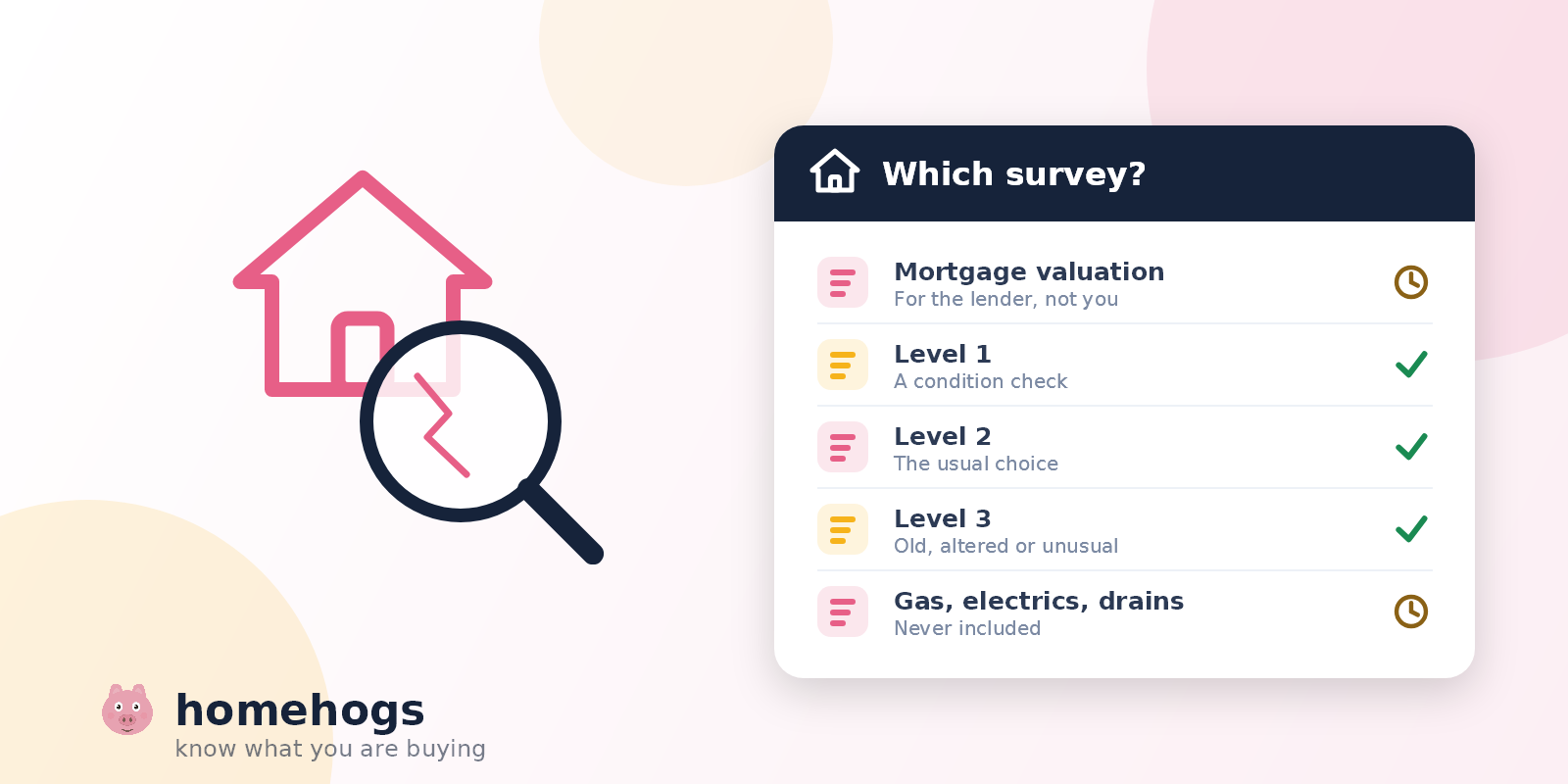
The lender's valuation is "a limited check on the property" for the lender's benefit (RICS), not a survey of its condition. A survey is yours: broadly, RICS Level 1 suits a newer home in good condition, Level 2 is the usual choice for a conventional home and Level 3 is the most detailed, for older, larger or much-altered homes. Our guide to house survey levels walks through which fits; RICS lists surveyors.
If the survey finds a problem, the usual options are a quote for the repair, asking the seller to fix it or reduce the price, a specialist report or walking away. All are normal at this stage.
Your mortgage offer
After the full application and the lender's valuation comes the formal mortgage offer, typically two to four weeks after you apply. Offers are generally valid for three to six months (FCA). Lenders can recheck before completion, so tell your adviser before changing jobs or taking on new credit.
Exchange of contracts
When the searches are back, the enquiries are answered, the mortgage offer is in and the survey is dealt with, you sign the contract and the mortgage deed and send your deposit to your conveyancer. The two conveyancers then exchange contracts, usually by phone, fixing the completion date. From that moment the purchase is legally binding: if you pull out, you lose your deposit and may owe the seller more. Lenders usually want buildings insurance in place from exchange.
Completion day
On completion day the money goes from your conveyancer to the seller's. Once it has arrived, the agent releases the keys, often by early afternoon, though a delay anywhere in a chain can push that later. Take meter readings and photos as soon as you arrive. Your conveyancer then pays the stamp duty, sends you a completion statement and registers you as owner at HM Land Registry, which can take some weeks.
Moving in
The first fortnight has its own list: meter readings, changing the locks, testing smoke and carbon monoxide alarms, finding the stopcock and fuse board, telling the council and your suppliers. Our guide to the first two weeks in a new home takes it day by day.
Your viewing-to-completion checklist
Work down this list from your first viewing to the week you move in.
Before you offer
- Agreement in principle in hand
- Deposit evidence ready, including any gifted deposit letter
- Sold prices of similar homes checked
- EPC, council tax band, flood risk and broadband checked
- Tenure confirmed; for a leasehold, the years left and the charges
- Second viewing done
Once your offer is accepted
- Conveyancer instructed, on your lender's panel
- Full mortgage application in
- Survey booked at the right level
- Lifetime ISA provider ready to pay your conveyancer, if you have one
- Buildings insurance quotes gathered
Before exchange
- Searches back and explained to you
- Survey problems priced, renegotiated or resolved
- Mortgage offer received and its conditions understood
- Contract, title and the seller's answers explained by your conveyancer
- Completion date agreed, with notice to your landlord if you rent
- Bank details for your deposit confirmed by phone
Exchange day
- Contract and mortgage deed signed
- Deposit sent
- Buildings insurance starts
Completion day
- Keys collected
- Meters read and photographed
- Condition and the items left photographed against the TA10 list
The first week
- Council tax, energy, water and broadband in your name
- Locks changed; smoke and carbon monoxide alarms tested
- Every document from the purchase saved in one place
What to keep afterwards
Completion is the one moment when all the paperwork about your home arrives together. Much of it you will need again: for a remortgage, an insurance or warranty claim and, one day, a sale (our guide to the documents you need to sell a house shows what a buyer will ask for).
- Completion statement. Exactly what you paid and to whom.
- Contract and transfer deed. Ask your conveyancer for copies.
- Title register and title plan. Once registration is complete, an online copy costs £7 each from HM Land Registry; an official copy, which counts as proof, costs £11.
- Mortgage offer and deed. The rate, when the deal ends and any early repayment charges.
- Survey report. Defects and recommended work, a useful baseline for years.
- Searches and the seller's answers. The TA6, TA10 and, for a leasehold, the TA7 and management pack: what you were told when you bought.
- Stamp duty paperwork. The return and the SDLT5 certificate HMRC issues, or the LBTT or LTT equivalent.
- Certificates and guarantees passed to you. The EPC, boiler service records, electrical certificates, FENSA or CERTASS window certificates, building regulations completion certificates, damp-proofing or timber guarantees, appliance manuals and any new-build warranty.
- Your own records from day one. Meter reading photos, a count of the keys, condition photos, your Lifetime ISA and gifted deposit paperwork.
Keep them for as long as you own the home, then pass the relevant ones to the next owner. It helps to keep each one with the thing it proves: the boiler guarantee with the boiler's service history, the window certificate with the windows. That is the idea behind a digital property logbook, which the government plans to make a standard part of buying and selling once it legislates (no law requires one today). homehogs is one: you can upload, photograph or email in documents, attach each to the room, appliance or job it belongs to and get reminders before a service or a guarantee falls due.
Buying in Scotland, Wales or Northern Ireland
- Scotland. The process is different. The seller must have a Home Report (a survey with a valuation, a property questionnaire and an energy report including the EPC), no more than 12 weeks old when the home goes on the market. Buyers can ask for a copy. Most homes are sold by blind bidding, with offers over or around a stated price; if several people note their interest, the seller sets a closing date. Your solicitor makes the formal offer, then the two solicitors exchange letters called missives. Once the missives are concluded you have a binding contract, after which pulling out can be costly (mygov.scot). The tax is LBTT, with first-time buyer relief.
- Wales. The legal process is the same as England's (offer, conveyancing, exchange, completion) and HM Land Registry covers both. The difference is the tax: LTT has no first-time buyer relief, but nobody pays it on the first £225,000.
- Northern Ireland. SDLT applies, with the same first-time buyer relief as England. The process follows the same outline as England and Wales, with a solicitor handling the contract and searches, but the paperwork differs and land is registered with Land and Property Services.
The Lifetime ISA and the Mortgage Guarantee Scheme work across the whole UK.
Sources
- GOV.UK: Stamp Duty Land Tax residential property rates
- GOV.UK: Stamp Duty Land Tax, how and when to pay
- legislation.gov.uk: Finance Act 2003, Schedule 6ZA (first-time buyers)
- Revenue Scotland: LBTT residential property rates and first-time buyer relief
- legislation.gov.uk: LBTT (First-Time Buyer Relief) (Scotland) Order 2018
- Welsh Government: Land Transaction Tax rates and bands
- Welsh Government: Land Transaction Tax guide
- GOV.UK: Chancellor's letter confirming the 2026 Budget date
- GOV.UK: Lifetime ISA
- GOV.UK: First Time Buyer ISA consultation
- GOV.UK: 2025 Mortgage Guarantee Scheme
- GOV.UK: Shared ownership
- GOV.UK: Inheritance Tax, rules on giving gifts
- Bank of England: CP6/26 high loan to income lending
- Bank of England: interest rate database (quoted rates, August 2026)
- FCA: interest rate stress test rule
- FCA: CP26/18 mortgage rule review
- FCA: support with mortgages and interest rates
- HM Land Registry: registration services fees
- GOV.UK: search the property register
- RICS: house surveys, costs, types and benefits
- GOV.UK: home buying and selling reform roadmap
- GOV.UK: homebuying reform announcement, June 2026
- legislation.gov.uk: Digital Markets, Competition and Consumers Act 2024, section 227
- GOV.UK: energy performance certificates when buying or selling
- mygov.scot: Home Report
- mygov.scot: making an offer
- nidirect: searching the land registry
- MoneyHelper: buying a home timeline (England, Wales and Northern Ireland)
- Which?: the cost of buying a house (updated 29 May 2026)
- HomeOwners Alliance: how long it takes to buy a house
- HomeOwners Alliance: gifted deposits
Last fact-checked 5 October 2026.
Start your home's record on day one
homehogs keeps your completion paperwork, certificates, guarantees and manuals together, each attached to the room, appliance or job it belongs to, with reminders before services and guarantees fall due. The free plan is enough to start.
Start free