Material information is anything an average buyer needs to decide whether to view, offer on or buy a home. Estate agents have a legal duty not to leave it out of a listing, though they depend on you for most of it. Here's the law as it stands, what happened to Parts A, B and C and a checklist of where to find each answer.
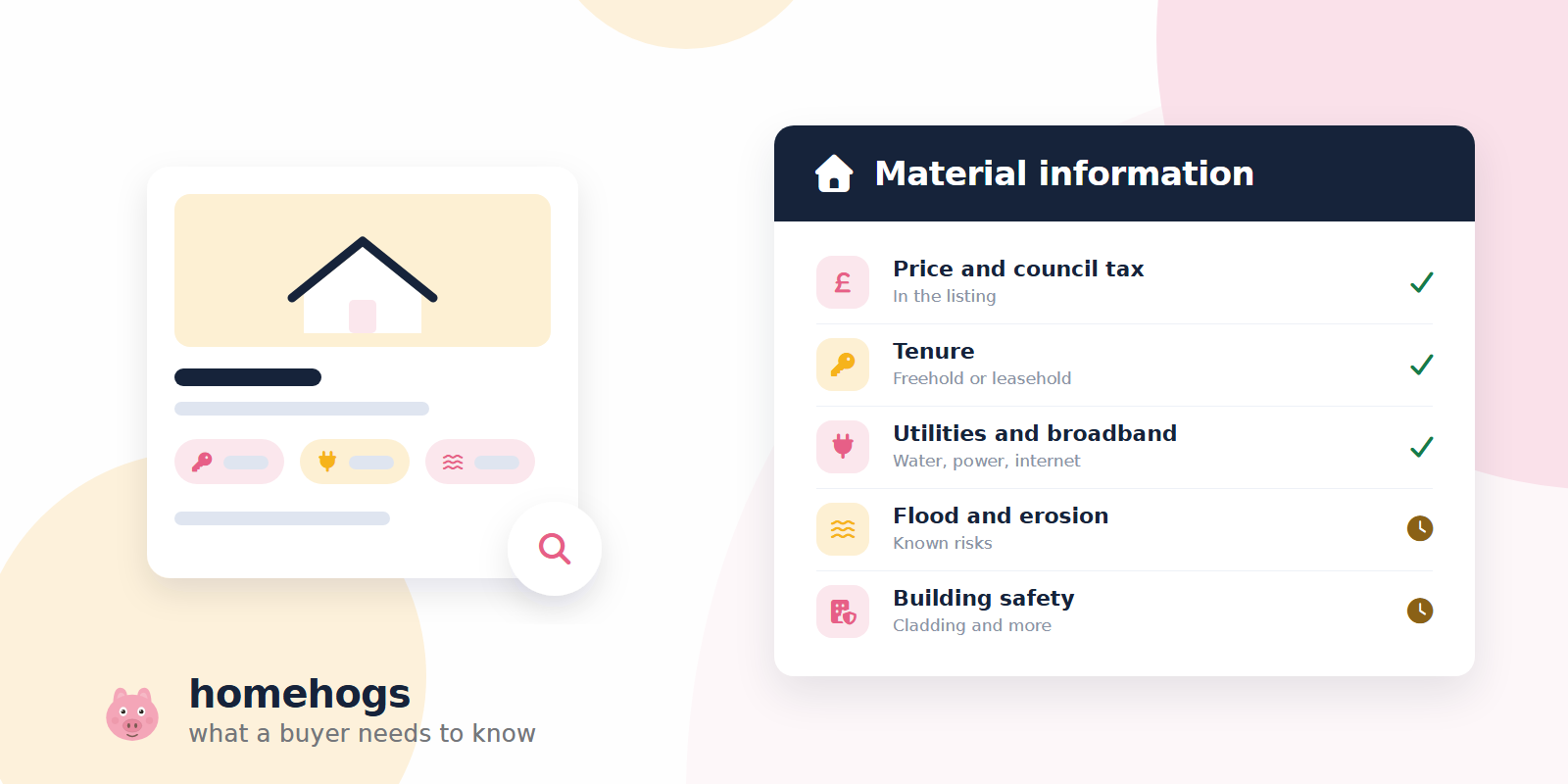
Material information is the information an average buyer needs to make an informed decision about a home: whether to view it, offer on it or walk away. There's no fixed list in law. Some things are material for every home, such as the price, the council tax band and the tenure. Others matter only where they apply, such as a history of flooding or a shared drive.
The legal duty sits with the estate agent. Under the Digital Markets, Competition and Consumers Act 2024, leaving material information out of a listing, or giving it in a way that's unclear or late, can be a misleading omission. Your agent can only publish what they know, though, which is why many agents hand sellers a questionnaire when they're instructed.
You may still see National Trading Standards' Parts A, B and C mentioned. That guidance was withdrawn in May 2025. The law it explained still applies. This guide covers where things stand, what usually counts and where to find each answer.
The short version
- Material information is what the average buyer needs to make an informed decision about a home; the law gives no fixed list.
- The duty sits with estate agents under section 227 of the Digital Markets, Competition and Consumers Act 2024, in force since 6 April 2025.
- National Trading Standards withdrew its Parts A, B and C guidance in May 2025, because the 2008 regulations it was written for had been replaced.
- The government said in June 2026 it will publish new guidance and a standardised form for gathering material information; neither had appeared by 5 October 2026.
- A homeowner selling their own home isn't bound by the Act, but the agent relies on their answers and a buyer may rely on what they say on the conveyancing forms.
- The usual categories are price, council tax, tenure and charges, the property itself, utilities, broadband and mobile, parking, flood and erosion, building safety, rights and restrictions, planning, accessibility and mining.
What material information means
The phrase comes from consumer law. Section 227 of the Digital Markets, Competition and Consumers Act 2024 defines it as "information that the average consumer needs to take an informed transactional decision". In a home sale, those decisions include whether to view, whether to make an offer and whether to go ahead with the purchase.
Three things follow from that wording:
- It depends on the home. A flood history is material for a home that has flooded and irrelevant for one that hasn't. In its 2025 consultation the government said it "will never be possible to comprehensively define" what every listing should include.
- Late or unclear counts as missing. The Act treats information given in a way that is "unclear or untimely", or where a buyer is unlikely to see it, as left out.
- The test is what would change a buyer's mind. The consultation said a listing shouldn't leave out information "that could lead the purchaser to rule out the property if it is revealed at a later stage".
Some things are always material once an advert gives a property's features and its price, which the law calls an invitation to purchase. These include the property's main characteristics, the total price and who the agent is.
The law today: the Digital Markets, Competition and Consumers Act 2024
The consumer protection part of the 2024 Act came into force on 6 April 2025. It replaced the Consumer Protection from Unfair Trading Regulations 2008, which is where the earlier material information rules came from. The Law Society's view is that the new Act contains "materially the same provisions"; the bigger change is in enforcement.
- Who it applies to. Traders, meaning businesses dealing with consumers. In an ordinary home sale that's the estate agent, not the homeowner. If you're selling as a business, a developer for example, ask your conveyancer how it applies to you.
- What it bans. Unfair commercial practices, including misleading actions and misleading omissions. These are criminal offences; the most serious cases can mean up to two years in prison.
- Who enforces it. Local trading standards services and the Competition and Markets Authority, which can now fine a business up to 10% of its global turnover.
- Where it applies. Across the UK.
If you're buying and think an agent has left out something important, the route to complain starts with the agent. After that comes their redress scheme: every estate agent dealing with residential property must belong to The Property Ombudsman or Property Redress. You can also report an agent to your local trading standards service.
What happened to material information Parts A, B and C
Before the 2024 Act, the National Trading Standards Estate and Letting Agency Team wrote guidance on what listings should include, in three stages:
- Part A, published on 12 July 2022: the price, the council tax band (or domestic rates in Northern Ireland) and the tenure.
- Part B, published in late 2023: things to establish for every home, such as its physical characteristics, utilities, broadband, mobile signal and parking.
- Part C, published alongside Part B: things to disclose where they apply, such as building safety, restrictions and rights, flood and erosion risk, planning, accessibility and coalfield or mining areas.
Property portals added listing fields for Part A. The Law Society's TA6 (5th edition) added questions to match the guidance.
In May 2025 National Trading Standards withdrew the guidance. Its statement explained that the guidance had been written for the 2008 regulations, which the 2024 Act had "superseded and replaced". The legal duty carried on under the new Act. What went was the official checklist.
In its June 2026 roadmap the government said it will publish non-statutory guidance explaining agents' duties under the 2024 Act, "with a view to ensuring that no further legislation on material information is required". It also plans a standardised form for gathering material information and plain-English guidance for buyers and sellers. It wants information gathered from source: title details from HM Land Registry, for example. The guidance was promised for later in 2026 and hadn't been published when we checked on 5 October 2026.
You'll still see the A, B and C headings on some agents' forms. They're a useful checklist; they just aren't official guidance any more.
Material information checklist: what it covers and where to find it
These are the categories the government listed in its 2025 consultation as likely to be material for most homes, grouped, with where a seller usually finds each answer. Not every row applies to every home.
| Item | What a buyer wants to know | Where you'll find it |
|---|---|---|
| Price | The asking or guide price | Agreed with your agent |
| Council tax | The band, or domestic rates in Northern Ireland | GOV.UK band checker in England and Wales; Scottish Assessors in Scotland; your rates bill in Northern Ireland |
| Tenure | Freehold, leasehold or share of freehold; years left on a lease | Your title register and your lease |
| Ground rent and service charge | What's payable and how often | Your latest demands and accounts |
| Type and rooms | Property type, number and use of rooms, floor area | Your floor plan; the EPC gives a floor area |
| Construction | Standard or not: thatch, timber frame, prefabricated | Your purchase survey or a surveyor |
| Known issues | Damp, subsidence, asbestos, Japanese knotweed | Surveys, repair invoices, any treatment plan |
| Utilities and heating | Electricity, water, mains drainage or a septic tank, heating type | Your bills; the EPC names the main heating |
| Broadband and mobile | Connection type, likely speed, signal | Ofcom's checker and your provider |
| Parking | Garage, driveway, allocated space or permit zone | Your title, lease or council permit |
| Flood risk | Flooding in your time, defences, claims, long-term risk | Your own records and insurer; long-term flood risk for England |
| Coastal erosion | Whether the nearby coast is eroding | The coastal erosion map for England |
| Building safety | For flats: cladding, fire safety work, who pays | Your freeholder or managing agent |
| Rights and restrictions | Rights of way, shared drives, covenants, listed status, conservation area | Your title register; your council |
| Planning | Permissions for your work; big plans nearby | Your paperwork; the council's planning register |
| Accessibility | Level access, ramps, lifts, adaptations | What you know; any adaptation paperwork |
| Mining | A former coalfield or other local ground risks | The coal mining check on GOV.UK |
| EPC | The rating; one must be ordered before marketing | Our EPC checker or the GOV.UK register |
A few notes on the trickier rows:
- Council tax. If the band looks wrong for your home, here's how to check and challenge your council tax band. Bear in mind a review can move a band up as well as down.
- Planning. If you've built an extension or converted a loft, buyers will want the paperwork; our guide to planning permission or building regulations explains which applies to what.
- Building safety. If you're selling a flat in England in a block 11 metres or taller, or with five or more storeys, expect questions about building safety work and the leaseholder protections under the Building Safety Act 2022. Your freeholder or managing agent holds the paperwork.
Our free home lookup brings some of this together by postcode: what nearby homes sold for, the EPC and, for homes in England, the Environment Agency's flood warning areas and planning protections such as conservation areas and listed buildings. It's a starting point, not a flood risk rating or a planning decision. It doesn't replace your conveyancer's searches.
Who is responsible: the estate agent, the seller or both?
- The estate agent carries the legal duty under the 2024 Act. They're expected to ask for the information, check what they reasonably can and present it clearly in the listing.
- You, the seller, aren't directly bound by the Act when you sell your own home. But the agent works from what you tell them. Respondents to the government's consultation said agents often depend on sellers, some of whom don't know key facts about their home or are reluctant to share bad news that could affect the price.
- Your answers on the conveyancing forms are a separate matter. The TA6 asks you to answer "truthfully, completely and as accurately as you can". The Law Society says a yes or a no is a statement the buyer may rely on. Where a seller gets it wrong, it notes, the result "might be misrepresentation".
If a listing says something you know is wrong, ask the agent to correct it and keep a note of what you told them and when.
How material information connects to the TA6 and logbooks
Material information is about the listing, before anyone offers. The TA6 property information form comes later, through your conveyancer. It goes into more detail on boundaries, disputes, alterations, guarantees and services.
The two used to overlap. The Law Society's TA6 (5th edition) added questions to match Parts A, B and C. The 6th edition, which firms in the Law Society's Conveyancing Quality Scheme must use for sales they take on from 30 March 2026, removed them again: council tax, asking price, tenure, physical characteristics, building safety, restrictive covenants, coastal erosion, accessibility and coalfield or mining. It no longer asks sellers for the EPC either, leaving that to the agent at marketing. So today the agent's questionnaire covers what goes in the listing and the TA6 covers what the buyer's conveyancer needs.
Looking ahead, the government's planned sales packs would gather much of this before a home is listed. Its draft list includes the tenure, council tax band, EPC rating, title documents, building safety information, searches and accessibility information. None of that is law yet; our guide to digital property logbooks sets out where the plans stand. Either way, a record of your home kept as you go means most of these answers are already written down when an agent asks.
Wales, Scotland and Northern Ireland
The 2024 Act applies across the UK, so agents everywhere must not leave out material information. The government expects most of its wider reforms to apply in England, Wales and Northern Ireland. The checkers differ by nation:
- Wales. Council tax bands are on the same GOV.UK service. For flooding, use Natural Resources Wales.
- Scotland. Sellers also need a Home Report before marketing: a survey with a valuation, a property questionnaire covering 16 categories (the council tax band, alterations and guarantees among them) and an energy report. Flood maps come from SEPA and coastal erosion data from Dynamic Coast.
- Northern Ireland. There's no council tax. Homes pay domestic rates based on a capital value, which is why Part A asked for rates information there. Check flooding through nidirect.
What to keep afterwards
Once the home is listed, keep a record of what was said about it. If a question comes up later, during the sale or after it, this shows where each answer came from.
- The agent's questionnaire as you filled it in, with the date.
- The listing as published, saved as a PDF or screenshots with the date. Listings can be edited, so a dated copy shows what buyers saw.
- Emails about corrections you asked for, with the agent's replies.
- The documents behind each answer: title register, lease and charges, council tax band, EPC, utility bills, broadband details, planning and building regulations papers, guarantees and any flood or insurance records.
- Your TA6 and TA10 answers and anything your conveyancer sent with them.
homehogs keeps a home's documents and certificates together, each attached to the record it proves. Its logbook page shows what's recorded and what's still missing, so most answers are to hand when the questionnaire arrives. For the full list a sale asks for, see what documents you need to sell a house and our house selling checklist.
Sources
- legislation.gov.uk: Digital Markets, Competition and Consumers Act 2024, section 227
- legislation.gov.uk: commencement of Part 4 Chapter 1 on 6 April 2025 (SI 2025/272)
- MHCLG: Material information in property listings, consultation document (October 2025)
- MHCLG: Home buying and selling reform roadmap, Chapter 12 (19 June 2026)
- National Trading Standards: Part A material information guidance (12 July 2022)
- National Trading Standards: Material information page, archived 14 May 2025, with the withdrawal notice
- National Trading Standards Estate Agency Team: Make a complaint about a property agent
- The Law Society: TA6 Property information form (6th edition)
- GOV.UK: Check your Council Tax band
- GOV.UK: Check the long term flood risk for an area in England
- GOV.UK: Check coastal erosion risk for an area in England
- GOV.UK: Find out if a property is affected by coal mining
- GOV.UK: Building safety leaseholder protections
- GOV.UK: Energy Performance Certificates when selling
- Ofcom: Broadband and mobile checker
- mygov.scot: Home Report
- nidirect: How rate bills are calculated
Last fact-checked 5 October 2026.
Have your answers ready before you list
homehogs keeps your home's certificates, guarantees and service records in one place and shows what's still missing, so an agent's questionnaire doesn't send you hunting through drawers.
Start free