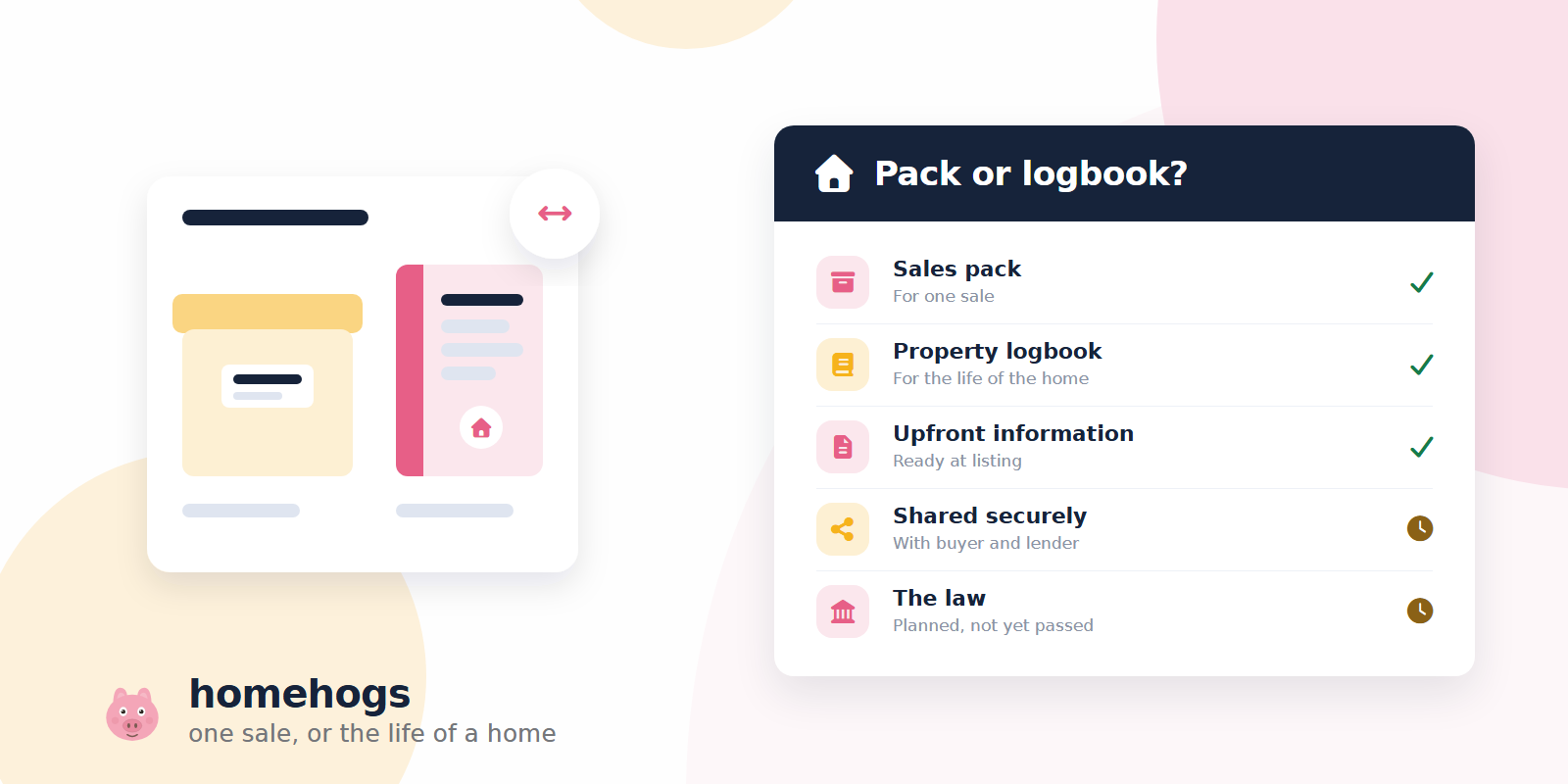
A digital sales pack gathers what buyers need for one sale, ready when a home is listed. A digital property logbook is the owner's record of the home, built up for as long as they own it. Neither is required by law yet, though the government plans to make both standard. Here's how they differ and fit together.
A digital sales pack is the information about one home put together for one sale, ready when it goes on the market. A digital property logbook is the owner's own record of the home, kept for as long as they own it and added to as things happen. The pack is a snapshot for buyers; the logbook is the history a pack can be drawn from.
Neither is a legal requirement anywhere in the UK as of October 2026. The government's June 2026 roadmap says it will legislate to make both a requirement for all property transactions when parliamentary time allows, with sales packs prepared before a home is listed.
Here's how the two compare side by side, how they're meant to fit together and what a seller can get ready now.
The short version
- A digital sales pack is prepared for one sale, before the home is listed, so buyers and their advisers see the key facts upfront.
- A digital property logbook is, in the government's words, an online secure record of information about a property, owned by the homeowner.
- The roadmap's draft sales pack list includes tenure, council tax band, EPC rating, title documents, searches, a condition report, leasehold costs, building safety and chain status.
- Neither is required by law as of 5 October 2026; the government plans legislation when parliamentary time allows and no bill has been introduced.
- The government also plans to require both in some of its own home ownership schemes from 2027, without yet naming which.
- Scotland already has a compulsory upfront pack, the Home Report; the plans aren't expected to apply there.
- A seller can prepare much of a sales pack now: the title, EPC, certificates, guarantees, leasehold papers and their answers to the usual questions.
What a digital sales pack is
In the government's plans, a sales pack is a standardised set of information "prepared before a property is listed, including property search and condition report results". The point is that buyers, their conveyancer, their lender and their surveyor see the key facts before an offer, rather than weeks into the sale.
The roadmap's draft contents, which it says are subject to change:
- About the home: tenure, council tax band, EPC rating, property type, a floor plan and accessibility information.
- Legal: title information and documents (known covenants, for example) and seller ID verification.
- Leasehold and estate costs: service charges, ground rent, estate rentcharges and managed freehold charges.
- Building safety: for example whether a block is mid or high rise and whether remediation has been identified.
- Searches: local authority, drainage and water, environmental and local risks such as mining or chalk.
- Condition: a property condition assessment report suited to the home's age and type.
- The seller's answers and plans: a property questionnaire and the chain status.
The seller would keep overall responsibility for the pack, with professionals gathering and checking their parts: conveyancers the legal and title information, surveyors the condition. Guidance still to come will say how and when information such as search results needs refreshing.
You'll also see the term on products sold today. Agents, conveyancers and data firms already offer upfront information packs under various names. Industry bodies slice it differently too: the Residential Logbook Association, for example, separates a marketing pack (for instructing an estate agent) from a digital sales pack (for instructing a conveyancer). homehogs is an associate member of the RLBA.
What a digital property logbook is
The roadmap describes digital property logbooks as "online secure records of information specific to a property owned by the homeowner". Where a sales pack is assembled for one sale, a logbook builds up over years: certificates, guarantees, work done, servicing, manuals, bills and the documents behind them.
The government notes that logbooks have "a wider role than just buying and selling". In practice that means running the home day to day: knowing when the boiler is due, finding the window guarantee, showing a tradesperson what was done last time.
Because it belongs to the owner, a logbook can outlast any one sale. Depending on how it's kept, it can be handed to the next owner, who carries on adding to it. Our home logbook guide covers what goes in one and how to start. Our guide to digital property logbooks sets out where the government's plans stand.
Digital sales pack vs digital property logbook: side by side
| Digital sales pack | Digital property logbook | |
|---|---|---|
| Purpose | Give buyers the key facts for one sale, upfront | Keep the home's history and paperwork in one place |
| Who prepares it | The seller, with their conveyancer, surveyor and search providers | The homeowner, often with a logbook provider |
| When | Before the home is listed | Throughout ownership, added to as things happen |
| What's in it | Title, tenure, council tax band, EPC, searches, condition report, leasehold costs, building safety, chain status | Certificates, guarantees, work records, servicing, manuals, bills and the documents behind them |
| How long it lasts | One sale; searches and reports date and may need refreshing | As long as the home, if it's handed on |
| Who sees it | Buyers, their conveyancer, lender, valuer and surveyor | The owner and whoever they choose to share it with |
| Legal status today | Not required anywhere in the UK (Scotland's Home Report aside) | Not required anywhere in the UK |
On the plans, the two travel together. The government says it will legislate to make "both digital property logbooks and sales packs a requirement for all property transactions when parliamentary time allows". From 2027 it plans to require them in some of its own home ownership schemes, which it hasn't named.
How the two fit together in the government's plans
The roadmap treats them as partners and brings them in by stages:
- Now (2026). Estate agents already have a legal duty to give material information in listings. The government is working with industry on sales pack information sellers could give voluntarily ahead of any law.
- Next (2027 to 2028). The government encourages uptake of digital logbooks and packs, considers which of its home ownership schemes should require them and sets up a voluntary accreditation scheme for data standards.
- Future, when parliamentary time allows. Legislation requiring sales packs before listing and making digital sales packs and logbooks "a standard feature of all property transactions". Binding conditional contracts, which would commit buyer and seller much earlier, follow only once packs are embedded.
When it legislates, the government says it will set "the minimum, standardised data that both products should contain", lined up with its sales pack requirements. It wants that data drawn from trusted sources: title information from HM Land Registry, for example, rather than retyped. Its standards work will be informed by the Residential Logbook Association's proof of concept on reaching HM Land Registry data from within logbooks and by the Open Property Data Association's work on its property data trust framework.
What the roadmap doesn't spell out is the mechanics: whether a pack will be built from a logbook, by whom and at what cost. The natural reading is that an up-to-date logbook holds much of what a seller brings to a pack (their answers, certificates, guarantees and leasehold papers), while searches and the condition report come fresh from professionals at the time of sale. That's a reasonable expectation, not a rule.
Haven't we tried this before?
England and Wales did have a compulsory upfront pack. Home Information Packs were required for most sales from 2007 until they were suspended on 21 May 2010.
The roadmap says the government has looked at why they failed. HIPs were criticised for adding cost, using jargon and not giving buyers the right information; they were paper-based and launched without proper industry involvement. This time, it says, the reforms are being designed with industry, will draw on trusted digital data and will be introduced in stages. When it consulted in October 2025, the government estimated that sellers who aren't buying again would see average net costs rise by £310, with first-time buyers saving on average. It has promised a full impact assessment before any legislation.
Scotland's Home Report and the rest of the UK
Scotland already has something close to a sales pack. A seller there must have a Home Report before marketing: a single survey with a valuation, a property questionnaire and an energy report including the EPC. Trading standards guidance says it must be no more than 12 weeks old when the home goes on the market. The seller or agent must provide it within nine days of a buyer asking.
The government doesn't expect its sales pack and logbook plans to apply in Scotland. It anticipates that most of its measures will apply in England, Wales and Northern Ireland, with the final reach of each decided case by case.
What a seller can prepare now
Nothing here is required yet, but most of a sales pack is paperwork a sale already needs. This maps the roadmap's draft list to what you can have ready today.
| Draft sales pack item | Ready now? | Where it comes from |
|---|---|---|
| Title information and documents | Yes | HM Land Registry: £7 each online for the register and plan |
| Tenure and council tax band | Yes | Your title register; the GOV.UK band checker |
| EPC rating | Yes, if it's in date | The register, or an accredited assessor for a new one |
| Property type and floor plan | Yes | Your own records, or a floor plan from your agent |
| Leasehold and estate charges | Partly; a full management pack takes time | Your freeholder or managing agent |
| Building safety information | For flats, ask early | Your freeholder or managing agent |
| Property questionnaire | Your answers, yes | The TA6, through your conveyancer |
| Searches | Possible if you instruct early | Your conveyancer; today buyers' conveyancers usually order them |
| Condition report | No standard version yet | Some sellers commission a survey of their own |
| Accessibility information | Yes | What you know about access and adaptations |
| Chain status | Yes | Your own plans |
| Seller ID verification | When you instruct | Your conveyancer or agent |
For the detail on each, see what documents you need to sell a house and what the TA6 property information form asks. If you're leasehold, service charges and ground rent explains what the accounts should show. If you're weighing up a survey of your own, house survey levels explained compares the options.
What to keep afterwards
A pack is used once; the records behind it are worth keeping on both sides of the sale.
- If you're selling: keep a copy of what you gave the buyer's side, your completed forms, the contract and the completion statement. Hand the next owner what belongs with the house: guarantees, certificates, manuals and the service history.
- If you're buying: the sales pack and your conveyancer's report are the first pages of your own record. Keep the searches, the survey, the title documents, the EPC and every guarantee that passed to you, then add to it as you go.
homehogs is a digital home logbook, not a sales pack. It keeps documents, certificates and guarantees attached to the records they prove, with a dated history of work and servicing. Its logbook page shows what's still missing. It can produce a Sale-Ready Property Record PDF to work from during a sale and a handover pack for the next owner. Searches, a condition report and the legal work still come from professionals.
Sources
- MHCLG: Home buying and selling reform roadmap, Chapters 4 and 6 and Annex B (19 June 2026)
- MHCLG: Homebuying shake-up press release (18 June 2026)
- MHCLG: Home buying and selling reform consultation (6 October to 29 December 2025)
- MHCLG: Material information in property listings, consultation document
- legislation.gov.uk: Home Information Pack (Suspension) Order 2010
- mygov.scot: Home Report
- Business Companion (trading standards): Home Reports and EPCs in Scotland
- GOV.UK: Get information about property and land
- GOV.UK: Check your Council Tax band
- Residential Logbook Association: Upfront information
- Open Property Data Association: Smart Property Data Trust Framework
Last fact-checked 5 October 2026.
Build the record a sales pack draws on
homehogs keeps your certificates, guarantees and work history together and shows what's still missing, so the papers a sale needs are already in one place when you come to sell.
Start free