Digital property logbooks have moved from a niche idea to a named part of UK housing policy. Here's what the government's roadmap says, how homeowners are starting to get their own data through a logbook, what a verified logbook is and why it's worth starting one long before you sell.
Digital property logbooks have moved from a niche idea to a named part of UK housing policy. The question has changed from whether every home will have one to how quickly.
Think about where the information about your home lives today. The deeds are with a solicitor. The boiler warranty is in an email. The EPC is on a government register. The receipt for the new kitchen is in a drawer. When you sell, all of it has to be pieced back together under pressure, usually by a conveyancer asking for things you last saw five years ago.
This autumn we joined the first all-members meeting of the Residential Logbook Association (RLBA), as one of its associate members. The RLBA is the industry body for digital property logbook providers. The mood in the room was clear: after years of pushing, government and industry are now coming to the logbook sector rather than the other way round.
The short version
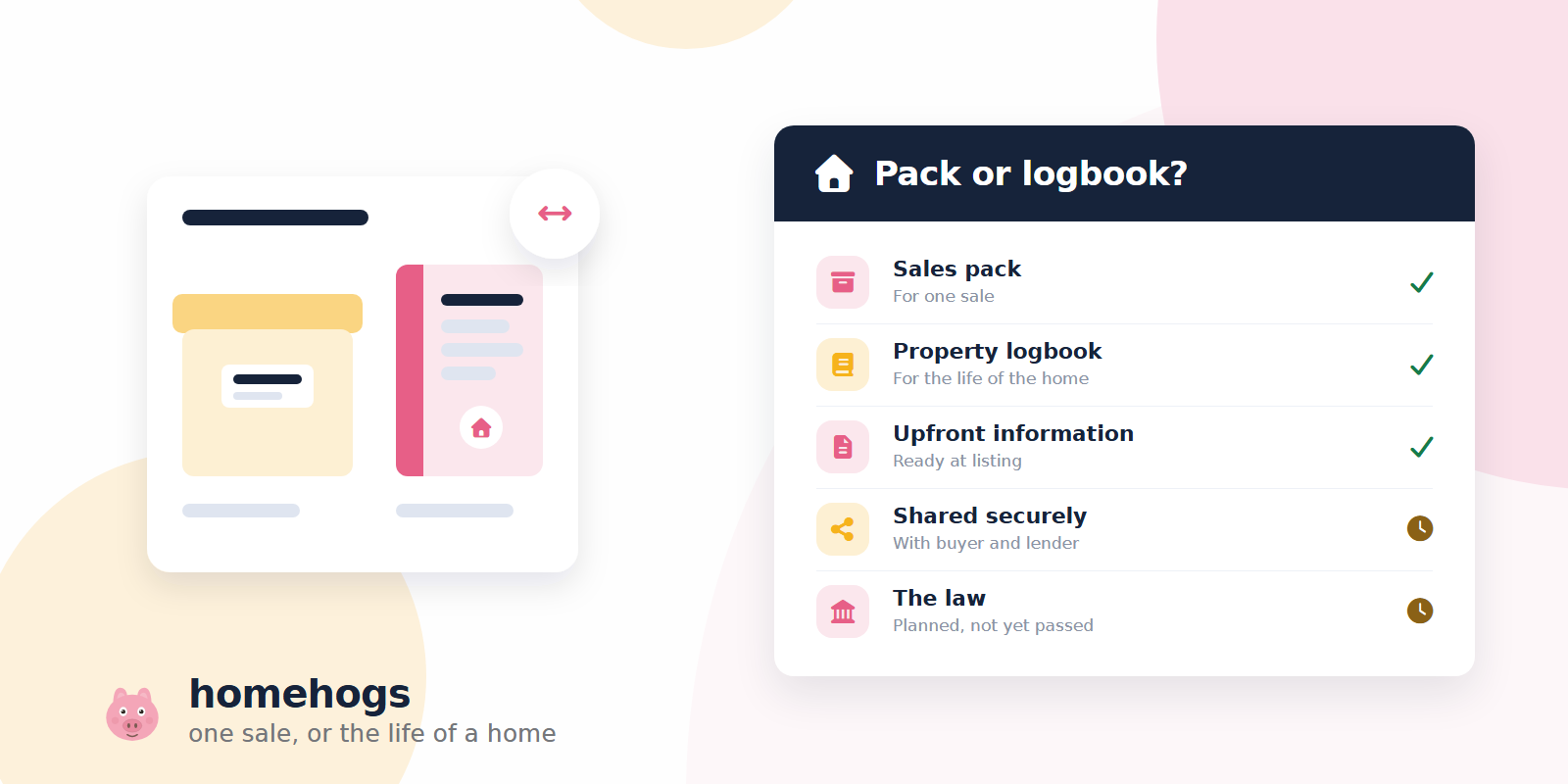
- The government's June 2026 roadmap plans to make digital property logbooks and sales packs a standard part of every sale, once Parliament finds the time.
- A logbook is a record of the home that stays with the property and passes to the next owner.
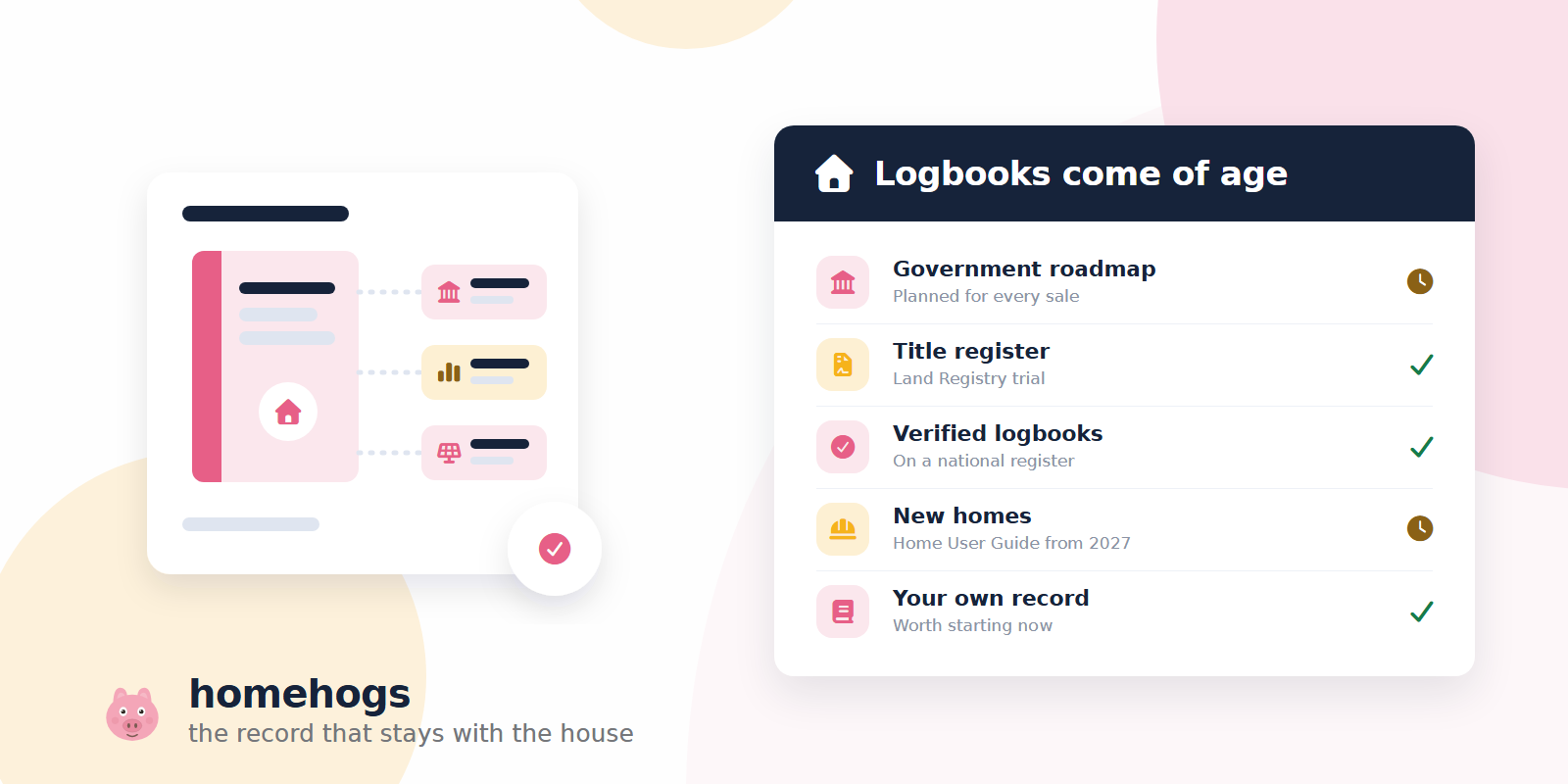
- Homeowners are starting to reach their own data through a logbook, beginning with a Land Registry trial that started in June 2026.
- A verified logbook is one whose owner has been checked. Verified logbooks are listed on the RLBA's National Logbook Register.
- New homes, retrofit, product passports and leasehold reform all open new routes in beyond selling.
- A logbook started years before a sale is fuller, more trusted and far less stressful than one built in a rush.
What a digital property logbook is
A digital property logbook is a living record of a home that stays with the property, not the person. It holds title details, plans, certificates, works carried out, appliances and warranties. It is handed on when the home changes hands. The RLBA's own explainer, What is a property logbook?, describes it as a digital companion to the home that grows more useful as documents are added. It is keyed to the property's Unique Property Reference Number (UPRN), so it follows the building rather than its owner.
The RLBA's long-term goal is simple: every home in the UK should have one. That is around 30 million homes (England alone had 25.6 million dwellings in March 2024, with Wales adding almost 1.5 million). It also wants a market of many providers, not a single government product. A new-build flat and a country farmhouse facing years of retrofit have very different needs. Different logbooks will serve them best.
That creates a balance the sector keeps returning to. There must be enough common standards for regulated industries such as conveyancing, lending and energy to trust a logbook. There must also be enough freedom for providers to innovate.
If you're new to the idea, our earlier guide to what digital property logbooks mean for UK homeowners covers the basics.
Government is now on board
The biggest shift came on 19 June 2026, when the Ministry of Housing, Communities and Local Government published its home buying and selling reform roadmap. It responds to the home buying and selling reform consultation that ran from October to December 2025. In it the government commits to "legislate to make both digital property logbooks and sales packs a requirement for all property transactions when parliamentary time allows". It also says the requirement will start in government home ownership schemes in 2027 and that industry can already provide these products today. The RLBA's proof of concept with HM Land Registry is named in the roadmap as informing how logbooks will be developed.
Other parts of the industry are following:
- Sale packs. The roadmap would require a sales pack, including searches and a property condition report, to be prepared before a home is listed. A logbook is a natural place to start building that pack, long before a home goes on the market. The RLBA says its survey of providers found they can already produce the digital marketing and sales packs the government is asking for. Agents already have to give buyers material information in a listing.
- Conveyancing. The Law Society is consulting on the first update to its Conveyancing Protocol since 2019, with responses due by 14 January 2027. The draft recognises digital identity checks, document exchange and lender portals.
- Lending. The finance industry's interest in pre-clearing properties for a mortgage from logbook data goes back several years. The roadmap itself looks at reusing machine-readable property data with lenders to make remortgaging quicker.
For homeowners, this means the logbook is becoming part of the process rather than an optional extra.
Your home's data should be yours
The core principle is that homeowners should be able to reach their own property data easily and free of charge. They should also control who else sees it. Logbooks are increasingly positioned as a consumer-protection tool that represents the homeowner in a market where property and energy data is often hard to reach.
| Type of data | Examples | The aim |
|---|---|---|
| Public | Planning records, the title register, EPCs | Logbooks get at least the same access as anyone else, ideally through an API |
| Restricted | Installation records, building control, meter data | Released to the verified homeowner, through their logbook, with consent |
| Private | Receipts, photos, manuals, warranties | Uploaded by the owner and shared only when they choose |
Restricted data is where most progress is being made. In June 2026 the RLBA and HM Land Registry began a 12-month trial that gives homeowners their own title register data inside their logbook. Four RLBA-registered providers are taking part, the usual fee is waived for the pilot and only the homeowner and the professionals they authorise can see the data. Official copies are still needed for a sale.
Consumer bodies are adding their weight. Citizens Advice's report Stepping Up: reforming protections in the retrofit market calls for every home with low-carbon technology, such as solar panels, heat pumps or EV chargers, to be given a building logbook (as reported by Today's Conveyancer). Which? had earlier recommended that every home's EPC link to a logbook.
Verified logbooks and the National Logbook Register
The data holders' worry is always the same: how do they know they are releasing data to the right person? The answer is the verified logbook: one whose owner's identity and link to the property have been checked.
Verified logbooks are listed on the National Logbook Register, which the RLBA launched in 2023 to give conveyancers a verified record of logbooks for UK addresses. A logbook joins it once a regulated professional, such as a conveyancer or estate agent, has checked who owns it. Data holders can then check a logbook against the register before they release anything, which is exactly how the Land Registry trial works.
Beyond buying and selling
A little over a million UK homes change hands each year (HMRC counted 1.1 million residential transactions in 2024). Relying on sales alone would take decades to reach every home, so the sector is building other routes in.
- New builds. The Future Homes and Buildings Standards, confirmed in March 2026, take effect on 24 March 2027. They require developers to give buyers a Home User Guide explaining how to run the home, heat pump included (see the government's response). Folding that guide into a logbook would give new homes one from day one.
- Energy and retrofit. As homes add solar panels, heat pumps and EV chargers, the case for a single record grows. The RLBA's retrofit grant consortium, its May 2026 response to the government's smart data reports and the Energy Saving Trust's Retrofit Proposition Toolkit, built with TrustMark and the RLBA, show where this is heading.
- Products and appliances. Digital product passports are already law in Europe under the Ecodesign for Sustainable Products Regulation, in force since July 2024 and being phased in product by product, starting with batteries in February 2027. They would let a logbook pull manufacturer data for each product in a home.
- Repairs and maintenance. If a contractor knows the exact make and model before arriving, many jobs can be fixed in one visit rather than two or three.
- Leasehold and commonhold. The draft Commonhold and Leasehold Reform Bill, published in January 2026, would make commonhold the default for new flats. That is a chance to give every flat in a block its own logbook from the start.
What this means for homeowners
It is worth starting a logbook now, not when you decide to sell. A record built up over years of ownership is more complete and more trusted than one assembled in a rush. It is much less stressful too. It also helps with everyday ownership: servicing reminders, warranty claims, insurance and finding the right part when something breaks.
That is the gap homehogs is built for. Our home management app helps homeowners keep their home's logbook in one place throughout ownership, then hand it over cleanly at the point of sale. As standards for verified logbooks, sale packs and data access mature, we intend to build to them, so the work our members put in today keeps paying off when they move.
The market for digital property logbooks barely existed a few years ago. With government, lawyers, lenders and energy bodies now pulling in the same direction, it is arriving fast.
Sources
- MHCLG: Home buying and selling reform roadmap (19 June 2026)
- Residential Logbook Association: What is a property logbook? and News
- Today's Conveyancer: Homeowners to be given access to HMLR data in digital property logbook trial (3 June 2026)
- Estate Agent Today: Upfront digital sales packs are ready for use, says trade group (July 2026)
- The Law Society: Proposed updates to the Conveyancing Protocol (consultation closes 14 January 2027)
- Citizens Advice: Stepping Up, reforming protections in the retrofit market (17 October 2025)
- Which?: Reforming EPCs to support households in the energy transition (June 2024)
- MHCLG: Future Homes and Buildings Standards consultation response (March 2026)
- MHCLG: Draft Commonhold and Leasehold Reform Bill (27 January 2026)
- EUR-Lex: Regulation (EU) 2024/1781, the Ecodesign for Sustainable Products Regulation
- HMRC: Monthly property transactions completed in the UK
- MHCLG: Dwelling stock estimates, England, 31 March 2024 and Welsh Government: Dwelling stock estimates, 31 March 2024
Last fact-checked 29 October 2026.
Start your home's logbook today
homehogs keeps your certificates, guarantees, appliances and work history in one place for as long as you own your home, then hands the record on when you sell. The logbook is on every plan, free included.
Start free