The Renters' Rights Act 2025 changed every private tenancy in England on 1 May 2026. More arrives in stages: the landlord register from 15 December 2026, an ombudsman expected in 2028 and the Decent Homes Standard in 2035. Here's what's in force, what was due by 31 May 2026 and what's coming, each with its status and source, then a checklist to work through.
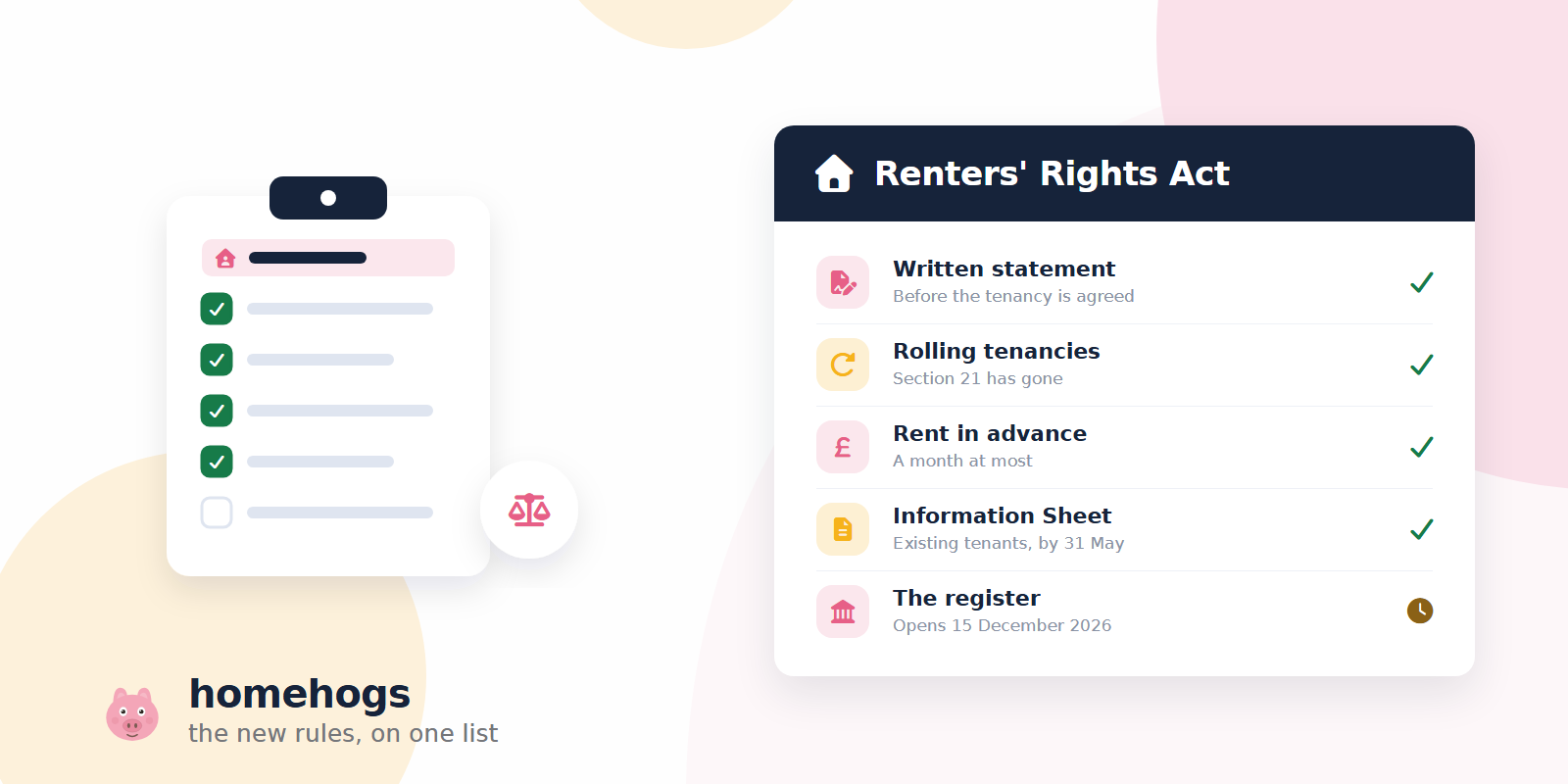
Under the Renters' Rights Act 2025, landlords in England now let on rolling tenancies with no section 21, give a written statement of terms before a tenancy is agreed, take no more than a month's rent in advance, advertise one fixed rent and raise it no more than once a year by formal notice. Those rules have applied to every private tenancy, new and existing, since 1 May 2026. Landlords with existing written tenancies also had to give their tenants the government's Information Sheet by 31 May 2026.
More arrives in stages: the landlord register from 15 December 2026, a landlord ombudsman expected in 2028 and the Decent Homes Standard in 2035. Below is each change with its status and its source, then a have-you-done-this checklist. It covers England only; Wales and Scotland have their own systems, with pointers at the end.
If you let one or two homes and all this landed on top of a day job, you're in good company. Most of it is a one-off tidy of paperwork and habits rather than new work every month.
The short version
- The Renters' Rights Act 2025 became law on 27 October 2025 and its first phase applied to every private tenancy in England from 1 May 2026.
- Section 21 has gone and every assured tenancy is now rolling, ended by the tenant with two months' notice or by the landlord on a legal ground.
- New tenants must get a written statement of terms before the tenancy is agreed; missing it can mean a penalty of up to £7,000.
- Existing written tenancies needed the government's Information Sheet by 31 May 2026, as a printed copy or a PDF attachment, never a link.
- Rent in advance is capped at one month, adverts must state one rent and increases come once a year by section 13 notice.
- The landlord register opens on 15 December 2026, with every region's deadline passed by 14 November 2027.
- The ombudsman (expected in 2028), the Decent Homes Standard (2035) and Awaab's Law for private renting (no date yet) are still to come.
The Renters' Rights Act timeline for landlords
The Act is being switched on in stages, following the government's implementation roadmap. Two related changes from outside the Act are included because they land on the same landlords.
| Date | What changes | Status | Source |
|---|---|---|---|
| 27 October 2025 | The Act receives Royal Assent | Law | legislation.gov.uk |
| 27 December 2025 | Councils can inspect, demand documents and use third-party data | In force | Roadmap |
| 1 May 2026 | Section 21 abolished, rolling tenancies, written statement, rent in advance cap, bidding ban, once-a-year increases, pets, no discrimination against children or benefits | In force | Guide to the Act |
| 31 May 2026 | Information Sheet for existing written tenancies; written terms for spoken ones | Deadline passed | GOV.UK |
| 1 October 2026 | New Right to Rent code of practice (immigration law, not this Act) | In force | Home Office code |
| 15 December 2026 | Landlord register opens; West Midlands first | Announced | Get ready to register |
| 14 November 2027 | Last regional register deadline, for the South West | Announced | Get ready to register |
| 2028 | Landlord ombudsman membership expected | Announced, no fixed date | Roadmap |
| 1 October 2030 | EPC band C equivalent for all private lets (energy rules, not this Act) | Announced, not law | Government response |
| 2035 | Decent Homes Standard applies to private renting | Announced | Government response |
| Not set | Awaab's Law for private renting | Committed, no date | Roadmap |
| Not set | Rent increase challenges move to a Valuation Office Agency service | Announced | GOV.UK news |
Dates marked announced can move, so check the source before relying on one.
What's in force since 1 May 2026
These apply to every private tenancy in England, including ones that began before 1 May 2026. GOV.UK's guide for landlords covers each in detail.
- Rolling tenancies, no section 21. Every assured tenancy is now periodic; existing fixed terms converted automatically. A tenant can leave with two months' notice.
- Possession only on a ground. To get a home back you serve a section 8 notice on the correct form naming a legal ground and usually need a court order. Notice is usually at least two months and can be up to four.
- Selling or moving in. These grounds need four months' notice, can't be used in the first 12 months of a tenancy and stop you marketing or reletting the home for 12 months after using them.
- A written statement before the tenancy. New tenants get written information on the key terms before anything is signed or agreed. What you have to give a new tenant lists what it covers.
- Rent in advance. Nothing before the agreement is signed; after that, at most one month's rent (or 28 days' rent for shorter rent periods) before the tenancy starts. Deposits stay capped at five weeks' rent, or six where the annual rent is £50,000 or more.
- No rental bidding. Adverts must state one rent rather than a range. You can't ask for, encourage or accept offers above it.
- Rent increases once a year. Only by a section 13 notice on Form 4A with at least two months' notice, never in the first year of a tenancy. A tenant can challenge it at the First-tier Tribunal. Rent review clauses no longer work.
- Pets. You can't unreasonably refuse a tenant's request to keep a pet and must reply in writing within 28 days, a little longer if you ask for more information.
- No discrimination against families or people on benefits. Turning people away for having children or claiming benefits is unlawful. The government says clauses like that in mortgage, insurance and tenancy documents no longer have effect.
- Deposits and possession. A court can't make a possession order while a deposit is unprotected or the prescribed information hasn't been given, except on the anti-social behaviour grounds (section 215 of the Housing Act 2004).
What landlords had to do by 31 May 2026
Tenancies that already existed on 1 May 2026 didn't need new agreements. They needed one of two things by 31 May 2026:
- A written tenancy agreement: give every tenant The Renters' Rights Act Information Sheet 2026, as a printed copy handed over or posted, or the PDF attached to an email or a text. A link to the PDF isn't valid. A letting agent managing the home had to give it too, even if the landlord already had.
- A spoken agreement only: give the tenant a written statement of the tenancy's terms instead.
Where a valid section 21 or section 8 notice had been served before 1 May 2026, the sheet is due within one month of the notice expiring or the proceedings ending. Missing either duty can mean a penalty of up to £7,000.
If it slipped past you, putting it right now is better than leaving it, though it doesn't undo the missed date; a landlord association or a solicitor can tell you where that leaves you. The government's own landlord checklist also lists updating rent increase processes, adverts, websites and internal documents.
What's coming next and what to do now
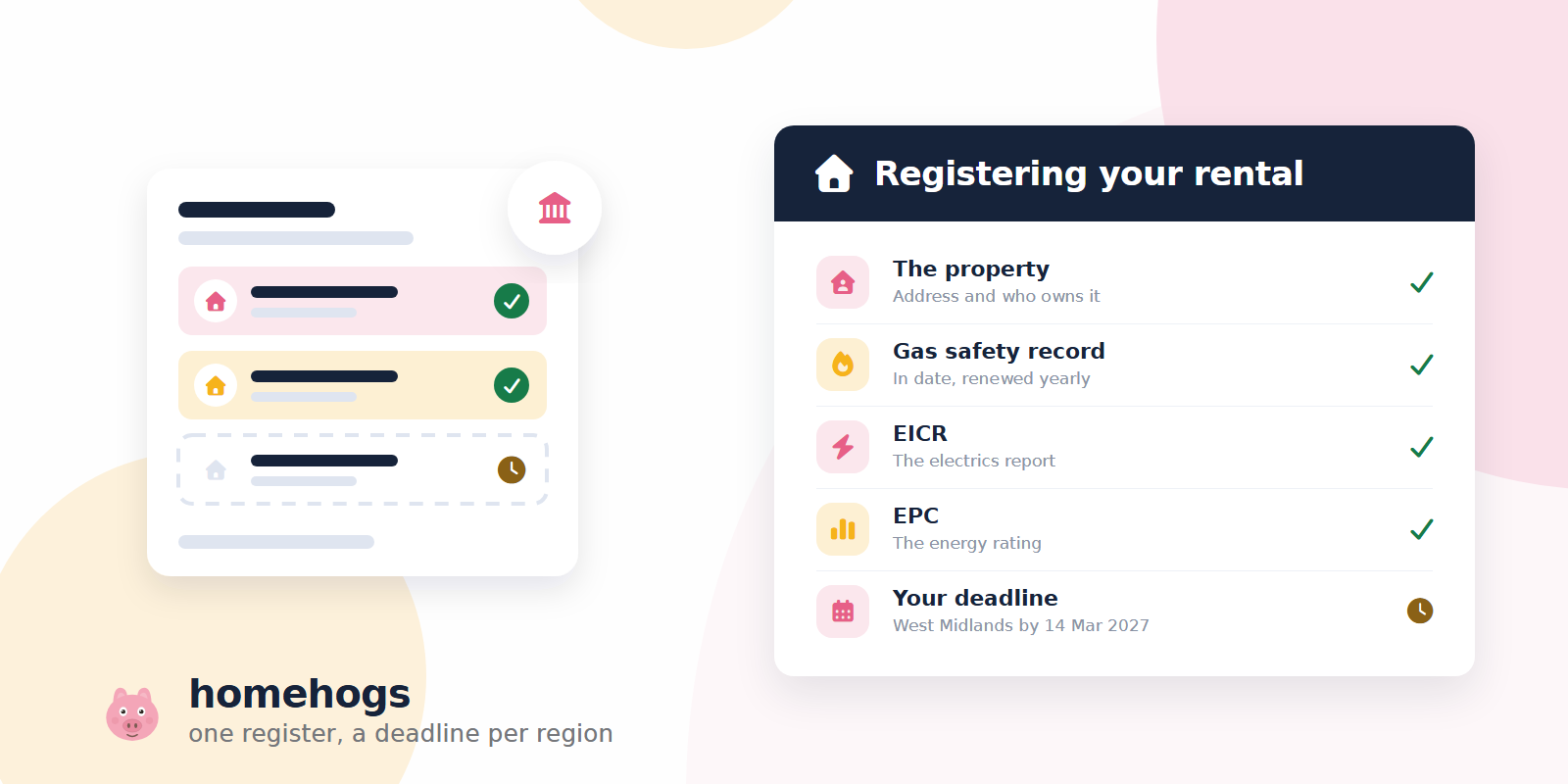
- The landlord register, from 15 December 2026. Every landlord of an assured or regulated tenancy in England registers themselves and each home they let. Anyone can register from 15 December 2026; regions are then called forward a month apart, the West Midlands first, each with three months, until 14 November 2027. The government says the fee is £65 per property per year. You'll need each home's gas safety record, EICR and EPC. England's landlord register has every region's dates and our free landlord register checker tells you yours.
- The landlord ombudsman, expected in 2028. Membership becomes compulsory once the government is confident the service is ready, with an annual fee per property. It will be able to require landlords to apologise, provide information, put things right or pay compensation. Not joining once it's required can mean a penalty of up to £40,000. No operator has been confirmed.
- The Decent Homes Standard, from 2035. A reformed standard will apply to privately rented homes, with enforcement starting in 2035.
- Awaab's Law, no date yet. The Act lets the government extend Awaab's Law, which sets deadlines for dealing with serious hazards such as damp and mould, to private renting. No date has been set. Damp and mould already fall under your existing repair and fitness duties; condensation, damp or mould explains how to tell them apart.
- EPC band C by 2030, policy rather than law. Separately from the Act, the government has announced that private lets should reach the equivalent of band C by 1 October 2030, with a £10,000 cost cap. The legislation isn't made yet and today's minimum is still E. What your EPC actually tells you explains the recommendations worth reading now.
- Rent challenges. The government plans to move rent increase challenges from the tribunal to a Valuation Office Agency service. No date has been set, so the First-tier Tribunal still decides them.
Have you done this? The landlord checklist
Work through these for each home. Anything you can't answer yes to is the next job.
Tenancies you already had
- Information Sheet given to every tenant with a written agreement, as a printed copy or a PDF attachment, with proof kept.
- Written terms given for any tenancy agreed only out loud.
- Records updated so nothing relies on a fixed-term end date or a rent review clause.
- Rent increases moved to section 13 notices on Form 4A.
Every new tenancy
- A current agreement template that includes the written statement, given before anything is signed or agreed.
- No rent taken before signing and no more than a month's rent in advance after it.
- Deposit within the cap, protected within 30 days with the prescribed information served.
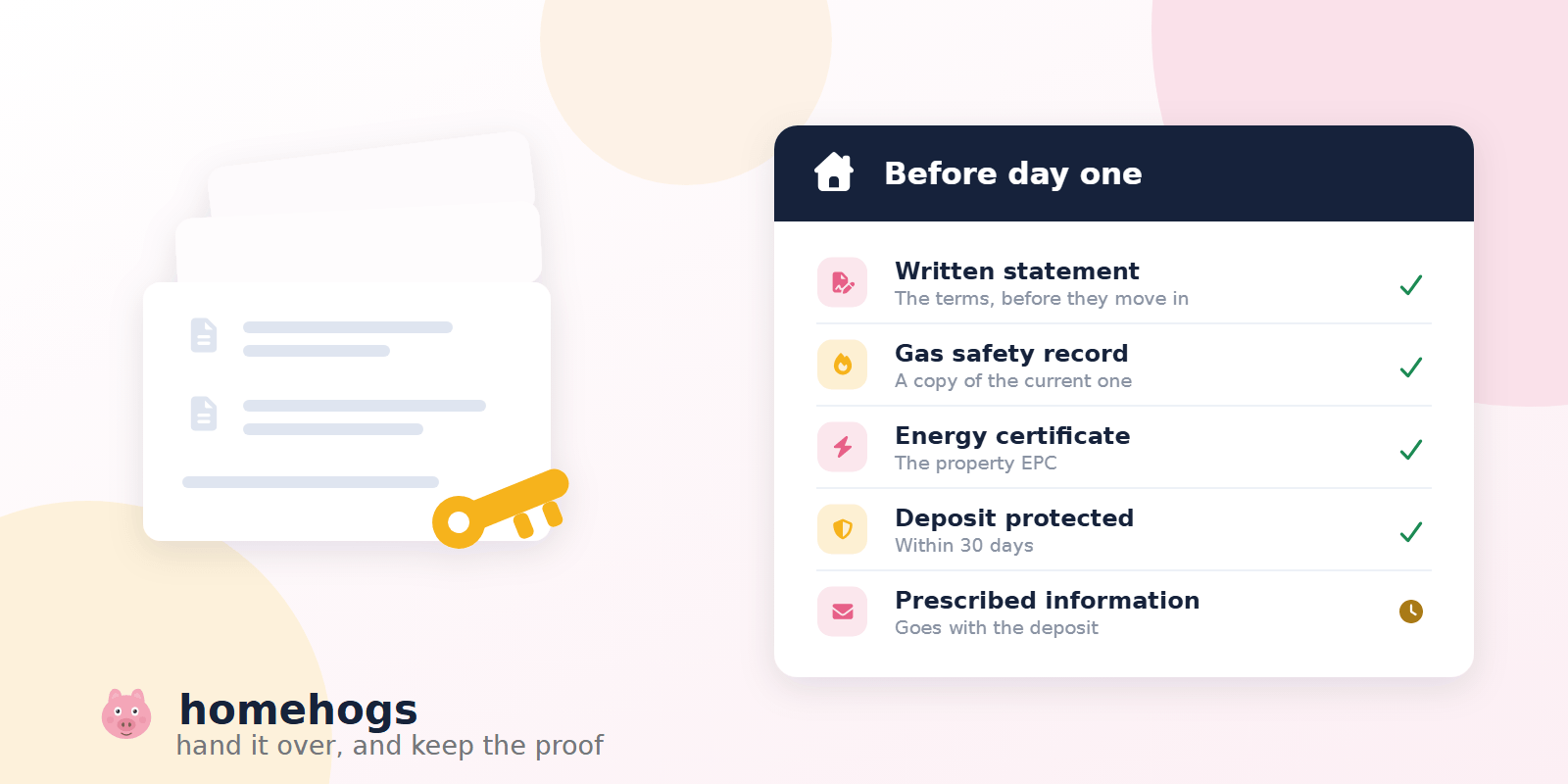
- Certificates and checks done: gas safety record and EICR before move-in, EPC with the advert, alarms checked on day one and Right to Rent checks beforehand. What you have to give a new tenant has the full list.
Adverts, requests and notices
- Adverts state one rent and you turn down offers above it.
- No 'no children' or 'no benefits' wording in adverts, criteria or agreements.
- A pet request process that answers in writing within 28 days.
- Possession plans checked against the grounds, the notice periods and the 12-month protected period.
Getting ready for what's next
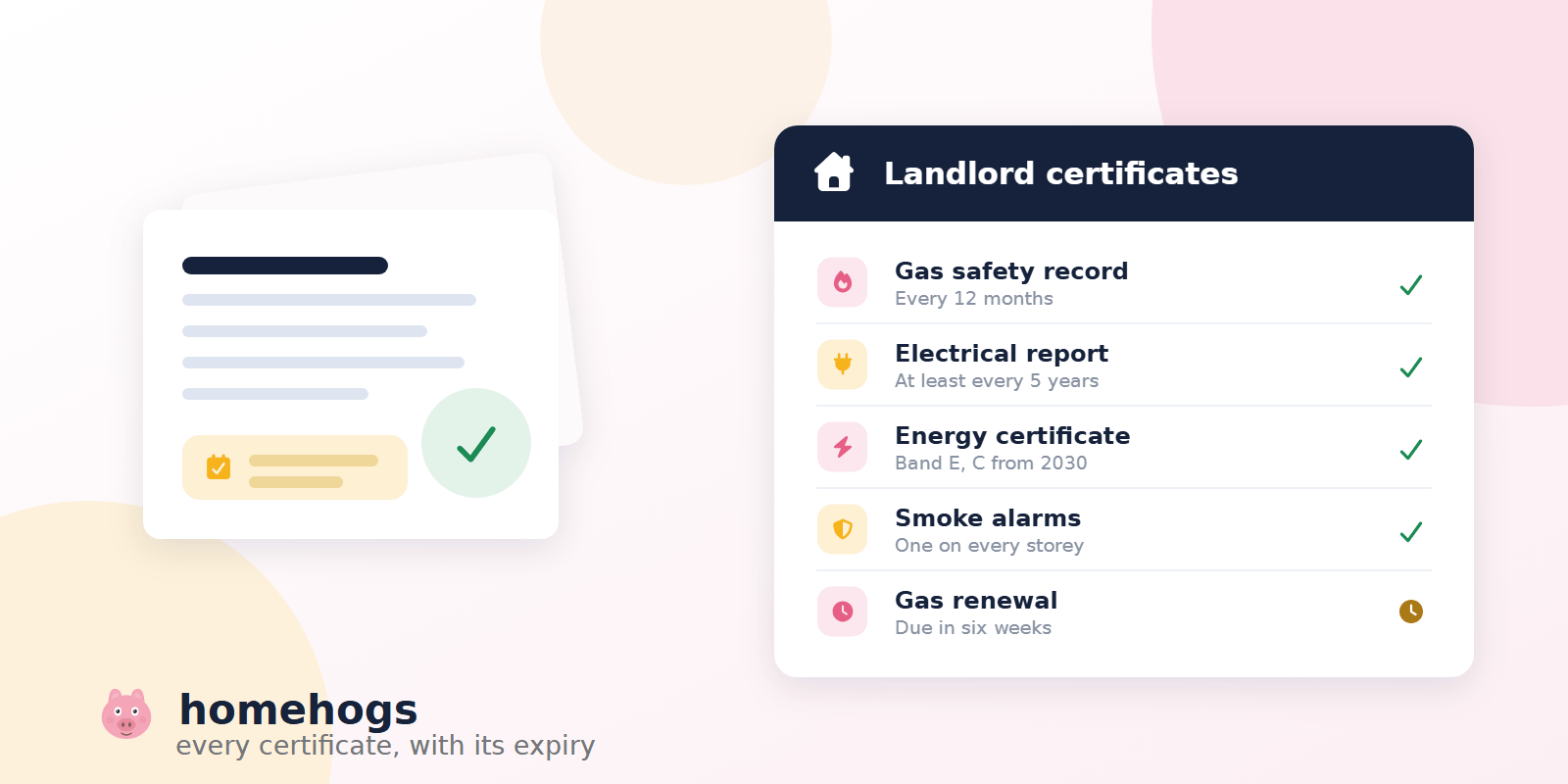
- Certificates in date and in one place for every home; landlord safety certificates has the renewal cycles.
- Your region's register window in the diary, with £65 per home set aside.
- EPC recommendations read with the 2030 proposal in mind.
- Damp and mould reports answered promptly and written up.
Penalties and enforcement
Councils enforce most of the Act and have had stronger powers to investigate since 27 December 2025, including inspecting homes and demanding documents. GOV.UK sets out the enforcement measures:
- Up to £7,000 for initial or minor breaches, such as claiming a tenancy has a fixed term, ending a tenancy verbally, not giving the written statement or not giving the Information Sheet
- Up to £40,000, or prosecution with an unlimited fine, for offences such as reletting within 12 months of using the selling or moving-in grounds, knowingly or recklessly relying on a ground that doesn't apply, repeating a breach within five years or carrying on 28 days after a penalty
- Rent repayment orders of up to two years' rent for certain offences
- No possession order while a deposit is unprotected, except on the anti-social behaviour grounds
Once the register's deadline has passed in your region, letting a home that isn't registered can bring a penalty of up to £7,000 too.
What to keep as evidence
Every duty here comes down to showing what you did and when. For each tenancy, keep:
- Proof the Information Sheet or the written terms went out, with the date and the method
- The tenancy agreement or written statement as given
- Every section 13 rent increase notice and how it was served
- Pet requests and your written replies
- The adverts you ran, showing the rent stated
- The deposit protection certificate and the prescribed information
- The gas safety record, EICR and EPC with their dates, plus proof each reached the tenant
- Right to Rent checks, for the tenancy plus one year
- Any notice seeking possession, with the ground relied on and how it was served
A council, a court and in time the ombudsman will all decide on what you can show rather than what you remember. If you use homehogs, the tenancy, its certificates and the documents you've shared with the tenant sit on the home's record, with a reminder before each certificate is due.
Wales, Scotland and Northern Ireland
The Act's tenancy changes apply to England only, though a few of its discrimination provisions reach Wales and Scotland.
- Wales reformed renting earlier, under the Renting Homes (Wales) Act 2016, from 1 December 2022: occupation contracts, a written statement within 14 days of moving in, at least six months' notice for a no-fault ending and registration with Rent Smart Wales.
- Scotland has used the private residential tenancy for new lets since 1 December 2017, with landlord registration before letting; mygov.scot has the rules.
- Northern Ireland has its own private tenancy rules; the Department for Communities' checklist is the place to start.
Sources
- legislation.gov.uk: Renters' Rights Act 2025
- GOV.UK: Guide to the Renters' Rights Act
- GOV.UK: Renters' Rights Act 2025 implementation roadmap
- MHCLG: Renters' Rights Act landlord checklist (PDF)
- GOV.UK: The Renters' Rights Act Information Sheet 2026
- GOV.UK: Assured tenancy agreements, a guide for landlords
- GOV.UK: Written information you need to give to your tenant
- GOV.UK: Rent in advance and deposits
- GOV.UK: Rental bidding
- GOV.UK: Rent increases
- GOV.UK: If a tenant wants a pet to live with them
- GOV.UK: Enforcement measures for landlords and letting agents
- legislation.gov.uk: Housing Act 2004, section 215
- GOV.UK Housing Hub: Get ready to register your rental property
- GOV.UK: Stronger protections and greater confidence for renters (9 September 2026)
- GOV.UK: Reformed Decent Homes Standard, government response
- GOV.UK: Improving the energy performance of privately rented homes, government response
- GOV.UK: Right to Rent code of practice for landlords, 1 October 2026
- Welsh Government: Housing law is changing, renting homes
- mygov.scot: Landlord registration
- Department for Communities: Landlords' checklist for new private tenancies
Last fact-checked 5 October 2026.
Keep each let's paperwork in one place
homehogs keeps each tenancy with its certificates, renewal reminders and the documents you've shared with the tenant, so the answer is ready when the register, a council or a court asks.
See landlord plans