Overpaying a mortgage takes money straight off the balance, so you pay less interest and can finish years early. This shows what different overpayments could save on an illustrative mortgage, how lenders apply them and the checks worth making before you send any.
Overpaying your mortgage means paying more than the monthly amount due. The extra comes straight off the balance, so you pay less interest and, if your monthly payment stays the same, the mortgage ends sooner. On an illustrative £180,000 mortgage at 4.5% over 25 years, an extra £250 a month saves about £40,870 in interest and clears the loan 7 years and 8 months early.
Whether it is the best use of spare money is a separate question, which depends on any dearer debts, your savings, your pension and your deal's overpayment allowance. Below are the mechanics, worked examples and a checklist of what may come first.
This is general information for UK borrowers, not advice. MoneyHelper has free, impartial guidance. A regulated financial or mortgage adviser can look at your own figures.
The short version
- An overpayment comes straight off the balance, so you stop paying interest on that amount for the rest of the term.
- On £180,000 over 25 years at an illustrative 4.5%, overpaying £100 a month saves about £20,760 in interest and 3 years 10 months.
- Many deals let you overpay up to 10% of the balance a year without an early repayment charge; your own offer has the figure.
- Keeping the payment and shortening the term saves far more interest than keeping the term and lowering the payment.
- The earlier you overpay, the more it saves: £10,000 on day one saves about £19,150 in the example, against about £13,530 five years in.
- General guidance puts clearing dearer debts, building an emergency fund and taking any employer pension match before overpaying.
What an overpayment actually does
Each monthly payment is split between interest on what you owe and capital that reduces what you owe. Early in a mortgage most of it is interest, because the balance is large.
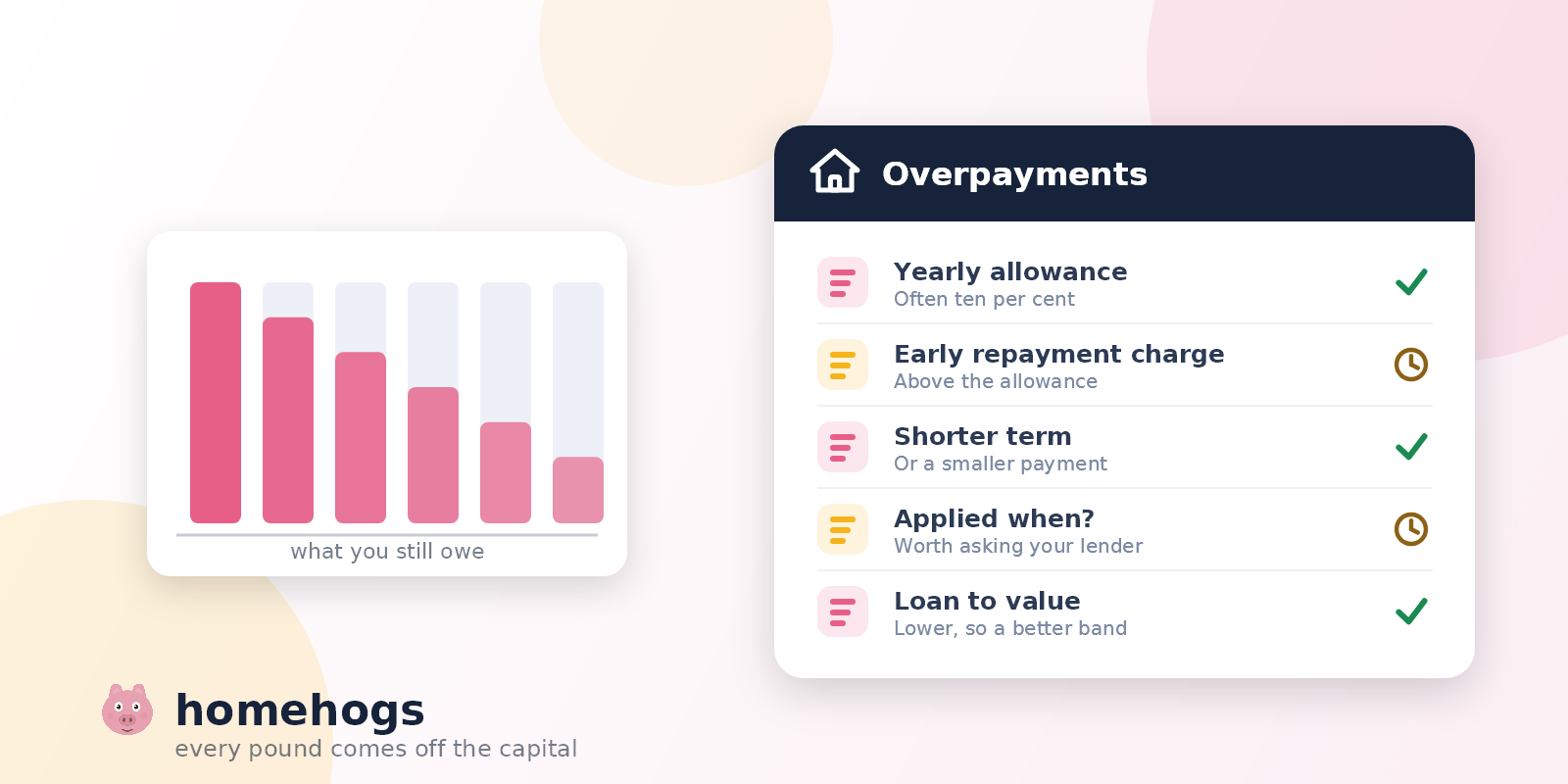
An overpayment goes entirely against the capital. Every pound of it removes a pound of balance; you never pay interest on that pound again. That is why an overpayment made early is worth more than the same amount made late: it has more years of interest left to cancel.
The effect builds on itself. A smaller balance means less interest next month, so more of your normal payment goes to capital, which shrinks the balance again.
Worked examples: what overpaying could save
The illustrative mortgage: £180,000 on repayment over 25 years at 4.5% for the whole term, so the monthly payment is £1,000.50 and total interest without overpaying is about £120,150. The 4.5% is close to the Bank of England's average rate on new mortgages of 4.60% in August 2026. Overpayments are made each month with the normal payment and applied straight away. The payment itself stays the same, so the term shortens.
| Overpay each month | You pay each month | Mortgage cleared in | Time saved | Interest saved |
|---|---|---|---|---|
| £0 | £1,000.50 | 25 years | None | None |
| £100 | £1,100.50 | 21 years 2 months | 3 years 10 months | About £20,760 |
| £250 | £1,250.50 | 17 years 4 months | 7 years 8 months | About £40,870 |
| £500 | £1,500.50 | 13 years 4 months | 11 years 8 months | About £60,600 |
All three fit inside a typical 10% allowance: £500 a month is £6,000 a year, against 10% of £180,000, which is £18,000.
Real mortgages are messier. Rates change when deals end, lenders calculate interest in slightly different ways and few people overpay the same amount for decades. Treat these figures as a sense of scale, not a forecast. The figures were worked out with standard monthly compounding; an online overpayment calculator or your lender can run your own.
Shorter term or smaller payment?
When you overpay, the lender either keeps your payment the same and shortens the term, or keeps the term and lowers the payment. Some let you choose; some do one by default. The difference is large. Here is a £10,000 lump sum paid on day one of the same illustrative mortgage:
| Keep the payment, shorten the term | Keep the term, lower the payment | |
|---|---|---|
| Monthly payment | £1,000.50 | £944.92 (down £55.58) |
| Mortgage cleared in | 22 years 7 months | 25 years |
| Interest saved | About £19,150 | About £6,670 |
Shortening the term saves almost three times as much here, because the full payment keeps working against a smaller balance. Lowering the payment saves less but cuts your committed outgoings, which has its own value if money is tight. Neither is automatically right; what matters is knowing which your lender is doing.
There is a third route: formally shortening the mortgage term. That raises your contractual payment, so you are committed to it, whereas a regular overpayment can usually be stopped if your income changes. Since 22 July 2025, FCA rules have made it easier for lenders to agree a shorter term without a full affordability assessment.
The question worth asking your lender
When does the overpayment actually come off the balance?
Some lenders apply it straight away, so interest is recalculated from the next day or the next month. Others hold overpayments and apply them once a year, often on the mortgage anniversary.
The difference is not trivial. In the £500 a month example, if the lender credited the overpayments once a year instead of each month, the interest saved falls from about £60,600 to about £58,360 and the mortgage takes four months longer to clear (13 years 8 months rather than 13 years 4 months). If your lender works that way, saving the money and paying it in just before the annual date can do as well, with the interest your savings earn in the meantime as a bonus.
Lump sums or monthly overpayments?
Both work. The rule of thumb is that money paid in sooner saves more, so the question is mostly about timing and what suits your cash flow.
- Timing matters. In the illustrative mortgage, £10,000 paid on day one (keeping the payment) saves about £19,150 and 2 years 5 months. The same £10,000 paid after five years saves about £13,530 and 1 year 11 months.
- Little and often beats once a year, if the lender applies overpayments straight away. £500 a month saves about £60,600 in the example; £6,000 paid once a year at each anniversary saves about £58,360. Interest earned on the money while you hold it narrows that gap.
- The end of a deal is often a good moment for a large sum. Early repayment charges usually stop when a fixed rate ends, so a lump sum paid at the switch to a new deal may avoid the allowance altogether. Ask your lender how it handles one; what happens when your fixed rate ends explains the timing.
- A windfall is still subject to the allowance while you are inside a fixed or discounted deal, so a bonus or inheritance may need splitting across years.
When overpaying may not come first: a checklist
Overpaying is rarely a bad thing to do, but general guidance from MoneyHelper and others puts several things ahead of it. Which of these apply to you is a question for your own figures, or an adviser.
- Dearer debt. Credit cards, overdrafts, personal loans and car finance usually charge more than a mortgage, so clearing them first tends to save more per pound.
- No emergency fund. MoneyHelper suggests keeping three to six months of essential outgoings in an easy access account. Money paid into a mortgage is hard to get back. Boilers rarely fail at a convenient moment (how long appliances last).
- An early repayment charge. Going over your allowance during a fixed or discounted deal can cost more than the overpayment saves.
- Pension contributions. If your employer matches extra contributions, that is money you would otherwise leave behind. Contributions also get tax relief. Pension money is locked away until later in life, so it is a different kind of trade-off.
- Savings that beat the mortgage after tax. Interest above your Personal Savings Allowance (£1,000 for basic rate taxpayers, £500 for higher rate, nothing for additional rate) is taxed; ISA interest is tax free. A 4% savings rate is worth 3.2% to a basic rate taxpayer above their allowance and 2.4% to a higher rate taxpayer. For context, the Bank of England's average quoted instant access rate was 2.07% in August 2026.
- Money you will need soon. A deposit for a move, planned building work or a big repair: overpayments are hard to reclaim unless your mortgage has a borrow-back facility or is an offset mortgage. Planned work is easier to fund if you know what is coming (the home maintenance checklist helps).
If none of those applies and your mortgage rate is higher than what the money would earn after tax, each pound overpaid saves interest at your mortgage rate: a certain saving with no investment risk.
The effect people forget
Overpaying also lowers your loan to value (LTV): your balance as a percentage of your home's value. Lenders price new deals in bands, commonly 60%, 75%, 80%, 85%, 90% and 95%, so crossing a boundary before your next deal can mean a lower rate on the whole balance. In August 2026 the Bank of England's average two-year fixes were 4.92% at 75% LTV, 5.16% at 90% and 5.52% at 95%.
An illustration: £152,000 owed on a home worth £200,000 is 76% LTV. Overpaying £2,000 takes the balance to £150,000, exactly 75%. If crossing that line cut the new rate from 5.0% to 4.8% (illustrative rates, 20 years left), the payment would fall from £1,003.13 to £973.44 a month. More than half of that saving comes from the lower rate, not the £2,000 itself.
So if your balance is near a boundary, it is worth working out where you sit a few months before the deal ends. The free house price calculator gives an estimate of your home's value to start from.
What to keep afterwards
Overpayments are easy to lose track of, especially irregular ones. Keep:
- your mortgage offer, which sets out the allowance, how the year is counted and the early repayment charges
- the date and amount of each overpayment, with the lender's confirmation
- any letter showing a new monthly payment or a new end date
- annual statements, to check the overpayments were applied as you expected
- a running total against the allowance for the current year
Two things depend on these: knowing how much allowance is left before a charge applies and seeing what the overpayments actually did to the balance. homehogs can record your mortgage, each overpayment and the balance over time with the rest of your home's paperwork, so the effect is visible rather than taken on trust.
Sources
- MoneyHelper: Should you pay off your mortgage early?
- GOV.UK: Tax on savings interest
- GOV.UK: Individual Savings Accounts
- GOV.UK: Tax relief on pension contributions
- Bank of England: Effective interest rates, August 2026
- Bank of England: Quoted household interest rates
- FCA: PS25/11 mortgage rule review
Last fact-checked 5 October 2026.
Watch the balance come down
homehogs records your mortgage, your overpayments and your balance over time, so you can see what each payment did instead of taking it on trust.
See the plans